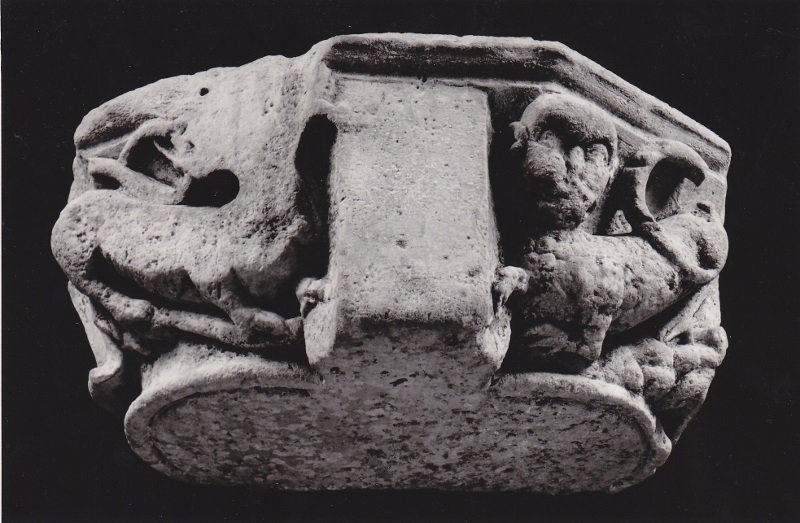
Tambour de pilier
Description
Chapiteau qui fait partie d'un pilier composé de six éléments. Le chapiteau reprend la structure des fûts et de la base du pilier (992.5.1, 992.5.2, 992.5.3, 992.5.4, 995.2.6) : de forme ovale épaulée sur les grands côtés par deux montants prismatiques. Sur la face en partie épargnée, deux créatures sont sculptées de part et d'autre du montant prismatique. A dextre, l'animal a subi des mutilations et l'on devine simplement un corps cylindrique, terminé par une grande queue qui se love sur son dos, et de petites pattes à deux doigts. L'autre créature, à senestre, possède le même corps cylindrique, prolongé par une grande queue s'enroulant sur sa cuisse gauche. Sa patte postérieure droite, reposant sur une grosse grappe de raisin, se termine par trois doigts dont, peut-être, un pouce. Sa tête vue de face montre un nez cassé, une bouche avec un objet mutilé entre les dents et des oreilles en anneaux. Tous ces traits la rapprochent assez du singe, sans certitude. La forme de la base (n° inv. 992.5.6) permet de dire qu'à l'origine ce pilier était fait pour être visible sur toutes les faces. Mais un remploi ultérieur l'a sans doute transformé en pilier engagé. Les montants prismatiques, la corniche faite d'un tore à listel ainsi que l'aspect de la base permettent de dater le pilier du XVe siècle. (Sylvain Debard)(JANNET Monique et JOUBERT Fabienne (dir.), Sculpture médiévale en Bourgogne - Collection lapidaire du Musée archéologique de Dijon, EUD, 2000)
Subject depicted
(animal, animal fabuleux, singe, lion, cerf)
About this work
The artwork titled "Tambour de pilier", attributed to anonyme, is preserved at musée archéologique. This piece is listed in the Joconde database of the Ministry of Culture, which catalogues the works held in French museums.
Technique and Materials
This work belongs to the field: archéologie, architecture, sculpture, médiéval. It was created using the following materials and techniques: calcaire (taillé). Its period of creation is identified as: 15th Century.
The Conserving Museum
musée archéologique preserves this work in its collections. As a « Musée de France » labeled museum, the institution is committed to preserving and showcasing the pieces entrusted to it.
Data sources
The information about this work comes from the Joconde database of the Ministry of Culture, published on data.culture.gouv.fr under the Open License v2.0 (Etalab).
About this artwork
Tambour de pilier est une oeuvre de anonyme, conservée au musée archéologique. Le procédé technique employé est calcaire (taillé). Mesures : Hauteur en cm 48 ; Largeur en cm 59 ; Profondeur en cm 66. L'oeuvre représente : (animal, animal fabuleux, singe, lion, cerf). L'oeuvre date de la 15e siècle.
Creation context
La 15e siècle fournit à anonyme le cadre propice pour imaginer Tambour de pilier. Cette œuvre, aujourd'hui trésor du musée archéologique, est l'aboutissement d'un échange fécond entre le créateur et les mouvements de pensée de son temps. Le contexte intellectuel et artistique se lit dans chaque choix formel de la composition.
See also
Technique
Author
Related pages
Frequently Asked Questions
Everything you need to know
The work « Tambour de pilier » is held at musée archéologique, an institution labeled as a « Musée de France ». This label guarantees the quality of collection preservation and accessibility to the public.
This artwork is attributed to anonyme according to the Joconde database of the Ministry of Culture. Check the artist's profile on DellArte to discover their background, other works, and museums that house their creations.
Data comes from the Joconde database of the Ministry of Culture (data.culture.gouv.fr), distributed under Open License v2.0 (Etalab). The records are provided by the museums and validated by the French Museum Service.
The work is part of the collections of a « Musée de France »-labelled museum. Contact the hosting museum to verify if the work is currently on display or held in reserve. Opening hours and admission fees are available on the museum's official website.
Image usage rights depend on the work, the artist, and the museum. If the author died more than 70 years ago, the work is in the public domain in France. Text data (title, technique, dimensions) are under Open License and freely reusable.
The work's record contains information from the Joconde database: title, author, technique and materials used, dimensions, creation period, artistic domain, inventory number, hosting museum, and when available, a digital image.
Use the DellArte contact page to report errors. Since data comes from the Joconde database, major corrections (attribution, dating, technique) should be reported to the Ministry of Culture via data.culture.gouv.fr.
The Joconde database lists over 700,000 works. Use the search bar to find works by the same artist, technique, or period. Each museum entry provides access to its entire digitized collection.
The image resolution depends on the museum's digitization program. Some museums offer high-resolution images through their own digital platforms. The image displayed on DellArte comes from the Joconde database at its dissemination resolution.
Museum shops often sell reproductions of their main works (postcards, posters, art books). For public domain works, services like RMN-Grand Palais (photo.rmn.fr) offer professional photographic reproductions.