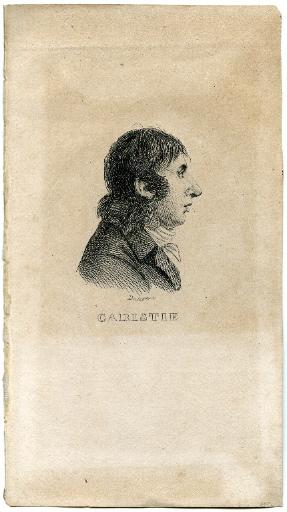
Portrait de Philippe Jospeh Marie Caristie
School : France
Description
Portrait de Philippe Joseph Marie Caristie (1775-1852). Polytechnicien, ingénieur des Ponts et Chaussées, Caristie est également membre de la Commission des Sciences et des Arts créée le 16 mars 1798. Elle était composée de 167 membres dont 151 se sont joints à l'expédition militaire de Bonaparte en Egypte et à laquelle a également participé le général Dumas. Parmi les savants, ingénieurs et artistes, membres de la Commission des Sciences et des Arts, on compte le géologue Dolomieu, Henri-Joseph Redouté, le mathématicien Gaspard Monge de l'école polytechnique, le chimiste Claude Louis Berthollet, Vivant Denon, Jean-Joseph Fourier, le naturaliste Étienne Geoffroy Saint-Hilaire, le botaniste Alire Raffeneau-Delile, l'ingénieur Nicolas-Jacques Conté du conservatoire national des arts et métiers font partie du voyage. Ils fondent l'Institut d'Égypte qui avait pour mission de propager les Lumières en Égypte grâce à un travail interdisciplinaire. Une revue scientifique est créée, la Décade égyptienne. Au cours de l'expédition, les savants ont observé la nature égyptienne, pris des dessins et se sont intéressé aux ressources du pays. On doit par exemple à Caristie et à Martin (autre ingénieur des Ponts et Chaussées) les observations et descriptions (31 décembre 1800)précieuses des ruines situées près de la pyramide de Haouârah, sîte qui sera ensuite complétement boulversé. Le travail de la Commission des Sciences et des Arts donna lieu à la Description de l'Égypte, publiée sous les ordres de Napoléon Bonaparte.
Subject depicted
portrait (Caristie Philippe Joseph Marie, homme, de profil, imberbe)
About this work
The artwork titled "Portrait de Philippe Jospeh Marie Caristie", attributed to DUTERTRE André, is preserved at musée Alexandre Dumas. Referenced in the Joconde database, this work contributes to the national artistic heritage preserved in labeled museums.
Technique and Materials
This work belongs to the field: estampe. It was created using the following materials and techniques: lithographie. Its period of creation is identified as: 18th Century.
The Conserving Museum
musée Alexandre Dumas preserves this work in its collections. As a « Musée de France » labeled museum, the institution is committed to preserving and showcasing the pieces entrusted to it.
Data sources
The information about this work comes from the Joconde database of the Ministry of Culture, published on data.culture.gouv.fr under the Open License v2.0 (Etalab).
About this artwork
DUTERTRE André a réalisé Portrait de Philippe Jospeh Marie Caristie, actuellement au musée Alexandre Dumas. DUTERTRE André a utilisé ici lithographie. Format : H. 18,4 ; l. 10,2 ; avec cadre : H. 26,5, l. 17. L'oeuvre dépeint : portrait (Caristie Philippe Joseph Marie, homme, de profil, imberbe). Elle est datée de la 18e siècle. Complément d'information : né en 1753 ; mort en 1842.
Creation context
DUTERTRE André crée Portrait de Philippe Jospeh Marie Caristie à une époque où la 18e siècle transforme en profondeur le paysage artistique. Le musée Alexandre Dumas, qui abrite cette œuvre, offre au visiteur la possibilité de mesurer l'influence du contexte historique et culturel sur la démarche de l'artiste. Les circonstances de la création éclairent le sens et la portée de cette pièce remarquable.
See also
Technique
Domain
Author
Related pages
Frequently Asked Questions
Everything you need to know
The work « Portrait de Philippe Jospeh Marie Caristie » is held at musée Alexandre Dumas, an institution labeled as a « Musée de France ». This label guarantees the quality of collection preservation and accessibility to the public.
This artwork is attributed to DUTERTRE André according to the Joconde database of the Ministry of Culture. Check the artist's profile on DellArte to discover their background, other works, and museums that house their creations.
Data comes from the Joconde database of the Ministry of Culture (data.culture.gouv.fr), distributed under Open License v2.0 (Etalab). The records are provided by the museums and validated by the French Museum Service.
The work is part of the collections of a « Musée de France »-labelled museum. Contact the hosting museum to verify if the work is currently on display or held in reserve. Opening hours and admission fees are available on the museum's official website.
Image usage rights depend on the work, the artist, and the museum. If the author died more than 70 years ago, the work is in the public domain in France. Text data (title, technique, dimensions) are under Open License and freely reusable.
The work's record contains information from the Joconde database: title, author, technique and materials used, dimensions, creation period, artistic domain, inventory number, hosting museum, and when available, a digital image.
Use the DellArte contact page to report errors. Since data comes from the Joconde database, major corrections (attribution, dating, technique) should be reported to the Ministry of Culture via data.culture.gouv.fr.
The Joconde database lists over 700,000 works. Use the search bar to find works by the same artist, technique, or period. Each museum entry provides access to its entire digitized collection.
The image resolution depends on the museum's digitization program. Some museums offer high-resolution images through their own digital platforms. The image displayed on DellArte comes from the Joconde database at its dissemination resolution.
Museum shops often sell reproductions of their main works (postcards, posters, art books). For public domain works, services like RMN-Grand Palais (photo.rmn.fr) offer professional photographic reproductions.