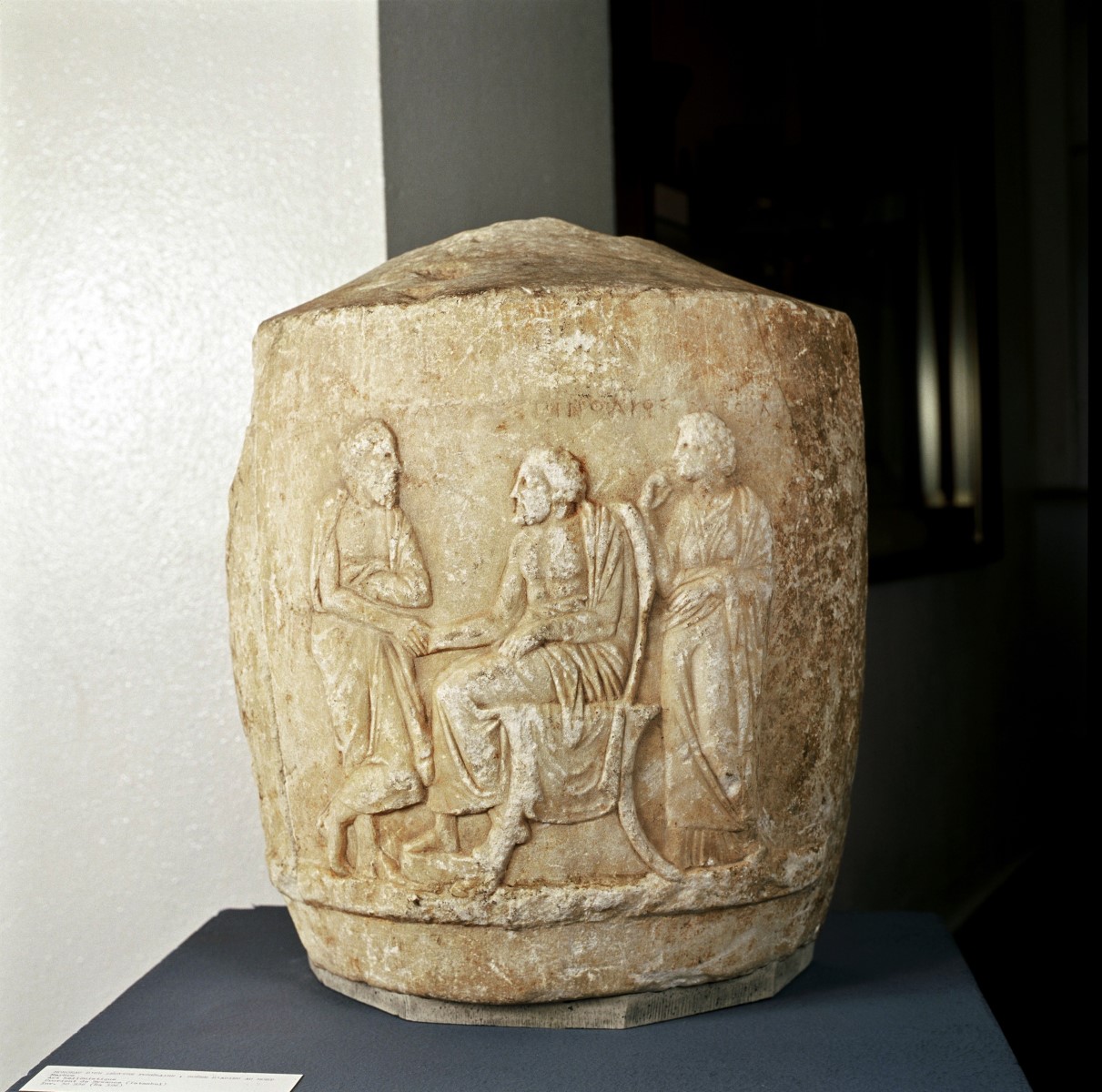
Morceau d'un lécythe funéraire : scène d'adieu au mort
Description
Le 17 février 1774, Du Mas, professeur d'éloquence au Collège Royal et membre associé de l'Académie des sciences, inscriptions et belles-lettres de Toulouse, lut devant cette compagnie son étude consacrée aux trois personnages représentés sur ce lécythe. Selon lui, Spintharos, l'homme assis, aurait vécu vers 360 avant J.-C. et aurait été un familier du fameux général et orateur thébain Epaminondas. Spintharos, l'homme assis, sur ce marbre, ferait ses adieux à son fils Euboulos. Derrière son siège se tient Boulètè dont Du Mas ne parvint pas à cerner l'identité. Cette explication de la sculpture ne fut pas admise par tous les savants et fut l'objet de controverses. En 1811, Millin en donne encore un écho lorsqu'il découvre l'œuvre dans la grande salle du musée de Toulouse aménagée dans l'église des Augustins : "Rien ne prouve non plus que le Spintharus père d'Eubulus fût celui qui étoit de Tarente, et lié avec Epaminondas, ainsi que l'avance M. Dumas : il auroit été trop vieux". Daniel Cazes, Toulouse et l'Antiquité retrouvée au XVIIIe siècle, 1989 ; Bas-relief d'une très faible saillie sur la face convexe. Un vieillard assis tend la main, en signe d'éternel adieu, à un autre vieillard debout devant lui. Derrière la première figure se tient une femme drapée, un doigt sur la bouche. Les noms des personnages sont gravés en caractères grecs au-dessus de leurs têtes ; vieillard debout : Eubulus ; vieillard assis : Spintharus ; femme : Bulété. (...) H. Rachou, 1912
Subject depicted
(vieillard, femme, mort, siège)
About this work
The artwork titled "Morceau d'un lécythe funéraire : scène d'adieu au mort" is preserved at musée Saint-Raymond. Referenced in the Joconde database, this work contributes to the national artistic heritage preserved in labeled museums.
Technique and Materials
This work belongs to the field: archéologie, sculpture, grec. It was created using the following materials and techniques: marbre (taillé, gravé). Its period of creation is identified as: 2nd quarter 4th Century av JC.
The Conserving Museum
musée Saint-Raymond preserves this work in its collections. As a « Musée de France » labeled museum, the institution is committed to preserving and showcasing the pieces entrusted to it.
Data sources
The information about this work comes from the Joconde database of the Ministry of Culture, published on data.culture.gouv.fr under the Open License v2.0 (Etalab).
About this artwork
Au musée Saint-Raymond, on trouve Morceau d'un lécythe funéraire : scène d'adieu au mort. Cette pièce est en marbre (taillé, gravé). L'oeuvre présente les dimensions suivantes : Hauteur en cm 43 ; Largeur en cm 39 ; Profondeur en cm 17. L'oeuvre dépeint : (vieillard, femme, mort, siège). La création de cette oeuvre remonte à la 2e quart 4e siècle av JC.
Creation context
La 2e quart 4e siècle av JC offre à le terreau fertile pour concevoir Morceau d'un lécythe funéraire : scène d'adieu au mort. Cette œuvre, désormais joyau du musée Saint-Raymond, est le fruit d'un dialogue constant entre l'artiste et les idées de son siècle. Le contexte de création confère à la pièce une dimension historique qui enrichit considérablement sa lecture.
See also
Technique
Domain
Related pages
Frequently Asked Questions
Everything you need to know
The work « Morceau d'un lécythe funéraire : scène d'adieu au mort » is held at musée Saint-Raymond, an institution labeled as a « Musée de France ». This label guarantees the quality of collection preservation and accessibility to the public.
This artwork is attributed to according to the Joconde database of the Ministry of Culture. Check the artist's profile on DellArte to discover their background, other works, and museums that house their creations.
Data comes from the Joconde database of the Ministry of Culture (data.culture.gouv.fr), distributed under Open License v2.0 (Etalab). The records are provided by the museums and validated by the French Museum Service.
The work is part of the collections of a « Musée de France »-labelled museum. Contact the hosting museum to verify if the work is currently on display or held in reserve. Opening hours and admission fees are available on the museum's official website.
Image usage rights depend on the work, the artist, and the museum. If the author died more than 70 years ago, the work is in the public domain in France. Text data (title, technique, dimensions) are under Open License and freely reusable.
The work's record contains information from the Joconde database: title, author, technique and materials used, dimensions, creation period, artistic domain, inventory number, hosting museum, and when available, a digital image.
Use the DellArte contact page to report errors. Since data comes from the Joconde database, major corrections (attribution, dating, technique) should be reported to the Ministry of Culture via data.culture.gouv.fr.
The Joconde database lists over 700,000 works. Use the search bar to find works by the same artist, technique, or period. Each museum entry provides access to its entire digitized collection.
The image resolution depends on the museum's digitization program. Some museums offer high-resolution images through their own digital platforms. The image displayed on DellArte comes from the Joconde database at its dissemination resolution.
Museum shops often sell reproductions of their main works (postcards, posters, art books). For public domain works, services like RMN-Grand Palais (photo.rmn.fr) offer professional photographic reproductions.