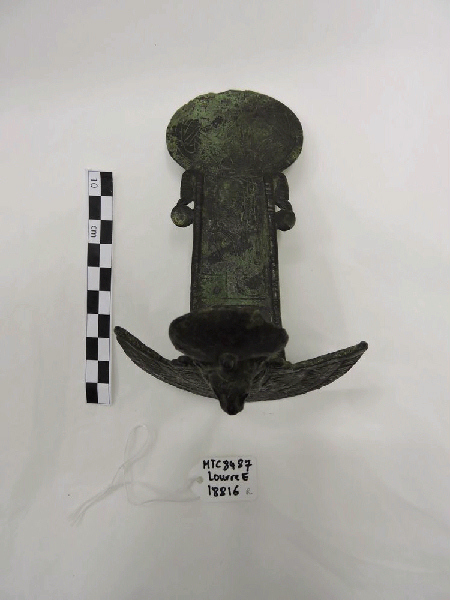
Egide et son contrepoids
Description
métal cuivreux ; "L'égide est un objet liturgique égyptien à l'effigie d'une divinité. Celle-ci est consacrée à Bastet, déesse à la fois lionne dangereuse et chatte paisible. Lors de processions religieuses, l'objet est placé sur la proue de barques divines. Il sert alors à apaiser la déesse et à transformer la lionne irascible en douce chatte protectrice. » (F. Rubiella, 2020) ; "Objet votif composé d'un collier entourant le cou d'une tête de lionne, et de son gros contrepoids. L'ensemble de l'objet est consacré à la déesse Bastet dont le nom est écrit. Le contrepoids est composé d'une partie ovale dans laquelle est gravée une divinité (Ré ?) protégée par deux rapaces ouvrant leurs ailes protectrices et d'une partie rectangulaire dans laquelle est gravée la déesse Bastet debout, coiffée du disque solaire et tenant un sceptre en forme de nénuphar. Son nom est écrit en face d'elle. Au dessus de cette scène, un vautour aux ailes déployées est gravé de façon grossière. A la base, deux uraei qui encadrent cette partie de leur queue. L'égide est formée d'un large collier d'où surgit une tête de lionne surmontée d'un disque solaire et d'une uraeus. Au verso du collier, deux attaches constituées par la queue du serpent. Cet objet liturgique est un des attributs de la déesse Bastet." (Affholder-Gérard et Cornic, 1990)
Subject depicted
représentation animalière,figure mythologique (Bastet, lionne, couronne)
About this work
The artwork titled "Egide et son contrepoids", attributed to anonyme, is preserved at musée Pincé. Referenced in the Joconde database, this work contributes to the national artistic heritage preserved in labeled museums.
Technique and Materials
This work belongs to the field: archéologie, égyptien, croyances - coutumes, vie sociale - culturelle. It was created using the following materials and techniques: métal cuivreux. Its period of creation is identified as: 2nd half 8th Century av JC;7th Century av JC;6th Century av JC;5th Century av JC;4th Century av JC.
The Conserving Museum
"Egide et son contrepoids" is preserved at musée Pincé, an institution bearing the « Musée de France » label. This label ensures that the collections are managed rigorously in terms of conservation, inventory, and public accessibility.
Data sources
The information about this work comes from the Joconde database of the Ministry of Culture, published on data.culture.gouv.fr under the Open License v2.0 (Etalab).
About this artwork
L'oeuvre Egide et son contrepoids de anonyme fait partie des collections du musée Pincé. Cette oeuvre est réalisée en métal cuivreux. Dimensions de l'oeuvre : Hauteur en cm 8.7 ; Largeur en cm 8.4 ; Profondeur en cm 13.5 ; Poids en kg. 0.171. Le motif représenté : représentation animalière,figure mythologique (Bastet, lionne, couronne). Elle a été créée durant la 2e moitié 8e siècle av JC;7e siècle av JC;6e siècle av JC;5e siècle av JC;4e siècle av JC.
Creation context
anonyme crée Egide et son contrepoids à une époque où la 2e moitié 8e siècle av JC;7e siècle av JC;6e siècle av JC;5e siècle av JC;4e siècle av JC transforme en profondeur le paysage artistique. Le musée Pincé, qui abrite cette œuvre, offre au visiteur la possibilité de mesurer l'influence du contexte historique et culturel sur la démarche de l'artiste. Les circonstances de la création éclairent le sens et la portée de cette pièce remarquable.
See also
Technique
Author
Related pages
Frequently Asked Questions
Everything you need to know
The work « Egide et son contrepoids » is held at musée Pincé, an institution labeled as a « Musée de France ». This label guarantees the quality of collection preservation and accessibility to the public.
This artwork is attributed to anonyme according to the Joconde database of the Ministry of Culture. Check the artist's profile on DellArte to discover their background, other works, and museums that house their creations.
Data comes from the Joconde database of the Ministry of Culture (data.culture.gouv.fr), distributed under Open License v2.0 (Etalab). The records are provided by the museums and validated by the French Museum Service.
The work is part of the collections of a « Musée de France »-labelled museum. Contact the hosting museum to verify if the work is currently on display or held in reserve. Opening hours and admission fees are available on the museum's official website.
Image usage rights depend on the work, the artist, and the museum. If the author died more than 70 years ago, the work is in the public domain in France. Text data (title, technique, dimensions) are under Open License and freely reusable.
The work's record contains information from the Joconde database: title, author, technique and materials used, dimensions, creation period, artistic domain, inventory number, hosting museum, and when available, a digital image.
Use the DellArte contact page to report errors. Since data comes from the Joconde database, major corrections (attribution, dating, technique) should be reported to the Ministry of Culture via data.culture.gouv.fr.
The Joconde database lists over 700,000 works. Use the search bar to find works by the same artist, technique, or period. Each museum entry provides access to its entire digitized collection.
The image resolution depends on the museum's digitization program. Some museums offer high-resolution images through their own digital platforms. The image displayed on DellArte comes from the Joconde database at its dissemination resolution.
Museum shops often sell reproductions of their main works (postcards, posters, art books). For public domain works, services like RMN-Grand Palais (photo.rmn.fr) offer professional photographic reproductions.