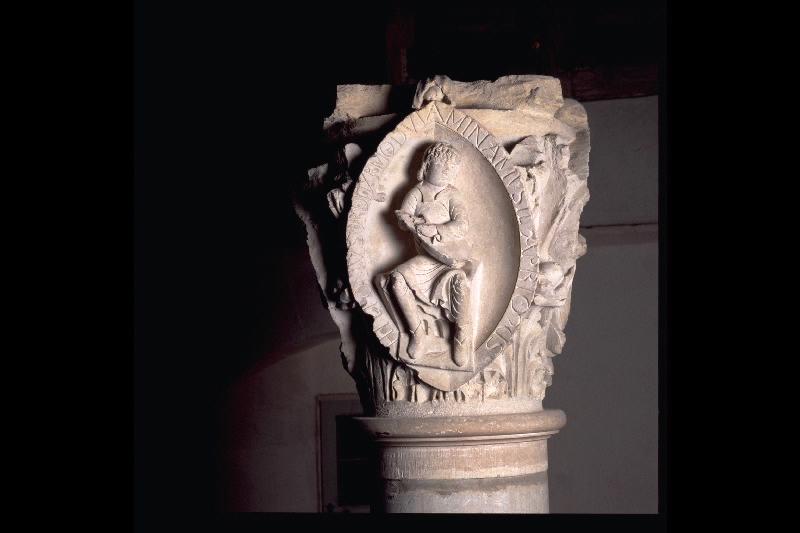
Chapiteau dit des 'quatre premiers tons du plain-chant'
Description
Chapiteau en calcaire micritique, dit des 'quatre premiers tons du plain-chant'. Il faisait partie de l'ensemble des huit chapiteaux qui couronnaient les colonnes de marbre du rond-point du choeur de l'abbatiale construite à partir de 1088. Chapiteau corinthisant orné de quatre personnages musiciens chacun dans une mandorle. Chaque personnage représente un ton du plain-chant. La bordure des quatre mandorles accueille une inscription qui indique un des tons du plain-chant. Le premier personnage est un homme assis jouant d'un instrument à cordes pincées pourvu d'un long manche. La mandorle porte l'inscription HIC TONUS ORDITUR MODULAMINA MUSICA PRIMUS. Le deuxième personnage, plus abîmé, est une jeune femme. Elle se tient debout, les genoux légèrement fléchis, la tête inclinée vers le bas. Elle tient une petite cymbale reliée par une cordelette à une poche à sa ceinture. Elle symbolise le deuxième ton. La mandorle porte l'inscription SUBSEQUITUR PTONGUS NUMERO VEL LEGE SECONDUS. Le troisième personnage est un homme barbu, avec des cheveux long. Il représente le troisième ton. Il est assis sur un siège ouvragé et joue d'un instrument à 6 cordes. La mandorle porte l'inscription TERTIUS IMPINGIT CHRISTUMQUE RESURGERE FINGIT. Le quatrième ton est représenté par un homme moustachu au cheveux courts et plus âgé que les trois autres. Il porte sur l'épaule droite un carillon de trois cloches et tient une quatrième dans sa main droite. Une cinquième, accrochée à son bras, pend au niveau du coude gauche. Il s'agit du tintinabulum des morts utilisé pour inviter l'ensemble de la communauté à la prière pour les morts. La mandorle porte l'inscription SUCCEDIT QUARTUSSIMULANS IN CARMINE PLANCTUS.
Subject depicted
groupe de figures (allégorie, musique, ?, homme, jeune femme, musicien, instrument à cordes, cymbale, cloche)
About this work
The artwork titled "Chapiteau dit des 'quatre premiers tons du plain-chant'" is preserved at musée d'Art et d'Archéologie. This piece is listed in the Joconde database of the Ministry of Culture, which catalogues the works held in French museums.
Technique and Materials
This work belongs to the field: sculpture, médiéval. It was created using the following materials and techniques: calcaire, taille directe. Its period of creation is identified as: 12th Century.
The Conserving Museum
musée d'Art et d'Archéologie preserves this work in its collections. As a « Musée de France » labeled museum, the institution is committed to preserving and showcasing the pieces entrusted to it.
Data sources
The information about this work comes from the Joconde database of the Ministry of Culture, published on data.culture.gouv.fr under the Open License v2.0 (Etalab).
About this artwork
Chapiteau dit des 'quatre premiers tons du plain-chant' est conservée au musée d'Art et d'Archéologie dans le domaine sculpture, médiéval. L'oeuvre a été exécutée en calcaire, taille directe. Cette pièce mesure Hauteur en cm 85 ; Longueur en cm - ; Profondeur en cm 80. Le thème de l'oeuvre est : groupe de figures (allégorie, musique, ?, homme, jeune femme, musicien, instrument à cordes, cymbale, cloche). Elle est datée de la 12e siècle.
Creation context
La 12e siècle offre à le terreau fertile pour concevoir Chapiteau dit des 'quatre premiers tons du plain-chant'. Cette œuvre, désormais joyau du musée d'Art et d'Archéologie, est le fruit d'un dialogue constant entre l'artiste et les idées de son siècle. Le contexte de création confère à la pièce une dimension historique qui enrichit considérablement sa lecture.
See also
Technique
Domain
Related pages
Frequently Asked Questions
Everything you need to know
The work « Chapiteau dit des 'quatre premiers tons du plain-chant' » is held at musée d'Art et d'Archéologie, an institution labeled as a « Musée de France ». This label guarantees the quality of collection preservation and accessibility to the public.
This artwork is attributed to according to the Joconde database of the Ministry of Culture. Check the artist's profile on DellArte to discover their background, other works, and museums that house their creations.
Data comes from the Joconde database of the Ministry of Culture (data.culture.gouv.fr), distributed under Open License v2.0 (Etalab). The records are provided by the museums and validated by the French Museum Service.
The work is part of the collections of a « Musée de France »-labelled museum. Contact the hosting museum to verify if the work is currently on display or held in reserve. Opening hours and admission fees are available on the museum's official website.
Image usage rights depend on the work, the artist, and the museum. If the author died more than 70 years ago, the work is in the public domain in France. Text data (title, technique, dimensions) are under Open License and freely reusable.
The work's record contains information from the Joconde database: title, author, technique and materials used, dimensions, creation period, artistic domain, inventory number, hosting museum, and when available, a digital image.
Use the DellArte contact page to report errors. Since data comes from the Joconde database, major corrections (attribution, dating, technique) should be reported to the Ministry of Culture via data.culture.gouv.fr.
The Joconde database lists over 700,000 works. Use the search bar to find works by the same artist, technique, or period. Each museum entry provides access to its entire digitized collection.
The image resolution depends on the museum's digitization program. Some museums offer high-resolution images through their own digital platforms. The image displayed on DellArte comes from the Joconde database at its dissemination resolution.
Museum shops often sell reproductions of their main works (postcards, posters, art books). For public domain works, services like RMN-Grand Palais (photo.rmn.fr) offer professional photographic reproductions.