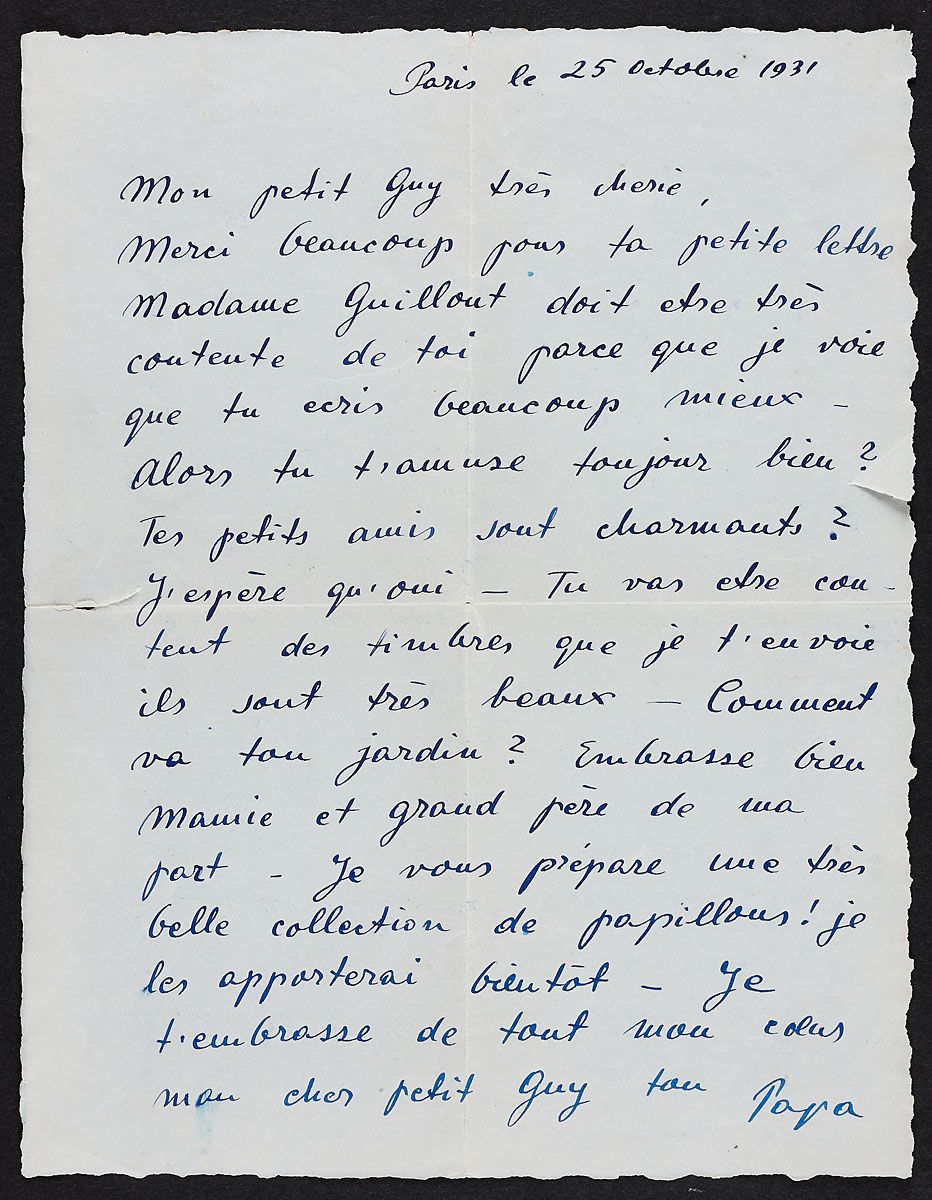
Untitled work
Description
En 1940, celui que l’on surnomme le prince de Montparnasse, Moïse Kisling, peintre emblématique de l’Ecole de Paris, est contraint à l’exil du fait de ses origines juives.#Il rejoint le sud de la France et embarque à Marseille en septembre 1940 pour rejoindre le Portugal. Il séjournera six mois, chez son beau-frère, le peintre Adriano de Sousa Lopes, à Lisbonne et à Nazaré. Au début de l’année 1941, il gagne les États-Unis où il résidera, principalement à New York, jusqu’à son retour en France en octobre 1946.#Sa femme Renée reste en France avec leurs enfants. Il ne cessera de lui écrire pendant toute cette période d’exil.#Ces lettres constituent le cœur de cette correspondance d’exil. Leur lecture permet d’appréhender les joies et les peines du peintre durant cette période à la fois tragique et exaltante, de connaître ses conditions de vie, de découvrir les artistes et intellectuels qu’il rencontre ou avec lesquels il correspond, de suivre ses activités artistiques, son travail d’atelier quotidien et ses expositions aux États-Unis.#Lettre adressée à son fils Guy, écrite à Paris le 25 octobre 1930.
About this work
The artwork titled "This artwork", attributed to Kisling Moïse (1891-1951), is preserved at musée national de l'histoire et des cultures de l'immigration. This piece is listed in the Joconde database of the Ministry of Culture, which catalogues the works held in French museums.
Technique and Materials
This work belongs to the field: manuscrit, migrations humaines. It was created using the following materials and techniques: papier, encre. Its period of creation is identified as: 2nd quarter 20th Century.
The Conserving Museum
"This artwork" is preserved at musée national de l'histoire et des cultures de l'immigration, an institution bearing the « Musée de France » label. This label ensures that the collections are managed rigorously in terms of conservation, inventory, and public accessibility.
Data sources
The information about this work comes from the Joconde database of the Ministry of Culture, published on data.culture.gouv.fr under the Open License v2.0 (Etalab).
About this artwork
Le procédé technique employé est papier, encre. Format : H. 27 cm, l. 21 cm (hors tout). L'oeuvre appartient à la 2e quart 20e siècle. Précisions sur cette oeuvre : Cracovie, 1891/01/22 ; Sanary, 1951/04/29.
Creation context
C'est durant la 2e quart 20e siècle que Kisling Moïse (1891-1951) conçoit , porté par un élan de renouvellement artistique qui traverse alors le monde de la création. Le musée national de l'histoire et des cultures de l'immigration conserve aujourd'hui cette pièce née d'un moment historique singulier, où les conventions esthétiques sont remises en question et où de nouvelles voies s'ouvrent aux artistes les plus audacieux.
See also
Technique
Related pages
Frequently Asked Questions
Everything you need to know
The work « Untitled work » is held at musée national de l'histoire et des cultures de l'immigration, an institution labeled as a « Musée de France ». This label guarantees the quality of collection preservation and accessibility to the public.
This artwork is attributed to Kisling Moïse (1891-1951) according to the Joconde database of the Ministry of Culture. Check the artist's profile on DellArte to discover their background, other works, and museums that house their creations.
Data comes from the Joconde database of the Ministry of Culture (data.culture.gouv.fr), distributed under Open License v2.0 (Etalab). The records are provided by the museums and validated by the French Museum Service.
The work is part of the collections of a « Musée de France »-labelled museum. Contact the hosting museum to verify if the work is currently on display or held in reserve. Opening hours and admission fees are available on the museum's official website.
Image usage rights depend on the work, the artist, and the museum. If the author died more than 70 years ago, the work is in the public domain in France. Text data (title, technique, dimensions) are under Open License and freely reusable.
The work's record contains information from the Joconde database: title, author, technique and materials used, dimensions, creation period, artistic domain, inventory number, hosting museum, and when available, a digital image.
Use the DellArte contact page to report errors. Since data comes from the Joconde database, major corrections (attribution, dating, technique) should be reported to the Ministry of Culture via data.culture.gouv.fr.
The Joconde database lists over 700,000 works. Use the search bar to find works by the same artist, technique, or period. Each museum entry provides access to its entire digitized collection.
The image resolution depends on the museum's digitization program. Some museums offer high-resolution images through their own digital platforms. The image displayed on DellArte comes from the Joconde database at its dissemination resolution.
Museum shops often sell reproductions of their main works (postcards, posters, art books). For public domain works, services like RMN-Grand Palais (photo.rmn.fr) offer professional photographic reproductions.