Untitled work
Description
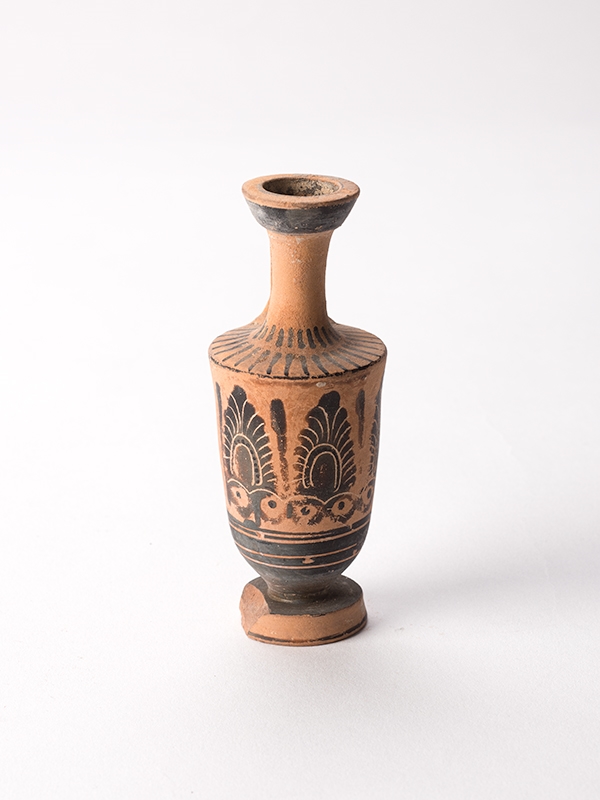
Matière : argile orange avec du mica ; vernis noir Technique : tourné ; peint ; technique des figures noires ; Le pied epais est en disque, sa tranche externe est concave. Le corps est cylindrique, un peu trapu, et se retrecit legerement vers le bas. L’epaule est en pente douce, sa jonction avec la panse est marquee par une arete vive. Le col court cylindrique est muni d’une embouchure en cupule, a tranche sur le dessous. L’anse rubanee est en saillie reliant la partie superieure du col a l’epaule. La tranche externe de l’embouchure et la face externe de l’anse sont vernissees. L’epaule est decoree par une double rangee d’aretes rayonnantes. Sur la panse, entre deux filets horizontaux, sont peintes trois grandes palmettes evasees, aux details incises. Chacune d’elles est separee par une bande verticale. Leurs corps triangulaires sont poses sur deux ovales pointes. Ce type de palmettes est appele palmetteson- Os par Donna Carol Kurtz. Le bas du vase et la face superieure du pied sont vernisses avec deux lignes incisees. Un filet horizontal decore la tranche externe du pied. Comparanda : la forme correspond a CVA Amsterdam 3, pl. 179. 1-3 et commentaire, apparente a l’atelier du Peintre de Haimon, mais les lignes horizontales incisees sont caracteristiques pour l’atelier du Peintre de Beldam, cf. CVA Amsterdam 3, pl. 179. 4-6. Cf. aussi : CVA Heidelberg 4, pl. 177. 6 ; CVA New Zealand, pl. 24. 12 ; CVA Geneve 2, pl. 77. 12. Bien que ce motif soit plus caracteristique de l’atelier du Peintre de Haimon, le profil de ce vase est a rapprocher de la production de l’atelier du Peintre de Beldam. Ulysse Barthel - Juliette Bolloch
About this work
The artwork titled "This artwork", attributed to Peintre de Beldam (actif vers 500-450 av JC) (actif vers 500-450 av JC), is preserved at Les Pêcheries, musée de Fécamp. Referenced in the Joconde database, this work contributes to the national artistic heritage preserved in labeled museums.
Technique and Materials
This work belongs to the field: archéologie, céramique, vie domestique. It was created using the following materials and techniques: argile (tourné, peinture, vernis).
The Conserving Museum
"This artwork" is preserved at Les Pêcheries, musée de Fécamp, an institution bearing the « Musée de France » label. This label ensures that the collections are managed rigorously in terms of conservation, inventory, and public accessibility.
Data sources
The information about this work comes from the Joconde database of the Ministry of Culture, published on data.culture.gouv.fr under the Open License v2.0 (Etalab).
About this artwork
argile (tourné, peinture, vernis) est le procédé utilisé pour cette oeuvre. Dimensions de l'oeuvre : Hauteur en mm 110 ; Diamètre de l'embouchure en mm 28 ; Diamètre maximal en mm 46 ; Diamètre du pied en mm 32.
Creation context
Peintre de Beldam (actif vers 500-450 av JC) (actif vers 500-450 av JC) conçoit dans un environnement artistique façonné par la . Cette pièce, conservée au Les Pêcheries, musée de Fécamp, porte l'empreinte des débats esthétiques et des innovations techniques qui animent alors la scène culturelle. Comprendre ce contexte permet d'apprécier pleinement la portée de l'œuvre.
See also
Frequently Asked Questions
Everything you need to know
The work « Untitled work » is held at Les Pêcheries, musée de Fécamp, an institution labeled as a « Musée de France ». This label guarantees the quality of collection preservation and accessibility to the public.
This artwork is attributed to Peintre de Beldam (actif vers 500-450 av JC) (actif vers 500-450 av JC) according to the Joconde database of the Ministry of Culture. Check the artist's profile on DellArte to discover their background, other works, and museums that house their creations.
Data comes from the Joconde database of the Ministry of Culture (data.culture.gouv.fr), distributed under Open License v2.0 (Etalab). The records are provided by the museums and validated by the French Museum Service.
The work is part of the collections of a « Musée de France »-labelled museum. Contact the hosting museum to verify if the work is currently on display or held in reserve. Opening hours and admission fees are available on the museum's official website.
Image usage rights depend on the work, the artist, and the museum. If the author died more than 70 years ago, the work is in the public domain in France. Text data (title, technique, dimensions) are under Open License and freely reusable.
The work's record contains information from the Joconde database: title, author, technique and materials used, dimensions, creation period, artistic domain, inventory number, hosting museum, and when available, a digital image.
Use the DellArte contact page to report errors. Since data comes from the Joconde database, major corrections (attribution, dating, technique) should be reported to the Ministry of Culture via data.culture.gouv.fr.
The Joconde database lists over 700,000 works. Use the search bar to find works by the same artist, technique, or period. Each museum entry provides access to its entire digitized collection.
The image resolution depends on the museum's digitization program. Some museums offer high-resolution images through their own digital platforms. The image displayed on DellArte comes from the Joconde database at its dissemination resolution.
Museum shops often sell reproductions of their main works (postcards, posters, art books). For public domain works, services like RMN-Grand Palais (photo.rmn.fr) offer professional photographic reproductions.