Untitled work
Description
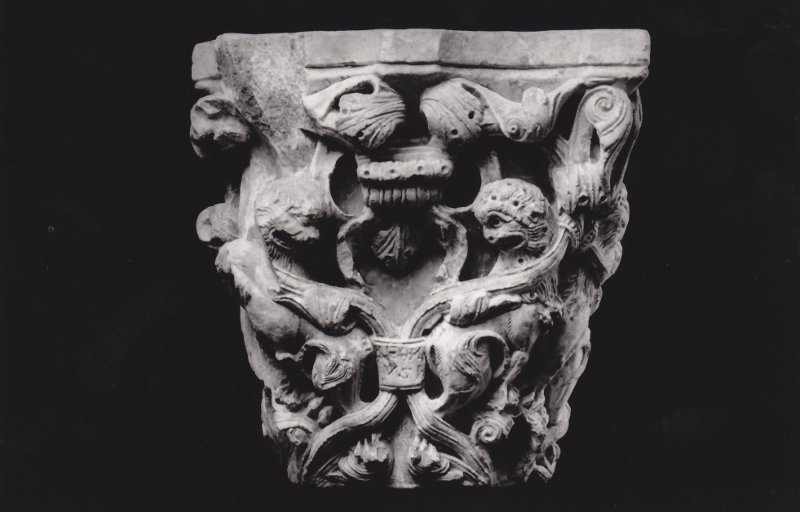
Tirage en plâtre ; Le moulage conserve le souvenir d'un chapiteau comportant encore lit de pose et lit d'attente, et sculpté sur toutes les faces ; il montre un abaque échancré, avec dé central. Un décor de rinceaux s'organise symétriquement sur chaque face du chapiteau, dont la disposition originelle avait entraîné une certaine hiérarchisation du décor. On reconnaît en effet une face principale, où deux lions adossés s'affrontent du regard, pris dans des tiges végétales réunies par un nœud portant l'inscription LEON VSI ; les deux faces latérales comportent un décor identique, sans inscription, enfin la quatrième face un simple décor de rinceaux. Le musée fit réaliser en 1886, par Pouchetty, ce moulage d'un chapiteau alors conservé dans la collection Saint-Père, chapiteau qui a disparu depuis. L'original avait été présenté à la CACO peu auparavant et des clichés photographiques en furent réalisés par Albert Joliet. On rapportait alors la tradition familiale selon laquelle il provenait de Saint-Bénigne, ce que semble confirmer un commentaire de L.B. Baudot, selon lequel l'architecte avait emporté chez lui des chapiteaux provenant de la rotonde en 1805. Les historiens locaux s'accordent d'ailleurs à lui donner comme provenance l'église de Guillaume de Volpiano. P. Quarré a justement rectifié l'appréciation de cette œuvre, qu'il a mise en relation avec d'autres fragments provenant de Saint-Bénigne (inv. Arb.1159 et Arb.1160). Le rapprochement est incontestable et l'utilisation de modèles communs ne fait guère de doute, même si le traitement de détail incite à reconnaître ici une main originale. On a affaire à un sculpteur particulièrement soucieux de creuser la pierre et de créer des contrastes d'ombre et de lumière : ainsi détache-t-il complètement ses végétaux de la corbeille, soulignant encore les rinceaux de filets nerveux et recourant au trépan pour obtenir des effets décoratifs. (Fabienne Joubert) (JANNET Monique et JOUBERT Fabienne (dir.), Sculpture médiévale en Bourgogne - Collection lapidaire du Musée archéologique de Dijon, EUD, 2000)
Subject depicted
représentation végétale, représentation animalière (lion, rinceau)
About this work
The artwork titled "This artwork", attributed to Pouchetty, is preserved at musée archéologique. Referenced in the Joconde database, this work contributes to the national artistic heritage preserved in labeled museums.
Technique and Materials
This work belongs to the field: archéologie, architecture, sculpture, médiéval. It was created using the following materials and techniques: plâtre (moulage). Its period of creation is identified as: 4th quarter 19th Century.
The Conserving Museum
musée archéologique preserves this work in its collections. As a « Musée de France » labeled museum, the institution is committed to preserving and showcasing the pieces entrusted to it.
Data sources
The information about this work comes from the Joconde database of the Ministry of Culture, published on data.culture.gouv.fr under the Open License v2.0 (Etalab).
About this artwork
La technique employée est : plâtre (moulage). Elle mesure Hauteur en cm 32,5 ; Largeur en cm 33 ; Diamètre en cm 18,5. On y reconnaît : représentation végétale, représentation animalière (lion, rinceau). Cette pièce remonte à la 4e quart 19e siècle.
Creation context
Pouchetty conçoit dans un environnement artistique façonné par la 4e quart 19e siècle. Cette pièce, conservée au musée archéologique, porte l'empreinte des débats esthétiques et des innovations techniques qui animent alors la scène culturelle. Comprendre ce contexte permet d'apprécier pleinement la portée de l'œuvre.
See also
Technique
Author
Related pages
Frequently Asked Questions
Everything you need to know
The work « Untitled work » is held at musée archéologique, an institution labeled as a « Musée de France ». This label guarantees the quality of collection preservation and accessibility to the public.
This artwork is attributed to Pouchetty according to the Joconde database of the Ministry of Culture. Check the artist's profile on DellArte to discover their background, other works, and museums that house their creations.
Data comes from the Joconde database of the Ministry of Culture (data.culture.gouv.fr), distributed under Open License v2.0 (Etalab). The records are provided by the museums and validated by the French Museum Service.
The work is part of the collections of a « Musée de France »-labelled museum. Contact the hosting museum to verify if the work is currently on display or held in reserve. Opening hours and admission fees are available on the museum's official website.
Image usage rights depend on the work, the artist, and the museum. If the author died more than 70 years ago, the work is in the public domain in France. Text data (title, technique, dimensions) are under Open License and freely reusable.
The work's record contains information from the Joconde database: title, author, technique and materials used, dimensions, creation period, artistic domain, inventory number, hosting museum, and when available, a digital image.
Use the DellArte contact page to report errors. Since data comes from the Joconde database, major corrections (attribution, dating, technique) should be reported to the Ministry of Culture via data.culture.gouv.fr.
The Joconde database lists over 700,000 works. Use the search bar to find works by the same artist, technique, or period. Each museum entry provides access to its entire digitized collection.
The image resolution depends on the museum's digitization program. Some museums offer high-resolution images through their own digital platforms. The image displayed on DellArte comes from the Joconde database at its dissemination resolution.
Museum shops often sell reproductions of their main works (postcards, posters, art books). For public domain works, services like RMN-Grand Palais (photo.rmn.fr) offer professional photographic reproductions.