Untitled work
School : Strasbourg
Description
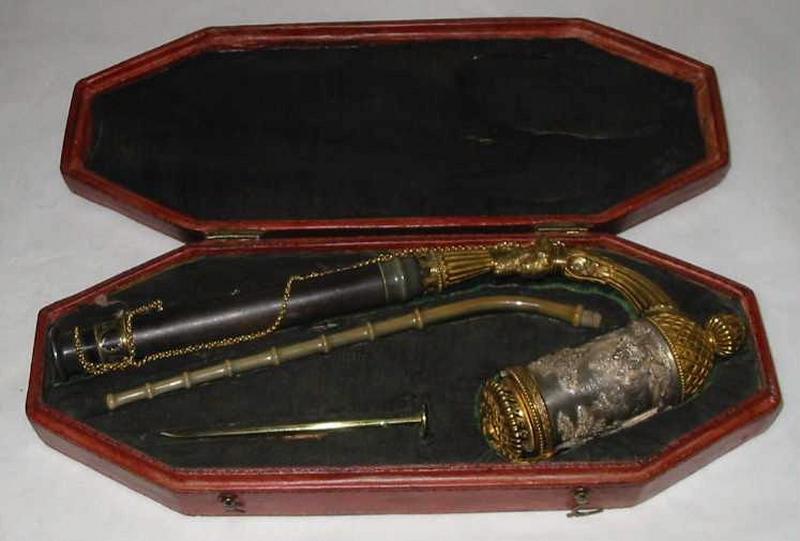
Pipe et cure-pipe dans leur gainage original en maroquin rouge doublé intérieurement de velours de soie vert. La pipe est divisée en trois parties amovibles : le fourneau avec l'amorce du tuyau et le tuyau à proprement parler constitué de deux éléments en corne. La fournée, doublé intérieurement de terre de pipe, est orné d'une spectaculaire scène de chasse à courre en forêt de plaine, l'horizon dévoilant au loin la chaîne des Vosges. Ce haut-relief en argent fondu est composé selon le principe du paysage panoramique déroulé en continu sur tout le pourtour de l'objet. Le bord supérieur du fourneau est orné d'une frise de losanges et d'une frise de perles. Le couvercle partiellement ajouré comporte une terrasse godronnée, sur laquelle est appliquée un mufle de lion entouré d'une couronne de feuilles de chêne dont les tiges nouées servent de fermoir. La base du fourneau, en dôme renversé recouvert d'un motif d'écailles, se termine par un bouton godronné en forme de gland. L'amorce du tuyau qui y prend naissance reprend le thème de la chasse. En effet, son décor de cannelure et de feuilles d'acanthe est interrompu par une tête de griffon, le museau ouvert dévoilant les crocs. Finement ciselée au naturel, elle émerge d'un collier relié par une chaînette mobile au tuyau de corne. Ce détail réaliste témoigne de l'inventivité de Jacques F. Kirstein mais surtout de sa passion pour la chasse et, par voie de conséquence, pour les chiens d'arrêt et courants qu'il observe attentivement, en véritable naturaliste. Le tuyau en corne est orné d'une bague ajourée de couronnes de laurier. La seconde partie du tuyau, à pas de vis, est courbe et simule une tige de bambou. Cure-pipe avec pointe facettée et prise plate en ovale.
Inscriptions
poinçon,signature
About this work
The artwork titled "This artwork", attributed to KIRSTEIN Jacques Frédéric (orfèvre), is preserved at musée des Arts Décoratifs. This piece is listed in the Joconde database of the Ministry of Culture, which catalogues the works held in French museums.
Technique and Materials
This work belongs to the field: orfèvrerie, vie domestique. It was created using the following materials and techniques: argent, terre de pipe, corne, doré. Its period of creation is identified as: 1st quarter 19th Century.
The Conserving Museum
"This artwork" is preserved at musée des Arts Décoratifs, an institution bearing the « Musée de France » label. This label ensures that the collections are managed rigorously in terms of conservation, inventory, and public accessibility.
Data sources
The information about this work comes from the Joconde database of the Ministry of Culture, published on data.gouv.fr under the Open License v2.0 (Etalab).
About this artwork
Il s'agit d'une oeuvre en argent, terre de pipe, corne, doré. La pièce a pour dimensions Longueur de l'oeuvre en cm 42.5. La création de cette oeuvre remonte à la 1er quart 19e siècle. Note sur cette oeuvre : KIRSTEIN : ?, 1765 ; ?, 1838.
Creation context
Dans quel contexte KIRSTEIN Jacques Frédéric (orfèvre) a-t-il créé ? La 1er quart 19e siècle constitue un moment de profonde effervescence créatrice, qui nourrit et stimule la démarche de l'artiste. Le musée des Arts Décoratifs, qui détient cette œuvre, permet au visiteur de comprendre les liens qui unissent la création artistique aux circonstances historiques de son émergence.
See also
Technique
Domain
Related pages
Frequently Asked Questions
Everything you need to know
The work « Untitled work » is held at musée des Arts Décoratifs, an institution labeled as a « Musée de France ». This label guarantees the quality of collection preservation and accessibility to the public.
This artwork is attributed to KIRSTEIN Jacques Frédéric (orfèvre) according to the Joconde database of the Ministry of Culture. Check the artist's profile on DellArte to discover their background, other works, and museums that house their creations.
Data comes from the Joconde database of the Ministry of Culture (data.gouv.fr), distributed under Open License v2.0 (Etalab). The records are provided by the museums and validated by the French Museum Service.
The work is part of the collections of a « Musée de France »-labelled museum. Contact the hosting museum to verify if the work is currently on display or held in reserve. Opening hours and admission fees are available on the museum's official website.
Image usage rights depend on the work, the artist, and the museum. If the author died more than 70 years ago, the work is in the public domain in France. Text data (title, technique, dimensions) are under Open License and freely reusable.
The work's record contains information from the Joconde database: title, author, technique and materials used, dimensions, creation period, artistic domain, inventory number, hosting museum, and when available, a digital image.
Use the DellArte contact page to report errors. Since data comes from the Joconde database, major corrections (attribution, dating, technique) should be reported to the Ministry of Culture via data.gouv.fr.
The Joconde database lists over 700,000 works. Use the search bar to find works by the same artist, technique, or period. Each museum entry provides access to its entire digitized collection.
The image resolution depends on the museum's digitization program. Some museums offer high-resolution images through their own digital platforms. The image displayed on DellArte comes from the Joconde database at its dissemination resolution.
Museum shops often sell reproductions of their main works (postcards, posters, art books). For public domain works, services like RMN-Grand Palais (photo.rmn.fr) offer professional photographic reproductions.