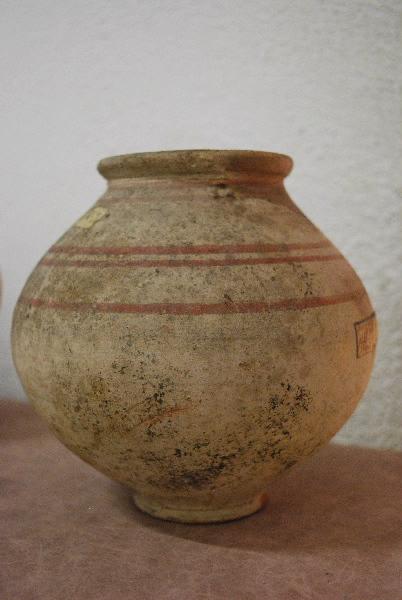
Vase funéraire
Description
Vase (olla) en céramique commune claire peinte, contenant une monnaie de bronze ; Contient 1078g de riz blanc sec soit 2 setiers. 'Vase (olla) en céramique commune claire peinte; 'pâte rose à couverte blanche ornée à l'épaulement et au rebord de cinq raies rouges. A l'évasement tout près du pied, graffito en capitales, tracé après cuisson : NIVSTI (de Nuistus ? mais ce nom n'est attesté nul par ailleurs). Ce vase, utilisé comme urne cinéraire, a été découvert extra-muros, dans la nécropole s'étendant au-delà de la Porte Sain-André, le long de la voie de Langres. Il contenait un moyen bronze, ayant peu circulé, d'Antonia, fille de Marc-Antoine et Octavie, et mère de Germanicus, Livilla et Claude (circa 16 avant J.C. - 37 après J.C.). Le décor peint, réalisé à l'aide d'un pinceau ou d'un instrument similaire, est une technique très faiblement représentée parmi les vases découverts à Autun. Il s'agit d'une tradition typiquement celtique, très bien illustrée dans le Forez, avec des bols de Roanne au décor géométrique tracé sur fond d'engobe kaolonique avec des substances végétales. Mais elle ne fut pourtant pas interrompue après la conquête et se poursuivit pendant une partie du Ier siècle pour connaître même un renouveau au IIe siècle.' Autun, Augustodunum, pp. 151-165, dont p. 153, n° 257 ; 'Vase à pédoncule étroit, terre blanche, orné de 5 filets en couleur rouge dont deux sous le goulot. une médaille moyen bronze d'Antonin était à l'intérieur. Sur la panse est écrit en lettres romaines NIVSTI. Haut 0,15 Diam. du goulot 0,10 Diam. de la panse 0,16 Trouvé Fg St Andoche, 1863.' Inventaire Bulliot
About this work
The artwork titled "Vase funéraire", attributed to ATELIER DU CENTRE DE LA GAULE (céramiste), is preserved at musée Rolin. This piece is listed in the Joconde database of the Ministry of Culture, which catalogues the works held in French museums.
Technique and Materials
This work belongs to the field: archéologie, céramique, croyances - coutumes. It was created using the following materials and techniques: terre cuite (claire), pigment, bronze, tourné, peint, martelé. Its period of creation is identified as: 1er siècle.
The Conserving Museum
musée Rolin preserves this work in its collections. As a « Musée de France » labeled museum, the institution is committed to preserving and showcasing the pieces entrusted to it.
Data sources
The information about this work comes from the Joconde database of the Ministry of Culture, published on data.culture.gouv.fr under the Open License v2.0 (Etalab).
About this artwork
Vase funéraire est une pièce de archéologie, céramique, croyances - coutumes réalisée par ATELIER DU CENTRE DE LA GAULE (céramiste), au musée Rolin. Le procédé technique employé est terre cuite (claire), pigment, bronze, tourné, peint, martelé. Mesures : Hauteur en cm 14.60 ; Diamètre en cm 15.10 ; Diamètre col en cm 6.30 ; Diamètre en cm 5.80 (pied) ; Poids en g 520. Elle a été créée durant la 1er siècle.
Creation context
C'est sous l'influence de la 1er siècle que ATELIER DU CENTRE DE LA GAULE (céramiste) donne vie à Vase funéraire. Aujourd'hui parmi les pièces les plus visitées du musée Rolin, cette œuvre rappelle un chapitre fondamental de l'histoire artistique, celui d'une époque où la création se réinvente en permanence.
See also
Frequently Asked Questions
Everything you need to know
The work « Vase funéraire » is held at musée Rolin, an institution labeled as a « Musée de France ». This label guarantees the quality of collection preservation and accessibility to the public.
This artwork is attributed to ATELIER DU CENTRE DE LA GAULE (céramiste) according to the Joconde database of the Ministry of Culture. Check the artist's profile on DellArte to discover their background, other works, and museums that house their creations.
Data comes from the Joconde database of the Ministry of Culture (data.culture.gouv.fr), distributed under Open License v2.0 (Etalab). The records are provided by the museums and validated by the French Museum Service.
The work is part of the collections of a « Musée de France »-labelled museum. Contact the hosting museum to verify if the work is currently on display or held in reserve. Opening hours and admission fees are available on the museum's official website.
Image usage rights depend on the work, the artist, and the museum. If the author died more than 70 years ago, the work is in the public domain in France. Text data (title, technique, dimensions) are under Open License and freely reusable.
The work's record contains information from the Joconde database: title, author, technique and materials used, dimensions, creation period, artistic domain, inventory number, hosting museum, and when available, a digital image.
Use the DellArte contact page to report errors. Since data comes from the Joconde database, major corrections (attribution, dating, technique) should be reported to the Ministry of Culture via data.culture.gouv.fr.
The Joconde database lists over 700,000 works. Use the search bar to find works by the same artist, technique, or period. Each museum entry provides access to its entire digitized collection.
The image resolution depends on the museum's digitization program. Some museums offer high-resolution images through their own digital platforms. The image displayed on DellArte comes from the Joconde database at its dissemination resolution.
Museum shops often sell reproductions of their main works (postcards, posters, art books). For public domain works, services like RMN-Grand Palais (photo.rmn.fr) offer professional photographic reproductions.