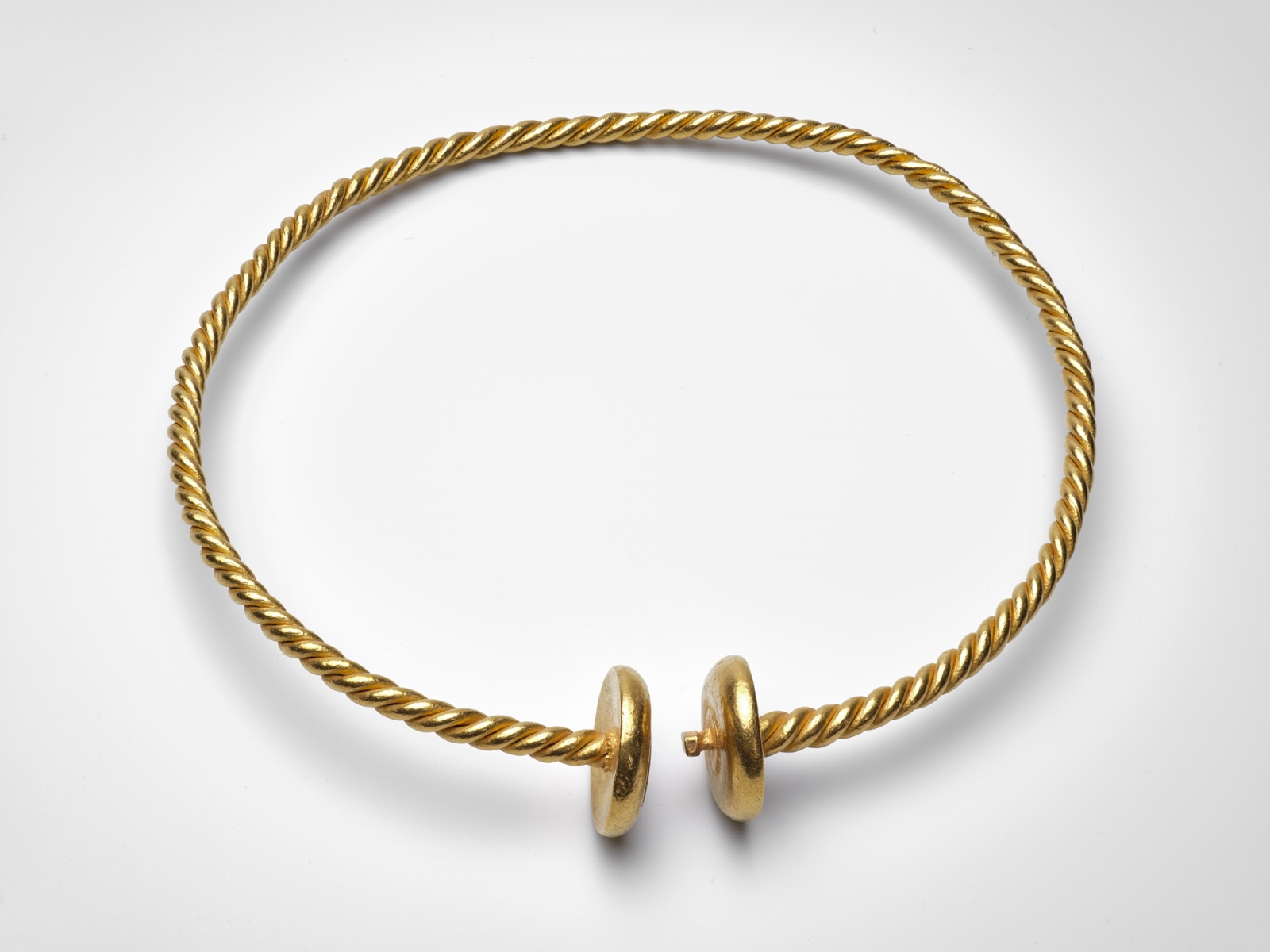
Torque pénannulaire à tampons et fermoir
Description
Le corps flexible est réalisé en torsadant régulièrement trois gros fils pleins au diamètre légèrement croissant vers les extrémités. Ces fils ronds, fabriqués par fonte puis roulage, présentent une surface peu régulière, non lissée, avec des traces de coups. Les tampons ont été obtenus d'une seule pièce par fonte creuse à cire perdue. La partie mâle du fermoir est constituée d'un tenon en T sur un socle circulaire fait d'un seul tenant par fonte massive à cire perdue et qui est entré en force, provoquant des fissures rayonnantes sur la calotte. La mortaise en forme de T est découpée dans une plaque circulaire épaisse au bord festonné soudée au sommet de la calotte femelle. Une bandelette d'or, crantée sur l'un de ses longs côtés, enroulée et soudée autour du corps contre le tampon, masque la jonction. Un lissage concentrique, destiné à effacer la soudure de la bandelette, a laissé de fines rayures sur le revers des tampons. Hélène Hautenauve, L'or de Tolosa, p. 117-119 ; Le torque était porté par les guerriers celtes, celui-ci semble avoir été placé, ensuite, dans un dépôt peut-être funéraire, mais plus vraisemblablement votif, en l'honneur d'une divinité chthonienne. D'après H. Hautenauve, L'or de Tolosa, p.78-83
About this work
The artwork titled "Torque pénannulaire à tampons et fermoir" is preserved at musée Saint-Raymond. Referenced in the Joconde database, this work contributes to the national artistic heritage preserved in labeled museums.
Technique and Materials
This work belongs to the field: archéologie, orfèvrerie, gaulois, costume - accessoires du costume, croyances - coutumes. It was created using the following materials and techniques: or. Its period of creation is identified as: 3rd Century av JC.
The Conserving Museum
musée Saint-Raymond preserves this work in its collections. As a « Musée de France » labeled museum, the institution is committed to preserving and showcasing the pieces entrusted to it.
Data sources
The information about this work comes from the Joconde database of the Ministry of Culture, published on data.culture.gouv.fr under the Open License v2.0 (Etalab).
About this artwork
Torque pénannulaire à tampons et fermoir, actuellement au musée Saint-Raymond. or. Format : Diamètre en cm 14,3 ; Poids en gr 160. La création de cette oeuvre remonte à la 3e siècle av JC.
Creation context
Comment le contexte de la 3e siècle av JC a-t-il influencé la création de Torque pénannulaire à tampons et fermoir ? travaille à cette époque dans un climat de renouveau qui irrigue sa pratique et oriente ses choix formels. Le musée Saint-Raymond offre au visiteur l'occasion de saisir cette dimension contextuelle essentielle à la compréhension de l'œuvre.
See also
Technique
Related pages
Frequently Asked Questions
Everything you need to know
The work « Torque pénannulaire à tampons et fermoir » is held at musée Saint-Raymond, an institution labeled as a « Musée de France ». This label guarantees the quality of collection preservation and accessibility to the public.
This artwork is attributed to according to the Joconde database of the Ministry of Culture. Check the artist's profile on DellArte to discover their background, other works, and museums that house their creations.
Data comes from the Joconde database of the Ministry of Culture (data.culture.gouv.fr), distributed under Open License v2.0 (Etalab). The records are provided by the museums and validated by the French Museum Service.
The work is part of the collections of a « Musée de France »-labelled museum. Contact the hosting museum to verify if the work is currently on display or held in reserve. Opening hours and admission fees are available on the museum's official website.
Image usage rights depend on the work, the artist, and the museum. If the author died more than 70 years ago, the work is in the public domain in France. Text data (title, technique, dimensions) are under Open License and freely reusable.
The work's record contains information from the Joconde database: title, author, technique and materials used, dimensions, creation period, artistic domain, inventory number, hosting museum, and when available, a digital image.
Use the DellArte contact page to report errors. Since data comes from the Joconde database, major corrections (attribution, dating, technique) should be reported to the Ministry of Culture via data.culture.gouv.fr.
The Joconde database lists over 700,000 works. Use the search bar to find works by the same artist, technique, or period. Each museum entry provides access to its entire digitized collection.
The image resolution depends on the museum's digitization program. Some museums offer high-resolution images through their own digital platforms. The image displayed on DellArte comes from the Joconde database at its dissemination resolution.
Museum shops often sell reproductions of their main works (postcards, posters, art books). For public domain works, services like RMN-Grand Palais (photo.rmn.fr) offer professional photographic reproductions.