"Té-Varoua-ino"
Description
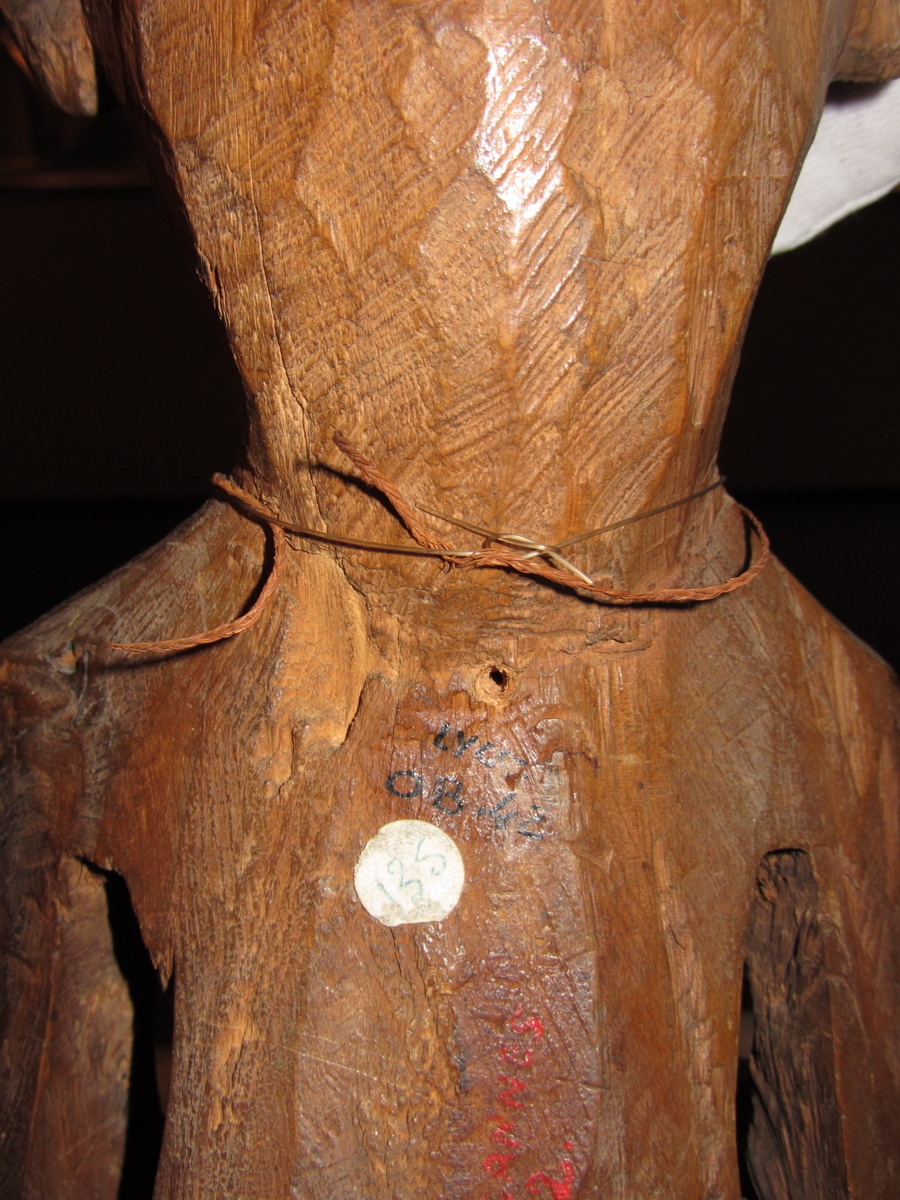
Tiki marquisien en bois d'arbre à pain avec un collier composé de deux perles de verre et de 5 dents percées, dont une dent humaine. Vindry, Inventaire Livre 7 : "Personnage assis, les mains posées au bas du torse, de chaque côté du nombril saillant. Torse en trapèze, sans ornements. Bras détachés du corps, entre-jambe évidé, petit sexe saillant. Tête sphéroïdale à gros cou penchée vers l'avant à oreilles saillantes décorées d'une double spirale schématisée. Sur le dessus de la tête, deux appendices cylindriques représentant deux mèches de cheveux se détachant du crâne rasé. Tatouages aux coins de la bouche. Gros yeux et petit nez. Mains stylisées, mains carrées, doigts plutôt ronds. Autour du cou, fil de coco portant deux perles européennes, verre vert et pâte de verre bleutée, encadrant une incisive humaine percée, deux canines percées, une dent travaillée et une canine percée. Travail rude et vigoureux. Bois d'arbre à pain brun clair." ; bois d'arbre à pain, collier de dents et perles de verre
About this work
The artwork titled ""Té-Varoua-ino"", attributed to anonyme, is preserved at musée des explorations du monde (MEM). This piece is listed in the Joconde database of the Ministry of Culture, which catalogues the works held in French museums.
Technique and Materials
This work belongs to the field: ethnologie, sculpture, croyances - coutumes, Océanie. It was created using the following materials and techniques: bois (arbre à pain) (taillé)#fibre végétale, ivoire, perle de verre#pâte de verre (perle, bleuté) (perçé, tressé). Its period of creation is identified as: 2nd quarter 19th Century.
The Conserving Museum
musée des explorations du monde (MEM) preserves this work in its collections. As a « Musée de France » labeled museum, the institution is committed to preserving and showcasing the pieces entrusted to it.
Data sources
The information about this work comes from the Joconde database of the Ministry of Culture, published on data.culture.gouv.fr under the Open License v2.0 (Etalab).
About this artwork
L'oeuvre "Té-Varoua-ino" de anonyme fait partie des collections du musée des explorations du monde (MEM). La technique employée est : bois (arbre à pain) (taillé)#fibre végétale, ivoire, perle de verre#pâte de verre (perle, bleuté) (perçé, tressé). La pièce a pour dimensions H. 43 cm ; l. 13 cm ; P. 24 cm ; VOLUM. 0,0134. La création de cette oeuvre remonte à la 2e quart 19e siècle. Note sur cette oeuvre : "Taïpis-Kaï-Kaï" (tribu) Le nom de "Taïpis-Kaï-Kaï" signifierait selon Edmond de Ginoux de La Coche "ennemis mangeurs d'hommes", ce n'est donc probablement pas le nom utilisé par la tribu elle-même.
Creation context
La genèse de "Té-Varoua-ino" par anonyme est indissociable de l'atmosphère culturelle de la 2e quart 19e siècle, moment de grands changements dans l'histoire de l'art. Conservée au musée des explorations du monde (MEM), cette œuvre renferme les échos d'un monde en pleine transformation, où les artistes cherchent de nouvelles manières de représenter la réalité.
See also
Frequently Asked Questions
Everything you need to know
The work « "Té-Varoua-ino" » is held at musée des explorations du monde (MEM), an institution labeled as a « Musée de France ». This label guarantees the quality of collection preservation and accessibility to the public.
This artwork is attributed to anonyme according to the Joconde database of the Ministry of Culture. Check the artist's profile on DellArte to discover their background, other works, and museums that house their creations.
Data comes from the Joconde database of the Ministry of Culture (data.culture.gouv.fr), distributed under Open License v2.0 (Etalab). The records are provided by the museums and validated by the French Museum Service.
The work is part of the collections of a « Musée de France »-labelled museum. Contact the hosting museum to verify if the work is currently on display or held in reserve. Opening hours and admission fees are available on the museum's official website.
Image usage rights depend on the work, the artist, and the museum. If the author died more than 70 years ago, the work is in the public domain in France. Text data (title, technique, dimensions) are under Open License and freely reusable.
The work's record contains information from the Joconde database: title, author, technique and materials used, dimensions, creation period, artistic domain, inventory number, hosting museum, and when available, a digital image.
Use the DellArte contact page to report errors. Since data comes from the Joconde database, major corrections (attribution, dating, technique) should be reported to the Ministry of Culture via data.culture.gouv.fr.
The Joconde database lists over 700,000 works. Use the search bar to find works by the same artist, technique, or period. Each museum entry provides access to its entire digitized collection.
The image resolution depends on the museum's digitization program. Some museums offer high-resolution images through their own digital platforms. The image displayed on DellArte comes from the Joconde database at its dissemination resolution.
Museum shops often sell reproductions of their main works (postcards, posters, art books). For public domain works, services like RMN-Grand Palais (photo.rmn.fr) offer professional photographic reproductions.