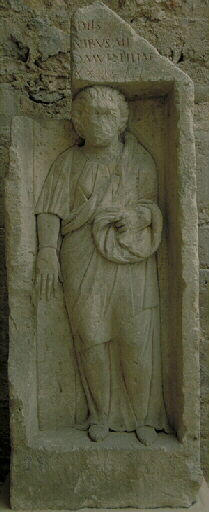
Stèle d'Aeliana
Description
Calcaire sculpté. La forme générale de cette stèle est très simple. Le décor architectural n'est composé que de lignes droites obtenues probablement par sciage. La stèle est longiligne et se termine par un fronton triangulaire orientant les pans du toit. Mais contrairement aux stèles J 51 et 66, le faîte n'est pas aplani. De plus, on ne distingue pas de séparation entre la base de la stèle, l'encadrement de la niche et le fronton. Ce dernier porte l'inscription suivante, sur quatre lignes: Diis / [Ma]nibus ae / [Lianae r]omuli filiae / [v(ixit) an(nis)] XXII 'Aux dieux Mânes d'Aeliana, fille de Romulus. Elle vécu 22 ans'. La particularité de cette stèle est la forme de sa niche. En effet, les niches rectangulaires sont peu nombreuses à Sens, notamment celles dont les parois sont parfaitement perpendiculaires. A l'intérieur, une femme debout s'appuie sur sa jambe droite et fléchit la gauche vers l'avant. Ceci est nettement visible par les plis du vêtement qui suivent les contours de ses jambes. Sur cette tunique légère la défunte porte un manteau drapé sur son épaule, passant en oblique sur sa poitrine et venant s'enrouler autour de sa main gauche. Son bras droit pend le long de son corps. La défunte porte un bracelet à son poignet droit. Son visage n'est plus visible, en revanche sa coiffure est très caractéristique. Elle est faite de grosses mèches parallèles, tirées en arrière. Le sculpteur a donné à cette femme une allure assez trapue, dénonçant sa maladresse tant dans le style que dans la forme: les plis des vêtements et la silhouette du personnage sont grossiers ; la forme de la stèle et le décor sont très simples et ne demandent pas une dextérité particulière. (BERGER Stéphanie).
Subject depicted
ornement à forme architecturale (fronton, niche orn),figure (femme, tunique)
About this work
The artwork titled "Stèle d'Aeliana" is preserved at musée municipal. This piece is listed in the Joconde database of the Ministry of Culture, which catalogues the works held in French museums.
Technique and Materials
This work belongs to the field: archéologie, gallo-romain, sculpture, épigraphie, croyances - coutumes. It was created using the following materials and techniques: calcaire, taillé. Its period of creation is identified as: 2nd half 1st Century.
The Conserving Museum
musée municipal preserves this work in its collections. As a « Musée de France » labeled museum, the institution is committed to preserving and showcasing the pieces entrusted to it.
Data sources
The information about this work comes from the Joconde database of the Ministry of Culture, published on data.culture.gouv.fr under the Open License v2.0 (Etalab).
About this artwork
Stèle d'Aeliana, oeuvre de archéologie, gallo-romain, sculpture, épigraphie, croyances - coutumes, et conservée au musée municipal. Le procédé technique employé est calcaire, taillé. Dimensions : H. 155 ; La. 60 ; E. 30 ; H. 111 (niche) ; La. 48 (niche) ; P. 11 (niche). Le thème de l'oeuvre est : ornement à forme architecturale (fronton, niche orn),figure (femme, tunique). L'oeuvre appartient à la 2e moitié 1er siècle.
Creation context
Quand entreprend la réalisation de Stèle d'Aeliana, la 2e moitié 1er siècle bat son plein et redéfinit les codes de la création. Cette œuvre, aujourd'hui au musée municipal, porte la marque indélébile de son époque, témoignant des tensions créatrices et des aspirations qui animent alors les milieux artistiques.
See also
Technique
Related pages
Frequently Asked Questions
Everything you need to know
The work « Stèle d'Aeliana » is held at musée municipal, an institution labeled as a « Musée de France ». This label guarantees the quality of collection preservation and accessibility to the public.
This artwork is attributed to according to the Joconde database of the Ministry of Culture. Check the artist's profile on DellArte to discover their background, other works, and museums that house their creations.
Data comes from the Joconde database of the Ministry of Culture (data.culture.gouv.fr), distributed under Open License v2.0 (Etalab). The records are provided by the museums and validated by the French Museum Service.
The work is part of the collections of a « Musée de France »-labelled museum. Contact the hosting museum to verify if the work is currently on display or held in reserve. Opening hours and admission fees are available on the museum's official website.
Image usage rights depend on the work, the artist, and the museum. If the author died more than 70 years ago, the work is in the public domain in France. Text data (title, technique, dimensions) are under Open License and freely reusable.
The work's record contains information from the Joconde database: title, author, technique and materials used, dimensions, creation period, artistic domain, inventory number, hosting museum, and when available, a digital image.
Use the DellArte contact page to report errors. Since data comes from the Joconde database, major corrections (attribution, dating, technique) should be reported to the Ministry of Culture via data.culture.gouv.fr.
The Joconde database lists over 700,000 works. Use the search bar to find works by the same artist, technique, or period. Each museum entry provides access to its entire digitized collection.
The image resolution depends on the museum's digitization program. Some museums offer high-resolution images through their own digital platforms. The image displayed on DellArte comes from the Joconde database at its dissemination resolution.
Museum shops often sell reproductions of their main works (postcards, posters, art books). For public domain works, services like RMN-Grand Palais (photo.rmn.fr) offer professional photographic reproductions.