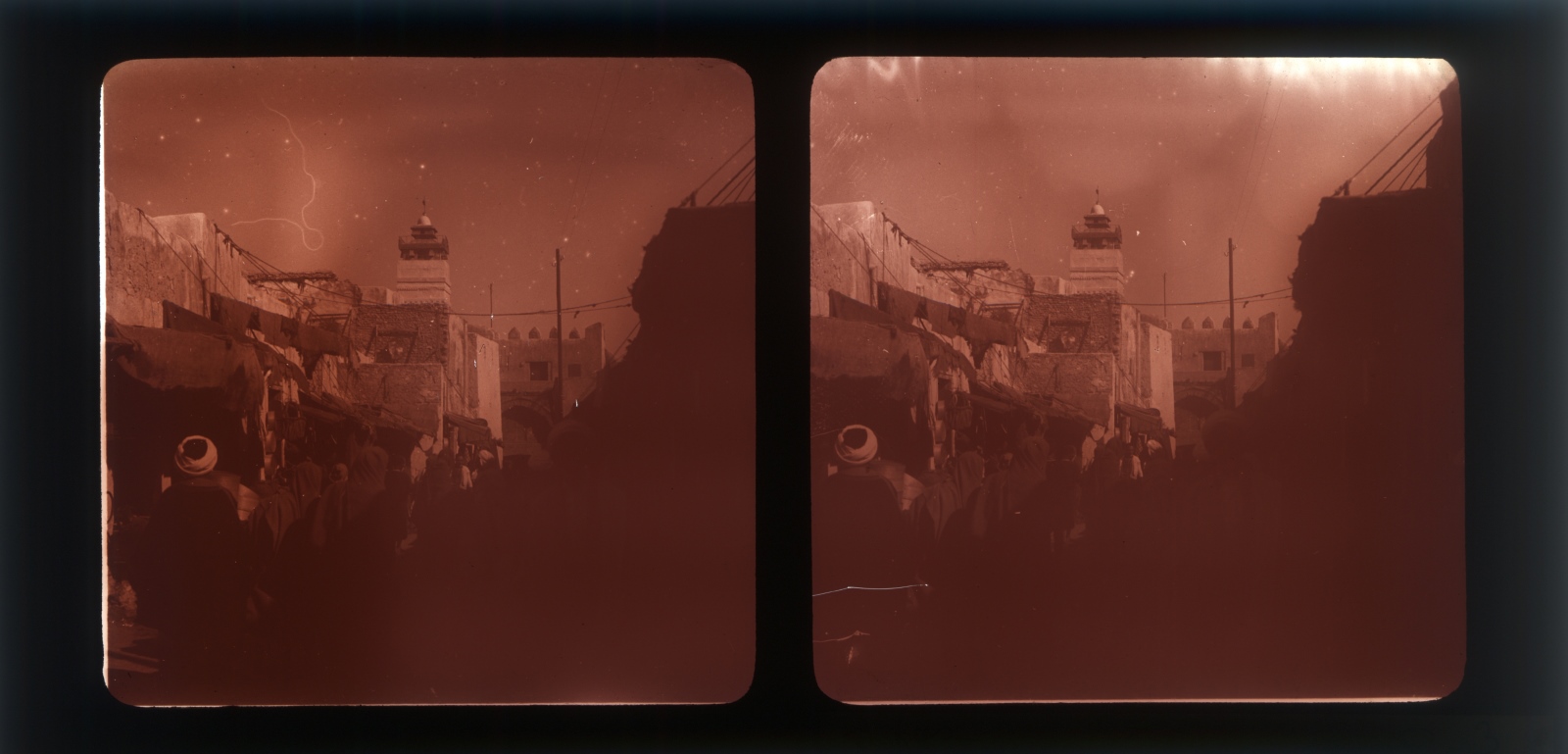
Sfax
Description
Photographie stéréoscopique sur plaque de verre montrant une rue animée de la vieille ville de Sfax (Tunisie), vers la mosquée de Bou Chouaïcha, dont on voit le minaret.
Subject depicted
scène (Sfax, rue, foule, ville, minaret, mosquée)
About this work
The artwork titled "Sfax", attributed to Verjat Louis Victor Emile (1857-1933) (photographe, attribué à), is preserved at musée Adrien Mentienne. This piece is listed in the Joconde database of the Ministry of Culture, which catalogues the works held in French museums.
Technique and Materials
This work belongs to the field: photographie, Afrique du nord, ethnologie. It was created using the following materials and techniques: verre (stéréophotographie, positif). Its period of creation is identified as: 1st quarter 20th Century.
The Conserving Museum
musée Adrien Mentienne preserves this work in its collections. As a « Musée de France » labeled museum, the institution is committed to preserving and showcasing the pieces entrusted to it.
Data sources
The information about this work comes from the Joconde database of the Ministry of Culture, published on data.culture.gouv.fr under the Open License v2.0 (Etalab).
About this artwork
Sfax est une pièce de photographie, Afrique du nord, ethnologie réalisée par Verjat Louis Victor Emile (1857-1933) (photographe, attribué à), au musée Adrien Mentienne. Elle est réalisée avec la technique suivante : verre (stéréophotographie, positif). Elle mesure hauteur en cm 8,5 ; largeur en cm 17. Le thème de l'oeuvre est : scène (Sfax, rue, foule, ville, minaret, mosquée). Elle a été créée durant la 1er quart 20e siècle. Concernant cette pièce : Verjat Louis Victor Emile : Louis Victor Emile Verjat, né le 17 février 1857 à Amboise (Indre-et-Loire) et mort le 12 juillet 1933 au château de La Landelle à Clécy (Calvados). Fils de Silvain Verjat (mort le 24 février 1918 à Clécy), entrepreneur de travaux publics et conseiller général du Calvados, il épousa le 21 décembre 1885 à Paris (9e) Alice Marie Joséphine Leturgeon (née à Paris le 5 novembre 1865 et morte prématurément entre 1891 et 1897), fille d’un autre entrepreneur de travaux publics, François Leturgeon (1830-1904), qui possédait le domaine de Sens, à Rochecorbon (Indre-et-Loire). Il eut avec son épouse au moins trois enfants : Suzanne, née le 3 novembre 1886 à Paris (17e) et morte le 31 août 1897 à Ouistreham (Calvados) ; André, mort à l’âge d’un jour le 10 juillet 1888 ; et un autre André, né le 6 novembre 1891 à Rochecorbon (Indre-et-Loire) et mort en 1978. Louis Victor Emile Verjat Verjat exerçait le métier d’ingénieur des arts et manufactures et d’entrepreneur de travaux publics mais c’est en qualité de comptable qu’il est désigné dans l’acte de décès de sa fille Suzanne en 1897. Au moment de son décès, il exerçait les fonctions de président de la Caisse générale de l’industrie et du bâtiment. Il habitait à Paris, 31 rue de Rome, mais il avait également une résidence à Ouistreham (Calvados) et fréquentait régulièrement le château de La Landelle à Clécy (Calvados), où vivait son père et où il passera les dernières années de sa vie. Il pratiquait la photographie en amateur et a réalisé de nombreux clichés de lieux liés à sa vie familiale (Ouistreham, Clécy et ses environs, Rochecorbon).
Creation context
Verjat Louis Victor Emile (1857-1933) (photographe, attribué à), immergé dans la 1er quart 20e siècle, livre avec Sfax une œuvre qui transcende son contexte de création tout en l'incarnant pleinement. Le musée Adrien Mentienne a su préserver cette pièce dont la pertinence artistique traverse les siècles et continue de susciter l'intérêt des amateurs d'art.
See also
Frequently Asked Questions
Everything you need to know
The work « Sfax » is held at musée Adrien Mentienne, an institution labeled as a « Musée de France ». This label guarantees the quality of collection preservation and accessibility to the public.
This artwork is attributed to Verjat Louis Victor Emile (1857-1933) (photographe, attribué à) according to the Joconde database of the Ministry of Culture. Check the artist's profile on DellArte to discover their background, other works, and museums that house their creations.
Data comes from the Joconde database of the Ministry of Culture (data.culture.gouv.fr), distributed under Open License v2.0 (Etalab). The records are provided by the museums and validated by the French Museum Service.
The work is part of the collections of a « Musée de France »-labelled museum. Contact the hosting museum to verify if the work is currently on display or held in reserve. Opening hours and admission fees are available on the museum's official website.
Image usage rights depend on the work, the artist, and the museum. If the author died more than 70 years ago, the work is in the public domain in France. Text data (title, technique, dimensions) are under Open License and freely reusable.
The work's record contains information from the Joconde database: title, author, technique and materials used, dimensions, creation period, artistic domain, inventory number, hosting museum, and when available, a digital image.
Use the DellArte contact page to report errors. Since data comes from the Joconde database, major corrections (attribution, dating, technique) should be reported to the Ministry of Culture via data.culture.gouv.fr.
The Joconde database lists over 700,000 works. Use the search bar to find works by the same artist, technique, or period. Each museum entry provides access to its entire digitized collection.
The image resolution depends on the museum's digitization program. Some museums offer high-resolution images through their own digital platforms. The image displayed on DellArte comes from the Joconde database at its dissemination resolution.
Museum shops often sell reproductions of their main works (postcards, posters, art books). For public domain works, services like RMN-Grand Palais (photo.rmn.fr) offer professional photographic reproductions.