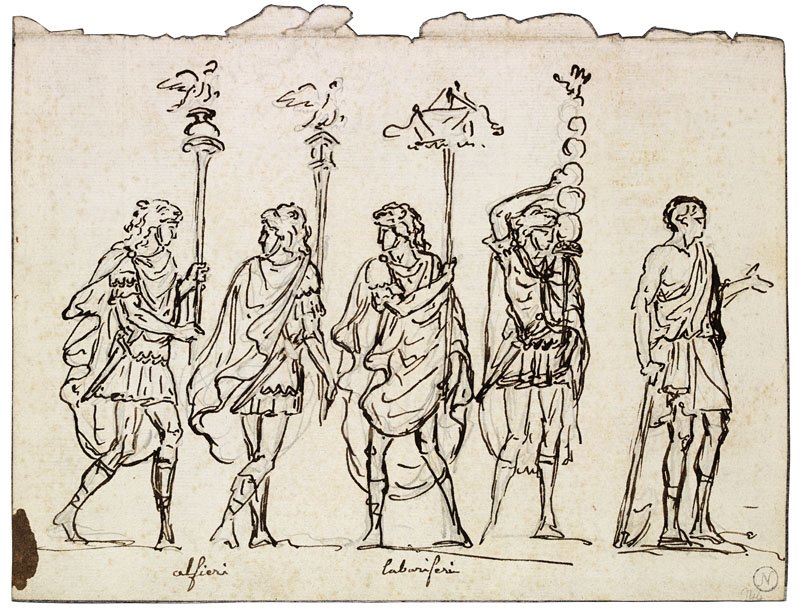
Porte-enseignes et ouvriers romains, d'après la colonne Trajane
School : France
Description
Plume et encre brune, graphite ; Jean-Claude Naigeon est l'un des plus importants élèves de l'École de dessin de Dijon au XVIIIe siècle. C'est le vainqueur en 1780 du prix de Rome organisé avec le soutien financier des États de Bourgogne, après Bénigne Gagneraux en 1776 et avant Pierre-Paul Prud'hon en 1784. L'artiste put ainsi séjourner à Rome de 1781 à 1785. Deux mois après son arrivée, Naigeon écrit dans une lettre adressée à son maître François Devosge qu’en Italie « l’art et la nature offrent sans cesse leurs plus belles productions ». Avant l'acquisition de 16 dessins en 2012, le musée des beaux-arts de Dijon conservait peu d'œuvres de Jean-Claude Naigeon : trois peintures envoyées depuis Rome et six dessins. L'achat de ce fonds ayant appartenu aux descendants de Naigeon permet d' illustrer la variété des styles et des sujets abordés par l'artiste dijonnais. Parmi ce lot, les études d'après l'Antique sont peu nombreuses. Le format des deux dessins d'après la Colonne trajane à Rome laisse penser qu'elles proviennent d'un petit carnet de dessin, même s'il est tout à fait probable que l'artiste ait en fait plutôt copié ces éléments d'après des gravures (celles de Santi Bartoli ou André Morell par exemple) plutôt que d'après les sculptures elles-mêmes, assez difficilement visibles dans le détail. (D'après Matthieu Gilles, 2012)
Subject depicted
scène (Rome, colonne Trajane, antiquité, soldat, romain, enseigne militaire)
About this work
The artwork titled "Porte-enseignes et ouvriers romains, d'après la colonne Trajane", attributed to Naigeon Jean Claude (1753-1832), is preserved at musée des beaux-arts. Referenced in the Joconde database, this work contributes to the national artistic heritage preserved in labeled museums.
Technique and Materials
This work belongs to the field: beaux-arts, dessin. It was created using the following materials and techniques: papier (plume, encre brune, graphite). Its period of creation is identified as: 4th quarter 18th Century.
The Conserving Museum
"Porte-enseignes et ouvriers romains, d'après la colonne Trajane" is preserved at musée des beaux-arts, an institution bearing the « Musée de France » label. This label ensures that the collections are managed rigorously in terms of conservation, inventory, and public accessibility.
Data sources
The information about this work comes from the Joconde database of the Ministry of Culture, published on data.culture.gouv.fr under the Open License v2.0 (Etalab).
About this artwork
Porte-enseignes et ouvriers romains, d'après la colonne Trajane, signée Naigeon Jean Claude (1753-1832), est conservée au musée des beaux-arts dans le domaine beaux-arts, dessin. La réalisation fait appel à papier (plume, encre brune, graphite). Dimensions de l'oeuvre : Dimensions Hauteur : 16,2 cm ; Largeur : 21,2 cm ; Hauteur (en cm) 16,2 ; Largeur (en cm) 21,2. Cette pièce a pour sujet : scène (Rome, colonne Trajane, antiquité, soldat, romain, enseigne militaire). L'oeuvre date de la 4e quart 18e siècle. Détail à relever : Naigeon Jean-Claude : Dijon, 1753 ; Dijon, 1832 ; nationalité : Française.
Creation context
Dans quel contexte Naigeon Jean Claude (1753-1832) a-t-il créé Porte-enseignes et ouvriers romains, d'après la colonne Trajane ? La 4e quart 18e siècle constitue un moment de profonde effervescence créatrice, qui nourrit et stimule la démarche de l'artiste. Le musée des beaux-arts, qui détient cette œuvre, permet au visiteur de comprendre les liens qui unissent la création artistique aux circonstances historiques de son émergence.
See also
Technique
Domain
Related pages
Frequently Asked Questions
Everything you need to know
The work « Porte-enseignes et ouvriers romains, d'après la colonne Trajane » is held at musée des beaux-arts, an institution labeled as a « Musée de France ». This label guarantees the quality of collection preservation and accessibility to the public.
This artwork is attributed to Naigeon Jean Claude (1753-1832) according to the Joconde database of the Ministry of Culture. Check the artist's profile on DellArte to discover their background, other works, and museums that house their creations.
Data comes from the Joconde database of the Ministry of Culture (data.culture.gouv.fr), distributed under Open License v2.0 (Etalab). The records are provided by the museums and validated by the French Museum Service.
The work is part of the collections of a « Musée de France »-labelled museum. Contact the hosting museum to verify if the work is currently on display or held in reserve. Opening hours and admission fees are available on the museum's official website.
Image usage rights depend on the work, the artist, and the museum. If the author died more than 70 years ago, the work is in the public domain in France. Text data (title, technique, dimensions) are under Open License and freely reusable.
The work's record contains information from the Joconde database: title, author, technique and materials used, dimensions, creation period, artistic domain, inventory number, hosting museum, and when available, a digital image.
Use the DellArte contact page to report errors. Since data comes from the Joconde database, major corrections (attribution, dating, technique) should be reported to the Ministry of Culture via data.culture.gouv.fr.
The Joconde database lists over 700,000 works. Use the search bar to find works by the same artist, technique, or period. Each museum entry provides access to its entire digitized collection.
The image resolution depends on the museum's digitization program. Some museums offer high-resolution images through their own digital platforms. The image displayed on DellArte comes from the Joconde database at its dissemination resolution.
Museum shops often sell reproductions of their main works (postcards, posters, art books). For public domain works, services like RMN-Grand Palais (photo.rmn.fr) offer professional photographic reproductions.