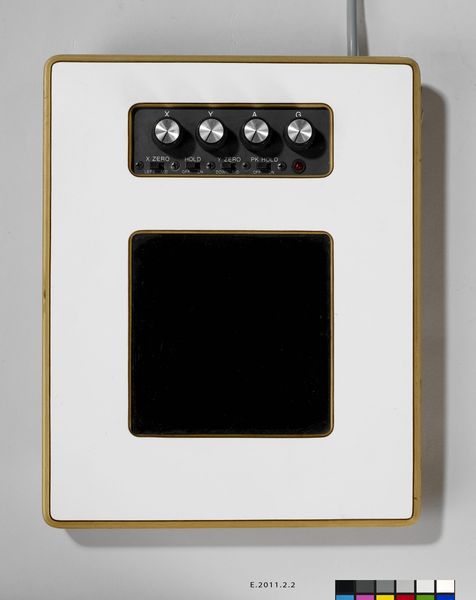
Pavé tactile prototype Touch Plate
Description
Présentation générale : Le pavé tactile illustre l'intérêt croissant des musiciens, au cours de la seconde moitié du XXe siècle, pour des contrôleurs gestuels renouvelant l'approche des instruments de musique traditionnels. Robert Moog invente le touch plate vers 1978 et le commercialise par le biais de sa nouvelle société Big Briar, fondée en 1978. Description des éléments : Ce contrôleur gestuel d'une toute nouvelle conception permet de capter le déplacement d'un ou de plusieurs doigts du musicien selon trois axes, deux horizontaux et un vertical. Il utilise pour cela le principe de capacité électrique, le champ d'électricité statique généré par le doigt du musicien interagissant avec le champ électrique présent sous la surface du pavé tactile. Plusieurs paramètres du signal sonore tels que la hauteur, l'intensité, le contenu spectral ou la durée peuvent être contrôlés, seuls ou de façon combinée. Le contrôle de l'axe vertical est particulièrement intéressant car, sensible à la pression, il permet de transcrire fidèlement tout mouvement de percussion. Le touch plate vient alors à l'appui des contrôleurs gestuels que l'on trouve couramment sur les instruments électroniques de l'époque tels que le ruban tactile, les potentiomètres à bouton, les roues, matrice à fiches, etc.
About this work
The artwork titled "Pavé tactile prototype Touch Plate", attributed to Moog Robert;Big Briar, is preserved at musée de la musique. Referenced in the Joconde database, this work contributes to the national artistic heritage preserved in labeled museums.
Technique and Materials
This work belongs to the field: musique - chant - danse, ethnologie, Amérique du nord. It was created using the following materials and techniques: bois vernis, fer, matière plastique, composants électroniques..
The Conserving Museum
musée de la musique preserves this work in its collections. As a « Musée de France » labeled museum, the institution is committed to preserving and showcasing the pieces entrusted to it.
Data sources
The information about this work comes from the Joconde database of the Ministry of Culture, published on data.culture.gouv.fr under the Open License v2.0 (Etalab).
About this artwork
Pavé tactile prototype Touch Plate, oeuvre de musique - chant - danse, ethnologie, Amérique du nord, est due à Moog Robert;Big Briar et conservée au musée de la musique. L'oeuvre a été exécutée en bois vernis, fer, matière plastique, composants électroniques. La pièce a pour dimensions Longueur totale : 273 mm. Epaisseur : 60 mm. Largeur : 219 mm. Complément d'information : Moog Robert, 1934-2005.
Creation context
Pavé tactile prototype Touch Plate émerge du bouillonnement de la , époque où Moog Robert;Big Briar atteint la pleine maturité de son art. Visible au musée de la musique, cette œuvre illustre à quel point le contexte historique nourrit et façonne la création artistique, lui conférant une profondeur qui va bien au-delà de la seule dimension esthétique.
See also
Frequently Asked Questions
Everything you need to know
The work « Pavé tactile prototype Touch Plate » is held at musée de la musique, an institution labeled as a « Musée de France ». This label guarantees the quality of collection preservation and accessibility to the public.
This artwork is attributed to Moog Robert;Big Briar according to the Joconde database of the Ministry of Culture. Check the artist's profile on DellArte to discover their background, other works, and museums that house their creations.
Data comes from the Joconde database of the Ministry of Culture (data.culture.gouv.fr), distributed under Open License v2.0 (Etalab). The records are provided by the museums and validated by the French Museum Service.
The work is part of the collections of a « Musée de France »-labelled museum. Contact the hosting museum to verify if the work is currently on display or held in reserve. Opening hours and admission fees are available on the museum's official website.
Image usage rights depend on the work, the artist, and the museum. If the author died more than 70 years ago, the work is in the public domain in France. Text data (title, technique, dimensions) are under Open License and freely reusable.
The work's record contains information from the Joconde database: title, author, technique and materials used, dimensions, creation period, artistic domain, inventory number, hosting museum, and when available, a digital image.
Use the DellArte contact page to report errors. Since data comes from the Joconde database, major corrections (attribution, dating, technique) should be reported to the Ministry of Culture via data.culture.gouv.fr.
The Joconde database lists over 700,000 works. Use the search bar to find works by the same artist, technique, or period. Each museum entry provides access to its entire digitized collection.
The image resolution depends on the museum's digitization program. Some museums offer high-resolution images through their own digital platforms. The image displayed on DellArte comes from the Joconde database at its dissemination resolution.
Museum shops often sell reproductions of their main works (postcards, posters, art books). For public domain works, services like RMN-Grand Palais (photo.rmn.fr) offer professional photographic reproductions.