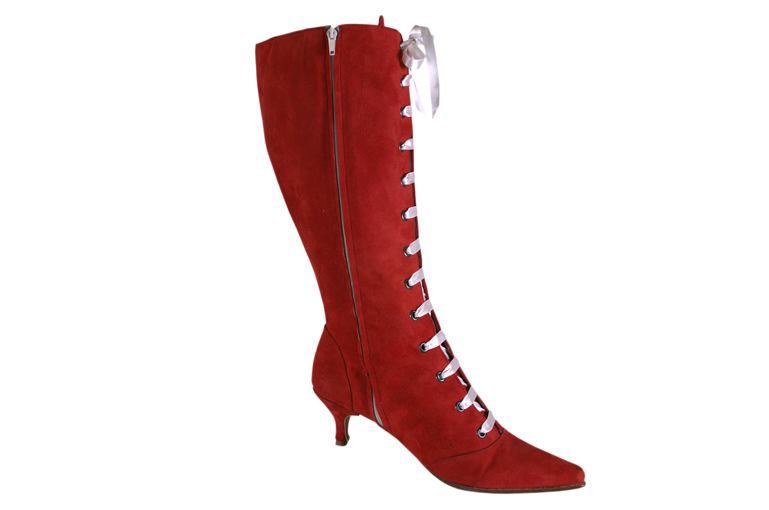
Ligne SATINE, modèle SEGOVIE
Description
Ligne SATINE, modèle SEGOVIE. Botte à lacet, veau velours rouge, doublure en chevreau bleu ciel. Bout pointu rapporté. Quartiers renforcés par une application de même peausserie. Double fermeture, une, latérale zippée et l'autre, décorative et fonctionnelle, sur le devant de la jambe avec oeillets et lacet en ruban blanc. Première chevreau bleu ciel. Talon cubain (faux Louis XV). Semelage cuir naturel. Pied gauche
About this work
The artwork titled "Ligne SATINE, modèle SEGOVIE", attributed to Brunel Eugénie (vers 1973-....) (créatrice);Franchini Maryline (vers 1973-....) (créatrice);MARYLINE-EUGENIE (fabricant), is preserved at musée de la chaussure. Referenced in the Joconde database, this work contributes to the national artistic heritage preserved in labeled museums.
Technique and Materials
This work belongs to the field: costume - accessoires du costume. It was created using the following materials and techniques: chevreau, cuir, veau (velours). Its period of creation is identified as: 1st quarter 21st Century.
The Conserving Museum
musée de la chaussure preserves this work in its collections. As a « Musée de France » labeled museum, the institution is committed to preserving and showcasing the pieces entrusted to it.
Data sources
The information about this work comes from the Joconde database of the Ministry of Culture, published on data.culture.gouv.fr under the Open License v2.0 (Etalab).
About this artwork
Ligne SATINE, modèle SEGOVIE de Brunel Eugénie (vers 1973-..) (créatrice);Franchini Maryline (vers 1973-..) (créatrice);MARYLINE-EUGENIE (fabricant) figure dans les collections du musée de la chaussure. L'oeuvre a été exécutée en chevreau, cuir, veau (velours). L'oeuvre présente les dimensions suivantes : L. 265 mm, l. 85 mm, H. 400 mm, Hauteur du talon 100 mm, Pointure 37,Pds. 322 g. La création de cette oeuvre remonte à la 1er quart 21e siècle. Informations complémentaires : Maryline Franchini et Eugénie Brunel, deux jeunes diplômées du Lycée du Dauphiné de Romans, se lancent dans la création de chaussures. Elles créent leur marque 'Maryline-Eugénie' avec la soutien du Lycée du Dauphiné. Depuis juin 2005, elles ont à leur actif une trentaine de modèles alliant confort et élégance. En effet, la marque se spécialise dans la huitième largeur, quand la grande distribution se limite généralement à la septième. Ces derniers ont été présentés en avant-première, sous la forme d'un défilé de mode, au musée international de la Chaussure en mars 2006. La commercialisation s'effectue sur commande. L'utilisation de matières de qualité en font un produit de luxe de fabrication française dans la tradition romanaise.
Creation context
Brunel Eugénie (vers 1973-....) (créatrice);Franchini Maryline (vers 1973-....) (créatrice);MARYLINE-EUGENIE (fabricant) puise dans le dynamisme de la 1er quart 21e siècle l'inspiration qui donne naissance à Ligne SATINE, modèle SEGOVIE. Exposée au musée de la chaussure, cette œuvre constitue un témoignage précieux des courants esthétiques et des sensibilités qui caractérisent cette époque de mutation artistique.
Frequently Asked Questions
Everything you need to know
The work « Ligne SATINE, modèle SEGOVIE » is held at musée de la chaussure, an institution labeled as a « Musée de France ». This label guarantees the quality of collection preservation and accessibility to the public.
This artwork is attributed to Brunel Eugénie (vers 1973-....) (créatrice);Franchini Maryline (vers 1973-....) (créatrice);MARYLINE-EUGENIE (fabricant) according to the Joconde database of the Ministry of Culture. Check the artist's profile on DellArte to discover their background, other works, and museums that house their creations.
Data comes from the Joconde database of the Ministry of Culture (data.culture.gouv.fr), distributed under Open License v2.0 (Etalab). The records are provided by the museums and validated by the French Museum Service.
The work is part of the collections of a « Musée de France »-labelled museum. Contact the hosting museum to verify if the work is currently on display or held in reserve. Opening hours and admission fees are available on the museum's official website.
Image usage rights depend on the work, the artist, and the museum. If the author died more than 70 years ago, the work is in the public domain in France. Text data (title, technique, dimensions) are under Open License and freely reusable.
The work's record contains information from the Joconde database: title, author, technique and materials used, dimensions, creation period, artistic domain, inventory number, hosting museum, and when available, a digital image.
Use the DellArte contact page to report errors. Since data comes from the Joconde database, major corrections (attribution, dating, technique) should be reported to the Ministry of Culture via data.culture.gouv.fr.
The Joconde database lists over 700,000 works. Use the search bar to find works by the same artist, technique, or period. Each museum entry provides access to its entire digitized collection.
The image resolution depends on the museum's digitization program. Some museums offer high-resolution images through their own digital platforms. The image displayed on DellArte comes from the Joconde database at its dissemination resolution.
Museum shops often sell reproductions of their main works (postcards, posters, art books). For public domain works, services like RMN-Grand Palais (photo.rmn.fr) offer professional photographic reproductions.