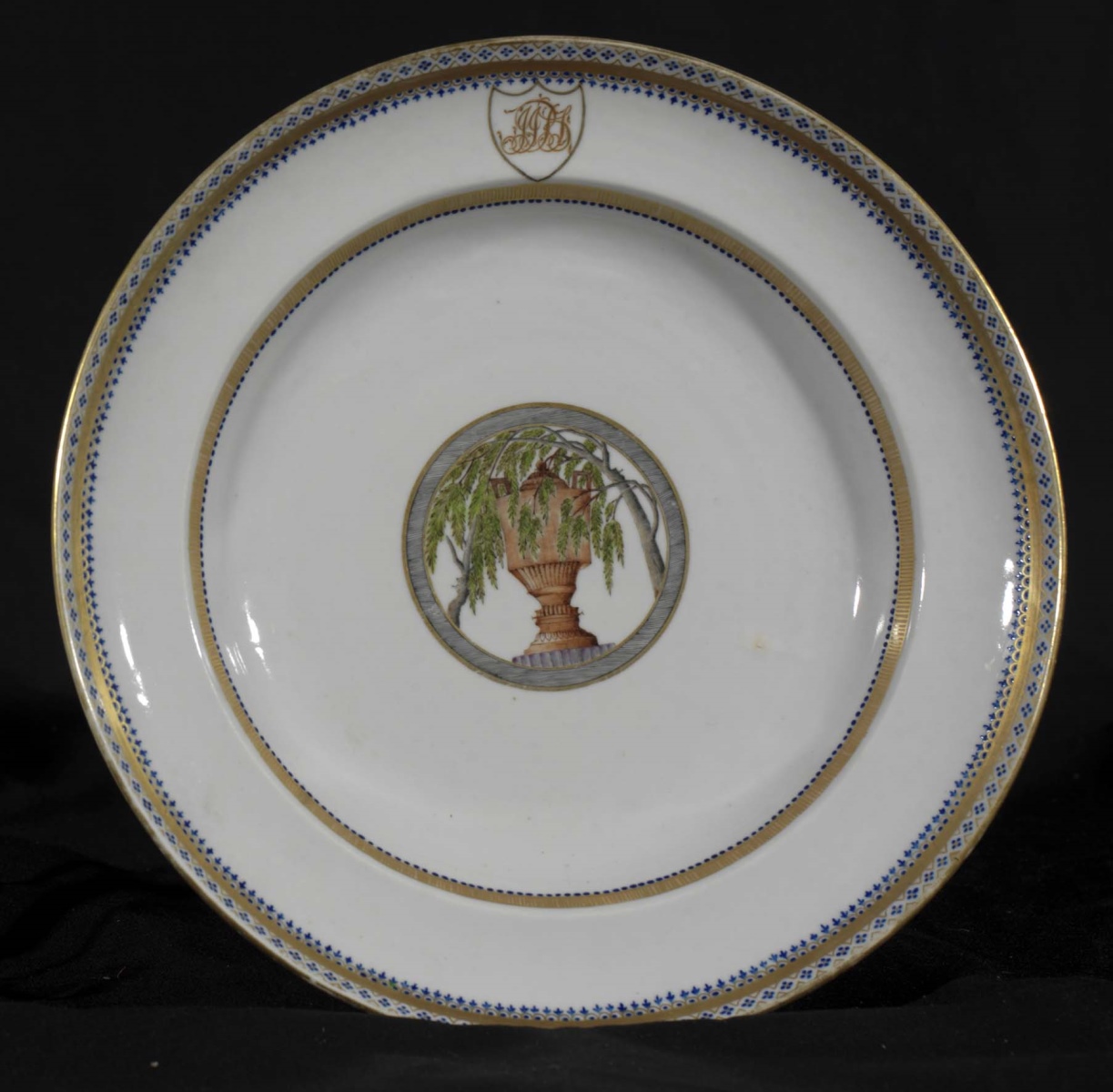
L'urne mystérieuse
Description
Ce décor énigmatique, réalisé par des artisans chinois, est inspiré d'une gravure française anonyme intitulée "l'urne mystérieuse". L’estampe fut diffusée clandestinement pendant la période révolutionnaire. Dans le médaillon central, le contour du piédouche de l'urne et les branches de deux saules pleureurs révèlent les profils de la famille royale : à droite, Louis XVI et le Dauphin, à gauche, visages de Marie-Antoinette et de Madame Royale. Comme en témoigne le chiffre dans un écusson (non identifié), cette assiette provient sans doute d'un service à la mémoire de la famille royale commandé par des émigrés.
Subject depicted
ornementation (médaillon orn, urne funéraire, saule pleureur, visage),ornementation (frise orn, ornement à forme géométrique),ornementation (filet orn, frise orn, fleur, lambrequin, écusson)
About this work
The artwork titled "L'urne mystérieuse", attributed to anonyme, is preserved at musée de Villèle. This piece is listed in the Joconde database of the Ministry of Culture, which catalogues the works held in French museums.
Technique and Materials
This work belongs to the field: céramique, Asie orientale. It was created using the following materials and techniques: porcelaine (doré, polychrome, bleu de cobalt). Its period of creation is identified as: 4th quarter 18th Century.
The Conserving Museum
"L'urne mystérieuse" is preserved at musée de Villèle, an institution bearing the « Musée de France » label. This label ensures that the collections are managed rigorously in terms of conservation, inventory, and public accessibility.
Data sources
The information about this work comes from the Joconde database of the Ministry of Culture, published on data.culture.gouv.fr under the Open License v2.0 (Etalab).
About this artwork
anonyme a réalisé L'urne mystérieuse, actuellement au musée de Villèle. La réalisation fait appel à porcelaine (doré, polychrome, bleu de cobalt). Dimensions de l'oeuvre : Diamètre en cm 24,6. L'oeuvre représente : ornementation (médaillon orn, urne funéraire, saule pleureur, visage),ornementation (frise orn, ornement à forme géométrique),ornementation (filet orn, frise orn, fleur, lambrequin, écusson). L'oeuvre date de la 4e quart 18e siècle.
Creation context
anonyme crée L'urne mystérieuse à une époque où la 4e quart 18e siècle transforme en profondeur le paysage artistique. Le musée de Villèle, qui abrite cette œuvre, offre au visiteur la possibilité de mesurer l'influence du contexte historique et culturel sur la démarche de l'artiste. Les circonstances de la création éclairent le sens et la portée de cette pièce remarquable.
See also
Domain
Author
Related pages
Frequently Asked Questions
Everything you need to know
The work « L'urne mystérieuse » is held at musée de Villèle, an institution labeled as a « Musée de France ». This label guarantees the quality of collection preservation and accessibility to the public.
This artwork is attributed to anonyme according to the Joconde database of the Ministry of Culture. Check the artist's profile on DellArte to discover their background, other works, and museums that house their creations.
Data comes from the Joconde database of the Ministry of Culture (data.culture.gouv.fr), distributed under Open License v2.0 (Etalab). The records are provided by the museums and validated by the French Museum Service.
The work is part of the collections of a « Musée de France »-labelled museum. Contact the hosting museum to verify if the work is currently on display or held in reserve. Opening hours and admission fees are available on the museum's official website.
Image usage rights depend on the work, the artist, and the museum. If the author died more than 70 years ago, the work is in the public domain in France. Text data (title, technique, dimensions) are under Open License and freely reusable.
The work's record contains information from the Joconde database: title, author, technique and materials used, dimensions, creation period, artistic domain, inventory number, hosting museum, and when available, a digital image.
Use the DellArte contact page to report errors. Since data comes from the Joconde database, major corrections (attribution, dating, technique) should be reported to the Ministry of Culture via data.culture.gouv.fr.
The Joconde database lists over 700,000 works. Use the search bar to find works by the same artist, technique, or period. Each museum entry provides access to its entire digitized collection.
The image resolution depends on the museum's digitization program. Some museums offer high-resolution images through their own digital platforms. The image displayed on DellArte comes from the Joconde database at its dissemination resolution.
Museum shops often sell reproductions of their main works (postcards, posters, art books). For public domain works, services like RMN-Grand Palais (photo.rmn.fr) offer professional photographic reproductions.