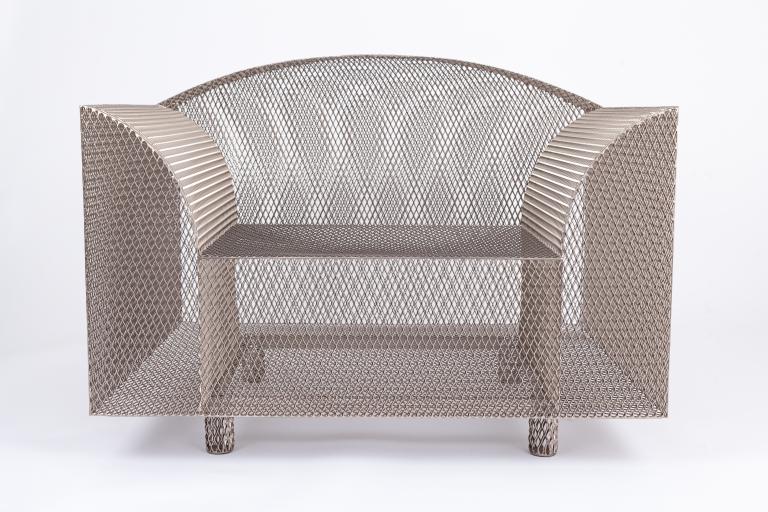
How High The Moon
Description
Fauteuil bas et large, à dossier moyennement haut et large, assise plate, accoudoirs larges à pans semi-circulaires inclinés vers l'assise, pieds tubulaires courts, réalisé dans une résille d'acier. La structure du fauteuil est réalisée par maillage du métal, réduit à une série de points d’intersection. Le volume créé tend à l’effacement et semble dénué de pesanteur. Résille en acier nickelé, déployé, formé et soudé. Excellent état
About this work
The artwork titled "How High The Moon", attributed to Kuramata Shirō (1934-1991), is preserved at musée départemental des arts asiatiques. This piece is listed in the Joconde database of the Ministry of Culture, which catalogues the works held in French museums.
Technique and Materials
This work belongs to the field: Asie orientale, ameublement, design. It was created using the following materials and techniques: acier, nickelage, tressé, soudé. Its period of creation is identified as: 4th quarter 20th Century.
The Conserving Museum
musée départemental des arts asiatiques preserves this work in its collections. As a « Musée de France » labeled museum, the institution is committed to preserving and showcasing the pieces entrusted to it.
Data sources
The information about this work comes from the Joconde database of the Ministry of Culture, published on data.gouv.fr under the Open License v2.0 (Etalab).
About this artwork
How High The Moon est une oeuvre de Asie orientale, ameublement, design par Kuramata Shirō (1934-1991), visible au musée départemental des arts asiatiques. Kuramata Shirō (1934-1991) a utilisé ici acier, nickelage, tressé, soudé. Dimensions : H. 72, l. 95, P. 81. L'oeuvre appartient à la 4e quart 20e siècle. Note sur cette oeuvre : 倉俣史朗 Tōkyō, 1934 ; Tōkyō, 1991 Architecte d’intérieur et designer, Kuramata Shirō fonde sa propre agence en 1965 et rejoint au début des années 1980 le groupe Memphis. Il privilégie l’expérience sensorielle ou intuitive et travaille de préférence les matériaux du quotidien et industriels, comme la résille d’acier, en vue de les ennoblir. Figure majeure de l’avant-garde internationale, il crée en 1986 le fauteuil How High the Moon, dont le nom rend hommage à la pièce de Duke Ellington et aux airs de jazz qu’il écoutait à l’époque de l’occupation américaine.
Creation context
Kuramata Shirō (1934-1991), immergé dans la 4e quart 20e siècle, livre avec How High The Moon une œuvre qui transcende son contexte de création tout en l'incarnant pleinement. Le musée départemental des arts asiatiques a su préserver cette pièce dont la pertinence artistique traverse les siècles et continue de susciter l'intérêt des amateurs d'art.
See also
Technique
Related pages
Frequently Asked Questions
Everything you need to know
The work « How High The Moon » is held at musée départemental des arts asiatiques, an institution labeled as a « Musée de France ». This label guarantees the quality of collection preservation and accessibility to the public.
This artwork is attributed to Kuramata Shirō (1934-1991) according to the Joconde database of the Ministry of Culture. Check the artist's profile on DellArte to discover their background, other works, and museums that house their creations.
Data comes from the Joconde database of the Ministry of Culture (data.gouv.fr), distributed under Open License v2.0 (Etalab). The records are provided by the museums and validated by the French Museum Service.
The work is part of the collections of a « Musée de France »-labelled museum. Contact the hosting museum to verify if the work is currently on display or held in reserve. Opening hours and admission fees are available on the museum's official website.
Image usage rights depend on the work, the artist, and the museum. If the author died more than 70 years ago, the work is in the public domain in France. Text data (title, technique, dimensions) are under Open License and freely reusable.
The work's record contains information from the Joconde database: title, author, technique and materials used, dimensions, creation period, artistic domain, inventory number, hosting museum, and when available, a digital image.
Use the DellArte contact page to report errors. Since data comes from the Joconde database, major corrections (attribution, dating, technique) should be reported to the Ministry of Culture via data.gouv.fr.
The Joconde database lists over 700,000 works. Use the search bar to find works by the same artist, technique, or period. Each museum entry provides access to its entire digitized collection.
The image resolution depends on the museum's digitization program. Some museums offer high-resolution images through their own digital platforms. The image displayed on DellArte comes from the Joconde database at its dissemination resolution.
Museum shops often sell reproductions of their main works (postcards, posters, art books). For public domain works, services like RMN-Grand Palais (photo.rmn.fr) offer professional photographic reproductions.