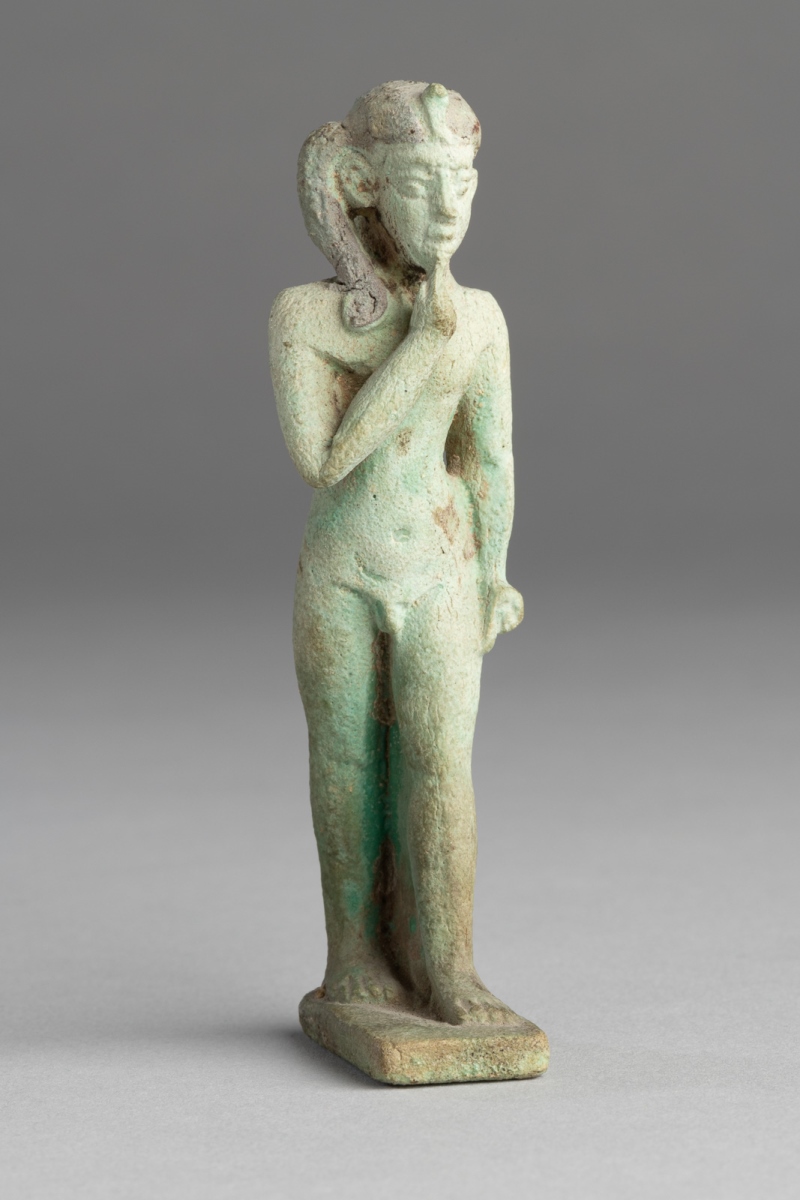
Harpocrate
Description
Harpocrate se tient debout, nu, avançant le pied gauche. L'amulette est réalisée en faïence bichrome : verte sur la presque totalité de la surface et noire sur les cheveux du dieu. Son bras gauche est le long du corps, tandis qu'il porte le doigt de sa main droite à sa bouche. Il arbore la mèche de l'enfance sur la tête et porte l’uræus sur son front. Dans la mythologie égyptienne, Harpocrate fait référence à Horus enfant, le fils d'Isis et d'Osiris. Ce nom a été adopté à Alexandrie, puis dans l'ensemble du monde gréco-romain, pour désigner le dieu Horus, vénéré aux côtés d'Isis, de Sérapis et d'Anubis. Il s'agit essentiellement d'une version hellénisée des termes égyptiens « Har-pokhrat », signifiant « Horus l'enfant ». Tous les termes en égyptien qui font référence aux amulettes ont pour signification la protection, définissant ainsi la fonction de ces petits objets conçus pour préserver celui qui les porte de tout danger. À partir du Moyen-Empire, vers 2060-1785 avant J.-C., on commence à produire spécifiquement des amulettes à des fins funéraires, qui sont disposées entre les bandelettes entourant la momie. Dans la plupart des cas, plusieurs exemplaires de la même amulette sont présents sur la momie, la multiplication de ces objets contribuant à une protection renforcée. Fabriquées en or, en bronze, en faïence, en pierre, et autres matériaux, ces amulettes étaient portées comme porte-bonheur autour du cou, sous la forme de colliers, ou dissimulées sur la poitrine, sous les vêtements.
About this work
The artwork titled "Harpocrate" is preserved at musée d'archéologie méditerranéenne. This piece is listed in the Joconde database of the Ministry of Culture, which catalogues the works held in French museums.
Technique and Materials
This work belongs to the field: égyptien, archéologie, croyances - coutumes. It was created using the following materials and techniques: terre cuite (émail).
The Conserving Museum
musée d'archéologie méditerranéenne preserves this work in its collections. As a « Musée de France » labeled museum, the institution is committed to preserving and showcasing the pieces entrusted to it.
Data sources
The information about this work comes from the Joconde database of the Ministry of Culture, published on data.culture.gouv.fr under the Open License v2.0 (Etalab).
About this artwork
Harpocrate, oeuvre de égyptien, archéologie, croyances - coutumes, et conservée au musée d'archéologie méditerranéenne. terre cuite (émail) est le procédé utilisé pour cette oeuvre. Format : Hauteur en cm 8,2 ; Longueur en cm 2,1 ; Epaisseur en cm 2,9.
Creation context
puise dans le dynamisme de la l'inspiration qui donne naissance à Harpocrate. Exposée au musée d'archéologie méditerranéenne, cette œuvre constitue un témoignage précieux des courants esthétiques et des sensibilités qui caractérisent cette époque de mutation artistique.
See also
Technique
Related pages
Frequently Asked Questions
Everything you need to know
The work « Harpocrate » is held at musée d'archéologie méditerranéenne, an institution labeled as a « Musée de France ». This label guarantees the quality of collection preservation and accessibility to the public.
This artwork is attributed to according to the Joconde database of the Ministry of Culture. Check the artist's profile on DellArte to discover their background, other works, and museums that house their creations.
Data comes from the Joconde database of the Ministry of Culture (data.culture.gouv.fr), distributed under Open License v2.0 (Etalab). The records are provided by the museums and validated by the French Museum Service.
The work is part of the collections of a « Musée de France »-labelled museum. Contact the hosting museum to verify if the work is currently on display or held in reserve. Opening hours and admission fees are available on the museum's official website.
Image usage rights depend on the work, the artist, and the museum. If the author died more than 70 years ago, the work is in the public domain in France. Text data (title, technique, dimensions) are under Open License and freely reusable.
The work's record contains information from the Joconde database: title, author, technique and materials used, dimensions, creation period, artistic domain, inventory number, hosting museum, and when available, a digital image.
Use the DellArte contact page to report errors. Since data comes from the Joconde database, major corrections (attribution, dating, technique) should be reported to the Ministry of Culture via data.culture.gouv.fr.
The Joconde database lists over 700,000 works. Use the search bar to find works by the same artist, technique, or period. Each museum entry provides access to its entire digitized collection.
The image resolution depends on the museum's digitization program. Some museums offer high-resolution images through their own digital platforms. The image displayed on DellArte comes from the Joconde database at its dissemination resolution.
Museum shops often sell reproductions of their main works (postcards, posters, art books). For public domain works, services like RMN-Grand Palais (photo.rmn.fr) offer professional photographic reproductions.