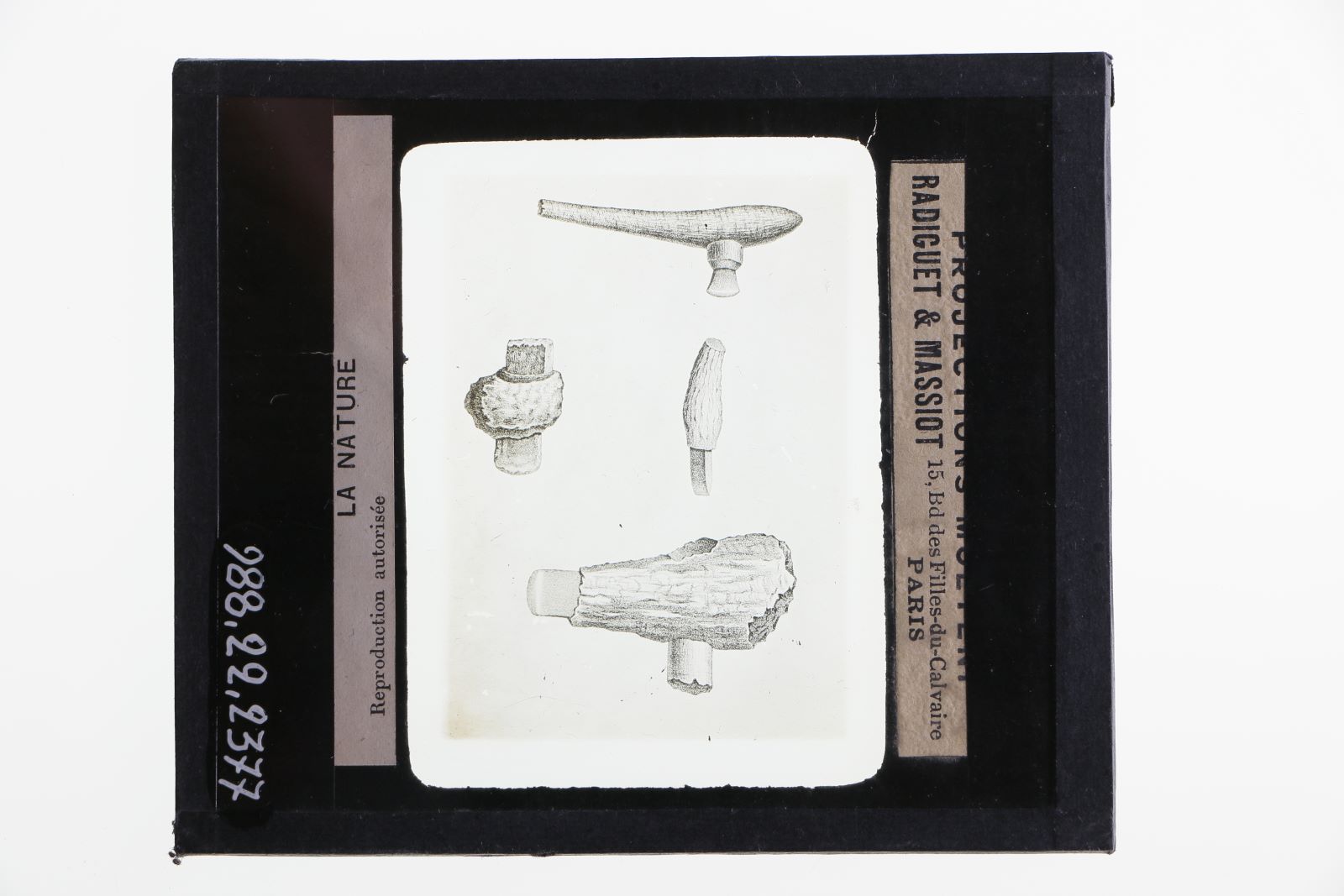
Haches et ciseaux en pierre avec manche en bois de cerf palafittes de l'époque néolithique. Muséum de Lyon (titre inscrit)
Description
Plaque de verre utilisée pour une projection avec une lanterne magique. plaque de verre pour projection
Subject depicted
hache,ciseaux,lien
About this work
The artwork titled "Haches et ciseaux en pierre avec manche en bois de cerf palafittes de l'époque néolithique. Muséum de Lyon (titre inscrit)", attributed to Molteni Alfred (1837-1907) (fabricant, éditeur);Radiguet et Massiot (fabricant, éditeur), is preserved at musée Bargoin. Referenced in the Joconde database, this work contributes to the national artistic heritage preserved in labeled museums.
Technique and Materials
This work belongs to the field: ethnologie, histoire, enseignement. It was created using the following materials and techniques: papier (chromolithographie, impression monochrome), verre (collage). Its period of creation is identified as: 4th quarter 19th Century;1st quarter 20th Century.
The Conserving Museum
"Haches et ciseaux en pierre avec manche en bois de cerf palafittes de l'époque néolithique. Muséum de Lyon (titre inscrit)" is preserved at musée Bargoin, an institution bearing the « Musée de France » label. This label ensures that the collections are managed rigorously in terms of conservation, inventory, and public accessibility.
Data sources
The information about this work comes from the Joconde database of the Ministry of Culture, published on data.culture.gouv.fr under the Open License v2.0 (Etalab).
About this artwork
L'oeuvre intitulée Haches et ciseaux en pierre avec manche en bois de cerf palafittes de l'époque néolithique. Muséum de Lyon (titre inscrit) est attribuée à Molteni Alfred (1837-1907) (fabricant, éditeur);Radiguet et Massiot (fabricant, éditeur) et se trouve au musée Bargoin. papier (chromolithographie, impression monochrome), verre (collage) est le procédé utilisé pour cette oeuvre. Les dimensions de l'oeuvre sont : H. 8.5 cm ; l. 10 cm. Le thème de l'oeuvre est : hache,ciseaux,lien. La création de cette oeuvre remonte à la 4e quart 19e siècle;1er quart 20e siècle. Note sur cette oeuvre : Alfred Molteni (Paris 1837-1907) : fabricant de lanterne et plaque pour projection, éditeur de plaque pour projection ; Arthur-Honoré Radiguet (Paris 1850-1905) et Gaston Massiot : fabricant de lanterne de projection.
Creation context
Haches et ciseaux en pierre avec manche en bois de cerf palafittes de l'époque néolithique. Muséum de Lyon (titre inscrit) émerge du bouillonnement de la 4e quart 19e siècle;1er quart 20e siècle, époque où Molteni Alfred (1837-1907) (fabricant, éditeur);Radiguet et Massiot (fabricant, éditeur) atteint la pleine maturité de son art. Visible au musée Bargoin, cette œuvre illustre à quel point le contexte historique nourrit et façonne la création artistique, lui conférant une profondeur qui va bien au-delà de la seule dimension esthétique.
Frequently Asked Questions
Everything you need to know
The work « Haches et ciseaux en pierre avec manche en bois de cerf palafittes de l'époque néolithique. Muséum de Lyon (titre inscrit) » is held at musée Bargoin, an institution labeled as a « Musée de France ». This label guarantees the quality of collection preservation and accessibility to the public.
This artwork is attributed to Molteni Alfred (1837-1907) (fabricant, éditeur);Radiguet et Massiot (fabricant, éditeur) according to the Joconde database of the Ministry of Culture. Check the artist's profile on DellArte to discover their background, other works, and museums that house their creations.
Data comes from the Joconde database of the Ministry of Culture (data.culture.gouv.fr), distributed under Open License v2.0 (Etalab). The records are provided by the museums and validated by the French Museum Service.
The work is part of the collections of a « Musée de France »-labelled museum. Contact the hosting museum to verify if the work is currently on display or held in reserve. Opening hours and admission fees are available on the museum's official website.
Image usage rights depend on the work, the artist, and the museum. If the author died more than 70 years ago, the work is in the public domain in France. Text data (title, technique, dimensions) are under Open License and freely reusable.
The work's record contains information from the Joconde database: title, author, technique and materials used, dimensions, creation period, artistic domain, inventory number, hosting museum, and when available, a digital image.
Use the DellArte contact page to report errors. Since data comes from the Joconde database, major corrections (attribution, dating, technique) should be reported to the Ministry of Culture via data.culture.gouv.fr.
The Joconde database lists over 700,000 works. Use the search bar to find works by the same artist, technique, or period. Each museum entry provides access to its entire digitized collection.
The image resolution depends on the museum's digitization program. Some museums offer high-resolution images through their own digital platforms. The image displayed on DellArte comes from the Joconde database at its dissemination resolution.
Museum shops often sell reproductions of their main works (postcards, posters, art books). For public domain works, services like RMN-Grand Palais (photo.rmn.fr) offer professional photographic reproductions.