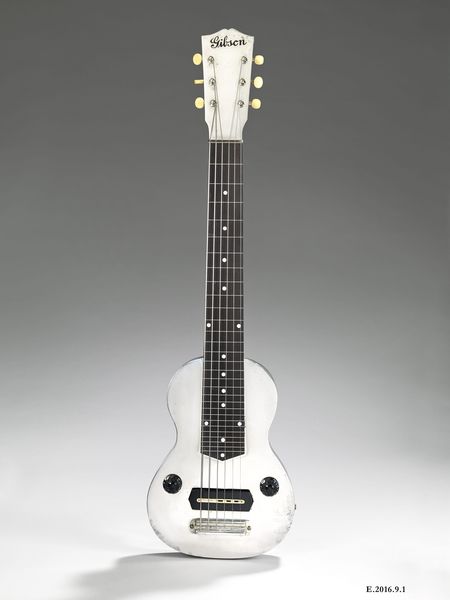
Guitare hawaïenne électrique modèle EHG
Description
Présentation générale : Créé fin 1935, le modèle EHG en aluminium fut rapidement stoppé par Gibson pour être remplacé à partir de janvier 1936 par un modèle construit entièrement en érable qui prit la désignation E-150, puis EH-150 dès fin 1936. Il convient de noter au passage que ce premier modèle de guitare hawaïenne électrique (appelée lap steel parce que jouée posée à plat sur les genoux), n'apparaît dans aucune brochure commerciale Gibson de 1935 ou 1936, et que sa seule représentation apparaît sous la forme d'un dessin dans le brevet (N° 2,087,106) déposé par Gibson le 8 février 1936. Description des éléments : Le manche et le corps de l'instrument ont été usinés en fonderie à partir d'un bloc d'aluminium. La touche sur laquelle sont incrustées 29 frettes est en bois. Les boutons des mécaniques "Grover" sont en matière plastique et les deux boutons de réglage (volume / graves-aigus) sont en bakélite. Le micro électro-magnétique est encastré dans le corps de l'instrument au dessus du chevalet / cordier. Une découpe rectangulaire sur le dos permet d'accéder au bloc électronique.
About this work
The artwork titled "Guitare hawaïenne électrique modèle EHG", attributed to Gibson, is preserved at musée de la musique. This piece is listed in the Joconde database of the Ministry of Culture, which catalogues the works held in French museums.
Technique and Materials
This work belongs to the field: musique - chant - danse, ethnologie, Amérique du nord. It was created using the following materials and techniques: métal, bois, matière plastique, bakélite, composants électroniques.
The Conserving Museum
musée de la musique preserves this work in its collections. As a « Musée de France » labeled museum, the institution is committed to preserving and showcasing the pieces entrusted to it.
Data sources
The information about this work comes from the Joconde database of the Ministry of Culture, published on data.culture.gouv.fr under the Open License v2.0 (Etalab).
About this artwork
On doit Guitare hawaïenne électrique modèle EHG à Gibson ; l'oeuvre est au musée de la musique. L'oeuvre a été exécutée en métal, bois, matière plastique, bakélite, composants électroniques. Dimensions : Longueur totale : 810 mm. Epaisseur : 70 mm. Largeur : 225 mm.
Creation context
Gibson puise dans le dynamisme de la l'inspiration qui donne naissance à Guitare hawaïenne électrique modèle EHG. Exposée au musée de la musique, cette œuvre constitue un témoignage précieux des courants esthétiques et des sensibilités qui caractérisent cette époque de mutation artistique.
See also
Author
Related pages
Frequently Asked Questions
Everything you need to know
The work « Guitare hawaïenne électrique modèle EHG » is held at musée de la musique, an institution labeled as a « Musée de France ». This label guarantees the quality of collection preservation and accessibility to the public.
This artwork is attributed to Gibson according to the Joconde database of the Ministry of Culture. Check the artist's profile on DellArte to discover their background, other works, and museums that house their creations.
Data comes from the Joconde database of the Ministry of Culture (data.culture.gouv.fr), distributed under Open License v2.0 (Etalab). The records are provided by the museums and validated by the French Museum Service.
The work is part of the collections of a « Musée de France »-labelled museum. Contact the hosting museum to verify if the work is currently on display or held in reserve. Opening hours and admission fees are available on the museum's official website.
Image usage rights depend on the work, the artist, and the museum. If the author died more than 70 years ago, the work is in the public domain in France. Text data (title, technique, dimensions) are under Open License and freely reusable.
The work's record contains information from the Joconde database: title, author, technique and materials used, dimensions, creation period, artistic domain, inventory number, hosting museum, and when available, a digital image.
Use the DellArte contact page to report errors. Since data comes from the Joconde database, major corrections (attribution, dating, technique) should be reported to the Ministry of Culture via data.culture.gouv.fr.
The Joconde database lists over 700,000 works. Use the search bar to find works by the same artist, technique, or period. Each museum entry provides access to its entire digitized collection.
The image resolution depends on the museum's digitization program. Some museums offer high-resolution images through their own digital platforms. The image displayed on DellArte comes from the Joconde database at its dissemination resolution.
Museum shops often sell reproductions of their main works (postcards, posters, art books). For public domain works, services like RMN-Grand Palais (photo.rmn.fr) offer professional photographic reproductions.