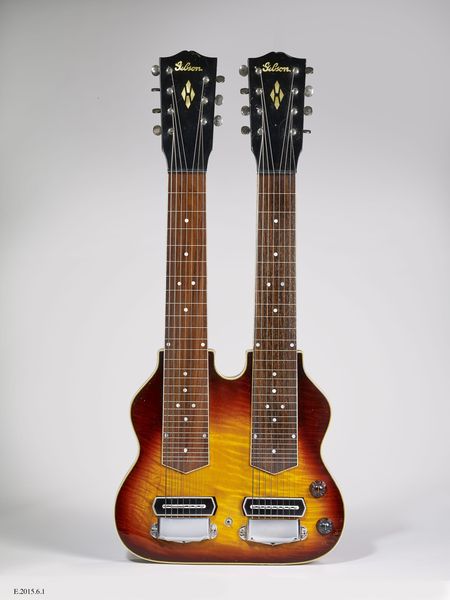
Guitare hawaïenne électrique double manche modèle EH-150
Description
Présentation générale : Seul et dernier exemplaire de ce modèle fabriqué en 1940. Description des éléments : Le corps de l'instrument est en érable ondé recouvert d'un vernis "sunburst". Le fond est constitué d'une plaque d’érable amovible, fixée à l'aide quatre vis situées en partie basse. Cette plaque recouvre le corps demi plein (solid body) dans lequel sont encastrés deux micros type "Charlie Christian", les deux potentiomètres en bakélite, l'un pour contrôler le volume et l'autre la tonalité "grave-aigus" et le câblage. Les micros simple bobinage sont protégés par une plaque noire en matière plastique dont le pourtour est aussi recouvert d'un triple filet. Un petit sélecteur de micro, non d'origine, a été ajouté ultérieurement entre les deux chevalets / cordiers. Les deux manches sont emboîtés et collés sur le corps. Leurs touches, en palissandre, se prolongent sur le corps de l'instrument pour recevoir chacune 29 repères de frettes. Les cordes métalliques reposent sur un sillet en métal situé au-dessus du premier repère / frette. Décor : Un triple filet (blanc-noir-blanc) souligne les contours de l'instrument. N° de série : FEG-892-1.
About this work
The artwork titled "Guitare hawaïenne électrique double manche modèle EH-150", attributed to Gibson, is preserved at musée de la musique. Referenced in the Joconde database, this work contributes to the national artistic heritage preserved in labeled museums.
Technique and Materials
This work belongs to the field: musique - chant - danse, ethnologie, Amérique du nord. It was created using the following materials and techniques: bois, métal, bakélite, composants électroniques, matière plastique.
The Conserving Museum
musée de la musique preserves this work in its collections. As a « Musée de France » labeled museum, the institution is committed to preserving and showcasing the pieces entrusted to it.
Data sources
The information about this work comes from the Joconde database of the Ministry of Culture, published on data.culture.gouv.fr under the Open License v2.0 (Etalab).
About this artwork
L'oeuvre Guitare hawaïenne électrique double manche modèle EH-150 de Gibson fait partie des collections du musée de la musique. Le procédé technique employé est bois, métal, bakélite, composants électroniques, matière plastique. Dimensions de l'oeuvre : Longueur totale : 840 mm. Epaisseur : 70 mm. Largeur : 377 mm.
Creation context
La fournit à Gibson le cadre propice pour imaginer Guitare hawaïenne électrique double manche modèle EH-150. Cette œuvre, aujourd'hui trésor du musée de la musique, est l'aboutissement d'un échange fécond entre le créateur et les mouvements de pensée de son temps. Le contexte intellectuel et artistique se lit dans chaque choix formel de la composition.
See also
Author
Related pages
Frequently Asked Questions
Everything you need to know
The work « Guitare hawaïenne électrique double manche modèle EH-150 » is held at musée de la musique, an institution labeled as a « Musée de France ». This label guarantees the quality of collection preservation and accessibility to the public.
This artwork is attributed to Gibson according to the Joconde database of the Ministry of Culture. Check the artist's profile on DellArte to discover their background, other works, and museums that house their creations.
Data comes from the Joconde database of the Ministry of Culture (data.culture.gouv.fr), distributed under Open License v2.0 (Etalab). The records are provided by the museums and validated by the French Museum Service.
The work is part of the collections of a « Musée de France »-labelled museum. Contact the hosting museum to verify if the work is currently on display or held in reserve. Opening hours and admission fees are available on the museum's official website.
Image usage rights depend on the work, the artist, and the museum. If the author died more than 70 years ago, the work is in the public domain in France. Text data (title, technique, dimensions) are under Open License and freely reusable.
The work's record contains information from the Joconde database: title, author, technique and materials used, dimensions, creation period, artistic domain, inventory number, hosting museum, and when available, a digital image.
Use the DellArte contact page to report errors. Since data comes from the Joconde database, major corrections (attribution, dating, technique) should be reported to the Ministry of Culture via data.culture.gouv.fr.
The Joconde database lists over 700,000 works. Use the search bar to find works by the same artist, technique, or period. Each museum entry provides access to its entire digitized collection.
The image resolution depends on the museum's digitization program. Some museums offer high-resolution images through their own digital platforms. The image displayed on DellArte comes from the Joconde database at its dissemination resolution.
Museum shops often sell reproductions of their main works (postcards, posters, art books). For public domain works, services like RMN-Grand Palais (photo.rmn.fr) offer professional photographic reproductions.