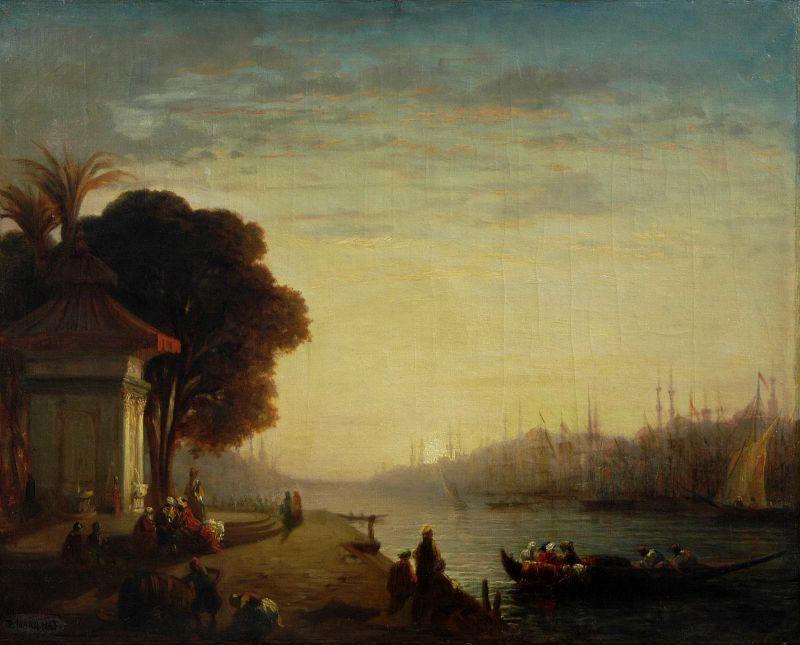
Entrée du Bosphore
School : France
Subject depicted
paysage (Turquie : Istanbul, bateau, mer, quai, port, marin, Bédouin, architecture, palmier)
Inscriptions
signé
About this work
The artwork titled "Entrée du Bosphore", attributed to Marilhat Prosper (1811-1847), is preserved at musée d'art Roger Quilliot. Referenced in the Joconde database, this work contributes to the national artistic heritage preserved in labeled museums.
Technique and Materials
This work belongs to the field: beaux-arts, peinture. It was created using the following materials and techniques: toile, peinture à l'huile. Its period of creation is identified as: 2nd quarter 19th Century.
The Conserving Museum
"Entrée du Bosphore" is preserved at musée d'art Roger Quilliot, an institution bearing the « Musée de France » label. This label ensures that the collections are managed rigorously in terms of conservation, inventory, and public accessibility.
Data sources
The information about this work comes from the Joconde database of the Ministry of Culture, published on data.gouv.fr under the Open License v2.0 (Etalab).
About this artwork
L'oeuvre Entrée du Bosphore de Marilhat Prosper (1811-1847) fait partie des collections du musée d'art Roger Quilliot. Cette oeuvre est réalisée en toile, peinture à l'huile. Mesures : H. 65,7 cm ; l. 81,3 cm (72,8 x 88,3 x 2 cm avec cadre). Cette pièce a pour sujet : paysage (Turquie : Istanbul, bateau, mer, quai, port, marin, Bédouin, architecture, palmier). Elle est datée de la 2e quart 19e siècle. Complément d'information : Vertaizon, 1811 ; Paris, 1847 ; Fils de banquier, il passa une jeunesse heureuse dans un château en Auvergne, puis dans la petite ville de Thiers, avant de monter à Paris étudier la peinture avec Camille Roqueplan. C'est en tant que dessinateur de l'expédition scientifique d'un aristocrate autrichien se piquant de botanique, le Baron Karl von Hügel, que Marilhat envisagea en 1831 son voyage en Orient : Syrie, Liban, Palestine, puis, début 1832, Haute-Egypte. Passionné par l'architecture du Caire et d'Alexandrie dont il réalisa de nombreux relevés, et alors que le baron poursuivit son voyage vers l'Inde, il choisit de rester en Egypte. Il vit là de son art, réalisant des portraits. Il retourna en France à bord du «Sphinx», accompagnant le transbordement de l'obélisque de Louksor affrété par le Baron Taylor. Exposés au Salon en 1834, ses premiers tableaux firent sensation et l'imposèrent comme une des figures majeures d'un courant orientaliste en peinture. Fromentin le rangea parmi les fondateurs du mouvement : il célébra en lui le paysagiste, à côté du «peintre de genre», Dauzats, et du «peintre d'histoire», Delacroix. La notoriété de Marilhat tient à un petit nombre d'oeuvres, mais d'une étrange intensité. Rapidement diminué par les accès d'une maladie dite mentale, il se révéla incapable de repartir pour un séjour au Caire. Il obtint cependant, grâce au soutien amical de Mérimée, une pension annuelle, mais mourut peu après, à l'âge de 36 ans.
Creation context
La genèse de Entrée du Bosphore par Marilhat Prosper (1811-1847) est indissociable de l'atmosphère culturelle de la 2e quart 19e siècle, moment de grands changements dans l'histoire de l'art. Conservée au musée d'art Roger Quilliot, cette œuvre renferme les échos d'un monde en pleine transformation, où les artistes cherchent de nouvelles manières de représenter la réalité.
See also
Technique
Domain
Related pages
Frequently Asked Questions
Everything you need to know
The work « Entrée du Bosphore » is held at musée d'art Roger Quilliot, an institution labeled as a « Musée de France ». This label guarantees the quality of collection preservation and accessibility to the public.
This artwork is attributed to Marilhat Prosper (1811-1847) according to the Joconde database of the Ministry of Culture. Check the artist's profile on DellArte to discover their background, other works, and museums that house their creations.
Data comes from the Joconde database of the Ministry of Culture (data.gouv.fr), distributed under Open License v2.0 (Etalab). The records are provided by the museums and validated by the French Museum Service.
The work is part of the collections of a « Musée de France »-labelled museum. Contact the hosting museum to verify if the work is currently on display or held in reserve. Opening hours and admission fees are available on the museum's official website.
Image usage rights depend on the work, the artist, and the museum. If the author died more than 70 years ago, the work is in the public domain in France. Text data (title, technique, dimensions) are under Open License and freely reusable.
The work's record contains information from the Joconde database: title, author, technique and materials used, dimensions, creation period, artistic domain, inventory number, hosting museum, and when available, a digital image.
Use the DellArte contact page to report errors. Since data comes from the Joconde database, major corrections (attribution, dating, technique) should be reported to the Ministry of Culture via data.gouv.fr.
The Joconde database lists over 700,000 works. Use the search bar to find works by the same artist, technique, or period. Each museum entry provides access to its entire digitized collection.
The image resolution depends on the museum's digitization program. Some museums offer high-resolution images through their own digital platforms. The image displayed on DellArte comes from the Joconde database at its dissemination resolution.
Museum shops often sell reproductions of their main works (postcards, posters, art books). For public domain works, services like RMN-Grand Palais (photo.rmn.fr) offer professional photographic reproductions.