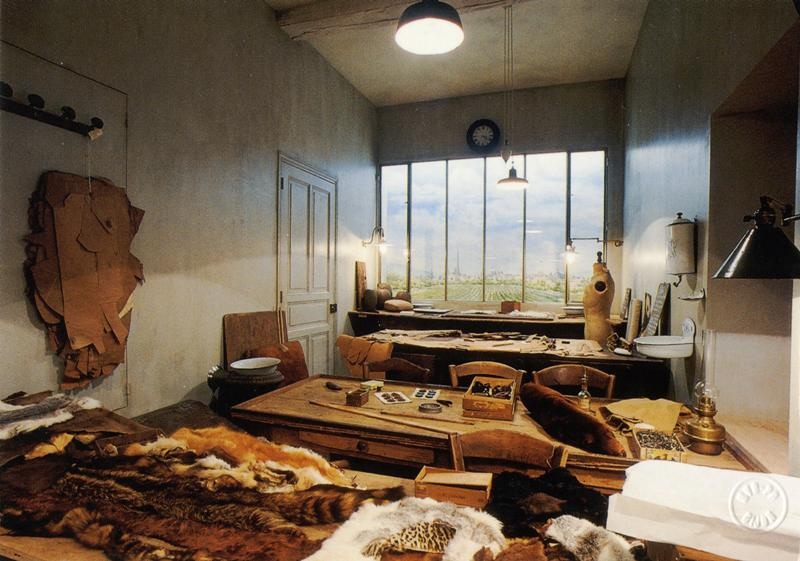
DIJON - Musée de la Vie Bourguignonne Perrin de Puycousin / Reconstitution de l'Atelier des Fourrures Bailly / (...)
Description
Carte postale d'une vue en couleur de l'intérieur de la reconstitution de l'atelier des Fourrures Bailly au Musée de la Vie Bourguignonne à Dijon (21).
Subject depicted
vue d'intérieur,vue d'intérieur,musée de la vie Bourguignonne,atelier,magasin,bailly (magasin),fourrure,tourisme
About this work
The artwork titled "DIJON - Musée de la Vie Bourguignonne Perrin de Puycousin / Reconstitution de l'Atelier des Fourrures Bailly / (...)", attributed to anonyme;;Darantière (Imprimerie) (imprimerie), is preserved at musée de la vie bourguignonne. Referenced in the Joconde database, this work contributes to the national artistic heritage preserved in labeled museums.
Technique and Materials
This work belongs to the field: vie sociale - culturelle, photographie. It was created using the following materials and techniques: papier, phototypie, imprimé (papier/carton-pâte). Its period of creation is identified as: 20 e Century, quatrième quart.
The Conserving Museum
musée de la vie bourguignonne preserves this work in its collections. As a « Musée de France » labeled museum, the institution is committed to preserving and showcasing the pieces entrusted to it.
Data sources
The information about this work comes from the Joconde database of the Ministry of Culture, published on data.culture.gouv.fr under the Open License v2.0 (Etalab).
About this artwork
Au musée de la vie bourguignonne, on trouve DIJON - Musée de la Vie Bourguignonne Perrin de Puycousin / Reconstitution de l'Atelier des Fourrures Bailly / (..), oeuvre de anonyme;;Darantière (Imprimerie) (imprimerie). papier, phototypie, imprimé (papier/carton-pâte) est le procédé utilisé pour cette oeuvre. Ses dimensions sont Hauteur en cm 10,5 ; Largeur en cm 15. Le motif représenté : vue d'intérieur,vue d'intérieur,musée de la vie Bourguignonne,atelier,magasin,bailly (magasin),fourrure,tourisme. La création de cette oeuvre remonte à la 20 e siècle, quatrième quart. Détail à relever : Darantière (Imprimerie) : Fondée en 1820 par Noellat qui fit paraître de nombreuses publications locales, l'imprimerie fut reprise par Nicolas Odobé et cédée en 1830 à Charles Brugnot, qui édita plusieurs ouvrages de Piron. Sa veuve lui succéda. En 1838, Mme Brugnot épousa un typographe, M. Duvallet, dont les ateliers furent installés place d'Armes. En 1844 , Duvallet vendit son imprimerie. Loireau-Feuchot, son successeur, employa le premier à Dijon, les presses mécaniques et contribua puissamment à donner à l'imprimerie dijonnaise l'impulsion importante qu'elle a prise aujourd'hui. En 1859, J.E. Rabutot lui succéda, place Saint-Jean, où depuis 1850 l'imprimerie avait été transportée ; ses impressions en plusieurs couleurs furent citées. Victor Darantière reprit les presses de Rabutot en 1871 et alla habiter l'ancien hôtel de Chabot-Charny (cf. 2011.6.2) Maurice Darantière transfère la société au 13 rue Paul Cabet. Bernard d'Avout reprend l'imprimerie en 1928. Claude d'Arbaumont la déménage à Quetigny en 1960.
Creation context
anonyme;;Darantière (Imprimerie) (imprimerie) conçoit DIJON - Musée de la Vie Bourguignonne Perrin de Puycousin / Reconstitution de l'Atelier des Fourrures Bailly / (...) dans un environnement artistique façonné par la 20 e siècle, quatrième quart. Cette pièce, conservée au musée de la vie bourguignonne, porte l'empreinte des débats esthétiques et des innovations techniques qui animent alors la scène culturelle. Comprendre ce contexte permet d'apprécier pleinement la portée de l'œuvre.
See also
Related pages
Frequently Asked Questions
Everything you need to know
The work « DIJON - Musée de la Vie Bourguignonne Perrin de Puycousin / Reconstitution de l'Atelier des Fourrures Bailly / (...) » is held at musée de la vie bourguignonne, an institution labeled as a « Musée de France ». This label guarantees the quality of collection preservation and accessibility to the public.
This artwork is attributed to anonyme;;Darantière (Imprimerie) (imprimerie) according to the Joconde database of the Ministry of Culture. Check the artist's profile on DellArte to discover their background, other works, and museums that house their creations.
Data comes from the Joconde database of the Ministry of Culture (data.culture.gouv.fr), distributed under Open License v2.0 (Etalab). The records are provided by the museums and validated by the French Museum Service.
The work is part of the collections of a « Musée de France »-labelled museum. Contact the hosting museum to verify if the work is currently on display or held in reserve. Opening hours and admission fees are available on the museum's official website.
Image usage rights depend on the work, the artist, and the museum. If the author died more than 70 years ago, the work is in the public domain in France. Text data (title, technique, dimensions) are under Open License and freely reusable.
The work's record contains information from the Joconde database: title, author, technique and materials used, dimensions, creation period, artistic domain, inventory number, hosting museum, and when available, a digital image.
Use the DellArte contact page to report errors. Since data comes from the Joconde database, major corrections (attribution, dating, technique) should be reported to the Ministry of Culture via data.culture.gouv.fr.
The Joconde database lists over 700,000 works. Use the search bar to find works by the same artist, technique, or period. Each museum entry provides access to its entire digitized collection.
The image resolution depends on the museum's digitization program. Some museums offer high-resolution images through their own digital platforms. The image displayed on DellArte comes from the Joconde database at its dissemination resolution.
Museum shops often sell reproductions of their main works (postcards, posters, art books). For public domain works, services like RMN-Grand Palais (photo.rmn.fr) offer professional photographic reproductions.