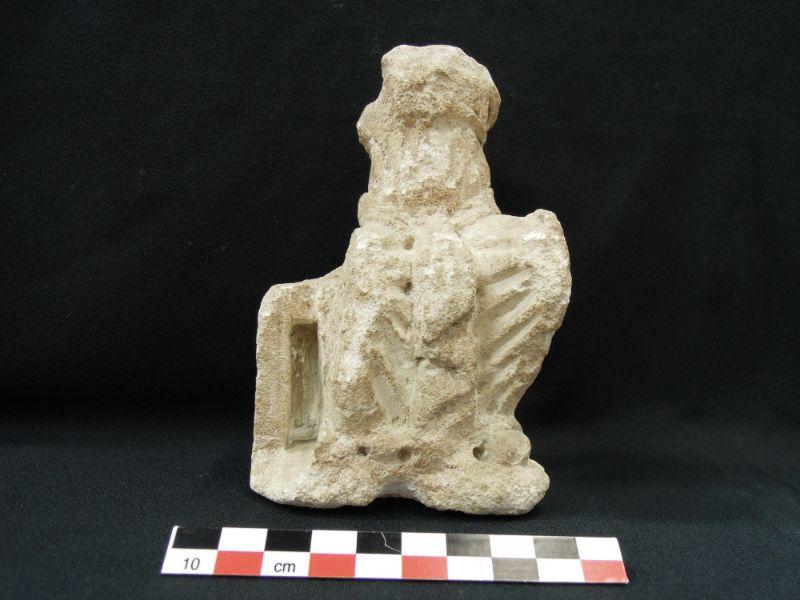
Déesse-mère assise
Description
La statuette est fortement usée sur toute sa surface, en particulier à droite. La tête, les bras, le pied droit et une partie de l'assise ont disparu. Un éclat marque une grande partie de la jambe droite. Elle est égrisée sur toute sa surface. Le sculpteur a utilisé le modelé et l'incision. ; Femme assise sur un siège à pieds droits dont les côtés et l'avant sont ajourés tandis que la face arrière est pleine. Le dossier est constitué d'un large montant central sur lequel elle est appuyée. Si des montants latéraux complétaient l'assise, ils ont disparu. La femme est vêtue d'une tunique longue qui repose sur les cuisses avant de tomber en larges plis jusqu'aux pieds qu'elle cache à moitié. Celle-ci est serrée par une ceinture sous la poitrine où les plis sont en U tandis qu'ils sont droits sur le ventre. Une large ceinture, à moins qu'il s'agisse du pan d'un manteau, entoure la taille et est nouée entre les deux jambes. Celle-ci tombe en un large pan ondulé jusqu'aux pieds. La partie inférieure du vêtement est animée par les nombreux plis obliques plus profondément creusés entre les jambes et les pans de la ceinture. Le drapé laisse ainsi deviner la forme des jambes et souligne l'écartement plus important de la jambe gauche qui dissimule d'ailleurs l'assise. Le pied gauche est chaussé. La facture de cette déesse montre une bonne maîtrise technique en particulier dans le rendu du vêtement et de l'attitude générale qui se libère de la frontalité. (Texte de M. Florian Blanchard, Dr en histoire ancienne).
About this work
The artwork titled "Déesse-mère assise" is preserved at Historial de la Vendée. This piece is listed in the Joconde database of the Ministry of Culture, which catalogues the works held in French museums.
Technique and Materials
This work belongs to the field: archéologie, gallo-romain. It was created using the following materials and techniques: pierre (blanc, calcaire).
The Conserving Museum
"Déesse-mère assise" is preserved at Historial de la Vendée, an institution bearing the « Musée de France » label. This label ensures that the collections are managed rigorously in terms of conservation, inventory, and public accessibility.
Data sources
The information about this work comes from the Joconde database of the Ministry of Culture, published on data.culture.gouv.fr under the Open License v2.0 (Etalab).
About this artwork
Le Historial de la Vendée conserve Déesse-mère assise. pierre (blanc, calcaire) est le procédé utilisé pour cette oeuvre. La pièce a pour dimensions H. 150 mm, l. 100 mm, E. 80 mm.
Creation context
C'est sous l'influence de la que donne vie à Déesse-mère assise. Aujourd'hui parmi les pièces les plus visitées du Historial de la Vendée, cette œuvre rappelle un chapitre fondamental de l'histoire artistique, celui d'une époque où la création se réinvente en permanence.
See also
Technique
Domain
Related pages
Frequently Asked Questions
Everything you need to know
The work « Déesse-mère assise » is held at Historial de la Vendée, an institution labeled as a « Musée de France ». This label guarantees the quality of collection preservation and accessibility to the public.
This artwork is attributed to according to the Joconde database of the Ministry of Culture. Check the artist's profile on DellArte to discover their background, other works, and museums that house their creations.
Data comes from the Joconde database of the Ministry of Culture (data.culture.gouv.fr), distributed under Open License v2.0 (Etalab). The records are provided by the museums and validated by the French Museum Service.
The work is part of the collections of a « Musée de France »-labelled museum. Contact the hosting museum to verify if the work is currently on display or held in reserve. Opening hours and admission fees are available on the museum's official website.
Image usage rights depend on the work, the artist, and the museum. If the author died more than 70 years ago, the work is in the public domain in France. Text data (title, technique, dimensions) are under Open License and freely reusable.
The work's record contains information from the Joconde database: title, author, technique and materials used, dimensions, creation period, artistic domain, inventory number, hosting museum, and when available, a digital image.
Use the DellArte contact page to report errors. Since data comes from the Joconde database, major corrections (attribution, dating, technique) should be reported to the Ministry of Culture via data.culture.gouv.fr.
The Joconde database lists over 700,000 works. Use the search bar to find works by the same artist, technique, or period. Each museum entry provides access to its entire digitized collection.
The image resolution depends on the museum's digitization program. Some museums offer high-resolution images through their own digital platforms. The image displayed on DellArte comes from the Joconde database at its dissemination resolution.
Museum shops often sell reproductions of their main works (postcards, posters, art books). For public domain works, services like RMN-Grand Palais (photo.rmn.fr) offer professional photographic reproductions.