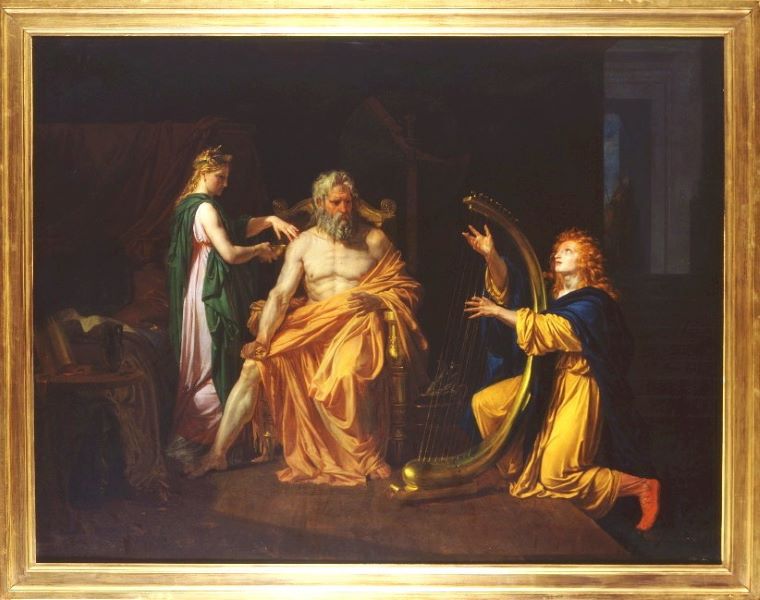
David et Saül ; David apaisant Saül (titre ancien)
School : France
Description
La scène comporte trois personnages, Saül assisté d’une servante et le jeune David représenté en train de jouer de la harpe. " Toutes les fois que l’Esprit malin tourmentait Saül, David prenait sa harpe et en jouait ; Saül respirait alors plus à l’aise et se sentait soulagé " (I. Rois, 16.). David est le harpiste le plus célèbre de l’histoire religieuse. Le Livre de Samuel exalte le talent précoce du petit berger qui, par la grâce des sons suaves de sa harpe, parvenait seul à calmer les crises de délire de Saül. Sur la gauche, mais presque au centre de la composition, le roi Saül est représenté le torse nu, assis sur un trône, face au spectateur. Saül est vêtu d’une grande draperie jaune-orangé qui enveloppe le bas de son corps. Sur la droite, David, tourné vers le roi mélancolique, joue de la harpe, le genou gauche poser à terre. Sur la gauche, une servante est représentée debout, tout près du roi. Cette jeune femme aux longs cheveux blonds tient un bol en métal muni de petites anses dans la main droite. Dans ce bol on entre-aperçoit des plantes. La jeune femme tente certainement d’apaiser la mélancolie de Saül par un autre moyen que la musique. La scène se déroule dans un intérieur sombre. Le mouvement des mains de David qui ondulent sur les cordes de l’instrument s’accorde avec celui des mains de la servante. La gestualité de ces deux personnages s’oppose à la " rigidité " qui se dégage du corps de Saül.
Subject depicted
figures bibliques (David, jeune homme, Saül, vieillard, assis, trône, nu, femme, servante, vêtements à l'antique),harpe,intérieur.
About this work
The artwork titled "David et Saül ; David apaisant Saül (titre ancien)", attributed to CHERY Philippe, is preserved at musée municipal. Referenced in the Joconde database, this work contributes to the national artistic heritage preserved in labeled museums.
Technique and Materials
This work belongs to the field: beaux-arts, peinture. It was created using the following materials and techniques: toile, peinture à l'huile. Its period of creation is identified as: 1st quarter 19th Century.
The Conserving Museum
"David et Saül ; David apaisant Saül (titre ancien)" is preserved at musée municipal, an institution bearing the « Musée de France » label. This label ensures that the collections are managed rigorously in terms of conservation, inventory, and public accessibility.
Data sources
The information about this work comes from the Joconde database of the Ministry of Culture, published on data.culture.gouv.fr under the Open License v2.0 (Etalab).
About this artwork
Au musée municipal, on trouve David et Saül ; David apaisant Saül (titre ancien), oeuvre de CHERY Philippe. La technique employée est : toile, peinture à l'huile. Dimensions : H. 117 cm ; l. 150 cm (avec cadre) ; H. 105,5 cm ; l. 138 cm (sans cadre). Cette pièce a pour sujet : figures bibliques (David, jeune homme, Saül, vieillard, assis, trône, nu, femme, servante, vêtements à l'antique),harpe,intérieur. L'oeuvre date de la 1er quart 19e siècle. Concernant cette pièce : Paris, 1759 ; Paris, 1838.
Creation context
La création de David et Saül ; David apaisant Saül (titre ancien) par CHERY Philippe s'inscrit dans le climat culturel et intellectuel de la 1er quart 19e siècle. Conservée au musée municipal, cette œuvre porte en elle les empreintes d'un moment charnière de l'histoire de l'art, où les artistes explorent de nouvelles formes d'expression et repoussent les limites de leur pratique.
See also
Technique
Domain
Author
Related pages
Frequently Asked Questions
Everything you need to know
The work « David et Saül ; David apaisant Saül (titre ancien) » is held at musée municipal, an institution labeled as a « Musée de France ». This label guarantees the quality of collection preservation and accessibility to the public.
This artwork is attributed to CHERY Philippe according to the Joconde database of the Ministry of Culture. Check the artist's profile on DellArte to discover their background, other works, and museums that house their creations.
Data comes from the Joconde database of the Ministry of Culture (data.culture.gouv.fr), distributed under Open License v2.0 (Etalab). The records are provided by the museums and validated by the French Museum Service.
The work is part of the collections of a « Musée de France »-labelled museum. Contact the hosting museum to verify if the work is currently on display or held in reserve. Opening hours and admission fees are available on the museum's official website.
Image usage rights depend on the work, the artist, and the museum. If the author died more than 70 years ago, the work is in the public domain in France. Text data (title, technique, dimensions) are under Open License and freely reusable.
The work's record contains information from the Joconde database: title, author, technique and materials used, dimensions, creation period, artistic domain, inventory number, hosting museum, and when available, a digital image.
Use the DellArte contact page to report errors. Since data comes from the Joconde database, major corrections (attribution, dating, technique) should be reported to the Ministry of Culture via data.culture.gouv.fr.
The Joconde database lists over 700,000 works. Use the search bar to find works by the same artist, technique, or period. Each museum entry provides access to its entire digitized collection.
The image resolution depends on the museum's digitization program. Some museums offer high-resolution images through their own digital platforms. The image displayed on DellArte comes from the Joconde database at its dissemination resolution.
Museum shops often sell reproductions of their main works (postcards, posters, art books). For public domain works, services like RMN-Grand Palais (photo.rmn.fr) offer professional photographic reproductions.