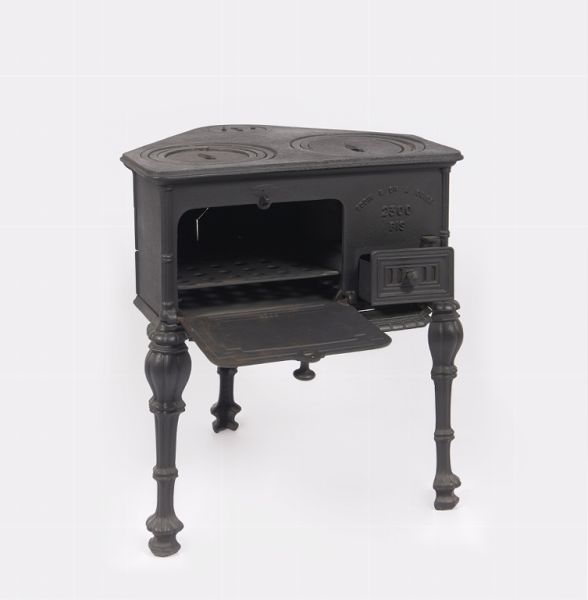
Cuisinière n° 2300 B triangulaire
Description
Les cuisinières triangulaires n° 2298 B, 2299 B, 2300 B et 2301 B apparaissent dans l'Album de reconstitution n° 1 de la Société du Familistère de Guise Colin & Cie de 1921 et font partie de la première série de production. Il s'agit en réalité de la recréation d'anciens modèles dont les étalons ont disparu pendant la guerre de 1914-1918. En effet, lors de la Première guerre mondiale, les usines de la Société ont été détruites en grande partie et la production a cessé. Certains modèles ont alors été récréés et leur numéro de modèle a été augmenté de 2000, comme cela a été présenté aux clients dans l'Album général de reconstitution n°1 de 1921, p.3 : "Avis important. Les appareils dont les étalons sont disparus pendant la guerre [...] portent maintenant sur le présent album le même numéro augmenté de 2000 [...] ". La cuisinière ici présentée, la n° 2300 B, est une recréation du modèle n° 300 B qui figure dès 1898 dans l'Album général de vente de la Société du Familistère de Guise. En plus de faire partie des plus anciens modèles de cuisinières produits par l'usine, cette cuisinière se distingue par sa forme triangulaire caractéristique. Elle possède un foyer rond à houille avec mouvement de dégrillage et le four est chauffé par le rayonnement du foyer. La buse est mobile et peut-être placée dessous ou derrière, ce qui la distingue du modèle n° 2300. La porte est abattant et les trois trous sur le dessus servent pour la cuisson des aliments. Ces cuisinières étaient toujours livrées en fonte ordinaire et sans galerie, comme celle conservée dans nos collections.
About this work
The artwork titled "Cuisinière n° 2300 B triangulaire", attributed to Société du Familistère de Guise de Guise Colin & Cie, is preserved at Familistère de Guise. This piece is listed in the Joconde database of the Ministry of Culture, which catalogues the works held in French museums.
Technique and Materials
This work belongs to the field: vie domestique, énergie, métallurgie. It was created using the following materials and techniques: Fonte de fer. Its period of creation is identified as: 1st quarter 20th Century.
The Conserving Museum
Familistère de Guise preserves this work in its collections. As a « Musée de France » labeled museum, the institution is committed to preserving and showcasing the pieces entrusted to it.
Data sources
The information about this work comes from the Joconde database of the Ministry of Culture, published on data.culture.gouv.fr under the Open License v2.0 (Etalab).
About this artwork
Cuisinière n° 2300 B triangulaire, oeuvre de vie domestique, énergie, métallurgie, est due à Société du Familistère de Guise de Guise Colin & Cie et conservée au Familistère de Guise. Le procédé technique employé est Fonte de fer. Format : Hauteur en cm : 60,5 ; Largeur en cm : 54,5 ; Profondeur en cm : 51. La création de cette oeuvre remonte à la 1er quart 20e siècle.
Creation context
La création de Cuisinière n° 2300 B triangulaire s'inscrit dans un moment charnière de la 1er quart 20e siècle. Société du Familistère de Guise de Guise Colin & Cie y répond aux interrogations de son temps avec une acuité remarquable, produisant une œuvre dont le Familistère de Guise assure aujourd'hui la conservation et la diffusion auprès du public. Le contexte de création enrichit la compréhension de cette pièce majeure.
See also
Technique
Related pages
Frequently Asked Questions
Everything you need to know
The work « Cuisinière n° 2300 B triangulaire » is held at Familistère de Guise, an institution labeled as a « Musée de France ». This label guarantees the quality of collection preservation and accessibility to the public.
This artwork is attributed to Société du Familistère de Guise de Guise Colin & Cie according to the Joconde database of the Ministry of Culture. Check the artist's profile on DellArte to discover their background, other works, and museums that house their creations.
Data comes from the Joconde database of the Ministry of Culture (data.culture.gouv.fr), distributed under Open License v2.0 (Etalab). The records are provided by the museums and validated by the French Museum Service.
The work is part of the collections of a « Musée de France »-labelled museum. Contact the hosting museum to verify if the work is currently on display or held in reserve. Opening hours and admission fees are available on the museum's official website.
Image usage rights depend on the work, the artist, and the museum. If the author died more than 70 years ago, the work is in the public domain in France. Text data (title, technique, dimensions) are under Open License and freely reusable.
The work's record contains information from the Joconde database: title, author, technique and materials used, dimensions, creation period, artistic domain, inventory number, hosting museum, and when available, a digital image.
Use the DellArte contact page to report errors. Since data comes from the Joconde database, major corrections (attribution, dating, technique) should be reported to the Ministry of Culture via data.culture.gouv.fr.
The Joconde database lists over 700,000 works. Use the search bar to find works by the same artist, technique, or period. Each museum entry provides access to its entire digitized collection.
The image resolution depends on the museum's digitization program. Some museums offer high-resolution images through their own digital platforms. The image displayed on DellArte comes from the Joconde database at its dissemination resolution.
Museum shops often sell reproductions of their main works (postcards, posters, art books). For public domain works, services like RMN-Grand Palais (photo.rmn.fr) offer professional photographic reproductions.