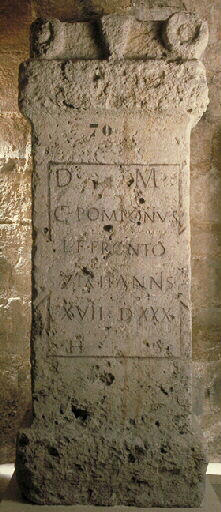
Cippe de C. Pomponius Fronto
Description
Calcaire poreux gravé. Le cippe est composé de trois éléments : un socle saillant, un dé sur lequel se trouve l'inscription et un couronnement saillant lui aussi. L'ensemble peut ainsi s'inscrire dans un parallélépipède. Le socle est formé d'une large et haute base détachée de la partie suivante par un chanfrein. C'est au centre de la face antérieure du dé, terminé par un congé, que l'on a placé, dans un cartouche à queues d'aronde, l'inscription suivante: D(iis) M(anibus) / C(aïus) Pomponius / L(ucii) F(ilius) Fronto / Vixit annis / XVII d(iebus) XXX / H(ic) S(itus est) 'Aux dieux Mânes. Caïus Pomponius Fronto, fils de Lucius Pomponius; il vécut 17 ans et 30 jours; son corps repose ici.' Le couronnement représente celui d'un autel: il est composé d'un large bandeau supportant une table à offrandes. Celle-ci est formée de deux enroulements aux extrémités encadrant une cavité aménagée sur la surface supérieure. Cette cavité rectangulaire comporte un canal d'évacuation dirigé vers l'arrière du monument. Cette installation servait sans nul doute au moment des profusiones en l'honneur du défunt. La table à offrandes est également visible de face. Elle se présente comme un second bandeau devant lequel le sculpteur a placé un triangle renversé. Selon J. Guerrier, il s'agirait d'une erreur de compréhension du tailleur, qui aurait retourné le triangle stylisé d'un fronton, sans comprendre véritablement sa signification architectonique. Mais, pourquoi ne verrions-nous pas plutôt là, le retour sur la face antérieure de cette cavité, transformé à l'ocasion en un élément décoratif ? Il se pourrait également qu'il s'agise d'un simple épannelage d'un décor quelconque. Le tailleur a donné l'impression de pétrification d'un autel par le rendu des enroulements qui font penser aux coussins situés sur la table à offrandes.(BERGER Stéphanie)
Subject depicted
ornement à forme architecturale (cartouche orn, autel)
About this work
The artwork titled "Cippe de C. Pomponius Fronto" is preserved at musée municipal. This piece is listed in the Joconde database of the Ministry of Culture, which catalogues the works held in French museums.
Technique and Materials
This work belongs to the field: archéologie, gallo-romain, sculpture, épigraphie, croyances - coutumes. It was created using the following materials and techniques: calcaire, taillé, gravé. Its period of creation is identified as: 1er siècle.
The Conserving Museum
"Cippe de C. Pomponius Fronto" is preserved at musée municipal, an institution bearing the « Musée de France » label. This label ensures that the collections are managed rigorously in terms of conservation, inventory, and public accessibility.
Data sources
The information about this work comes from the Joconde database of the Ministry of Culture, published on data.culture.gouv.fr under the Open License v2.0 (Etalab).
About this artwork
Le musée municipal conserve Cippe de C. Pomponius Fronto. calcaire, taillé, gravé est le procédé utilisé pour cette oeuvre. Mesures : H. 167 ; La. 63 ; E. 63 ; H. 108 (dé) ; La. 53 (dé) ; H. 65 (cartouche) ; La. 44 (cartouche). Le thème de l'oeuvre est : ornement à forme architecturale (cartouche orn, autel). Cette réalisation date de la 1er siècle.
Creation context
La 1er siècle offre à le terreau fertile pour concevoir Cippe de C. Pomponius Fronto. Cette œuvre, désormais joyau du musée municipal, est le fruit d'un dialogue constant entre l'artiste et les idées de son siècle. Le contexte de création confère à la pièce une dimension historique qui enrichit considérablement sa lecture.
See also
Technique
Related pages
Frequently Asked Questions
Everything you need to know
The work « Cippe de C. Pomponius Fronto » is held at musée municipal, an institution labeled as a « Musée de France ». This label guarantees the quality of collection preservation and accessibility to the public.
This artwork is attributed to according to the Joconde database of the Ministry of Culture. Check the artist's profile on DellArte to discover their background, other works, and museums that house their creations.
Data comes from the Joconde database of the Ministry of Culture (data.culture.gouv.fr), distributed under Open License v2.0 (Etalab). The records are provided by the museums and validated by the French Museum Service.
The work is part of the collections of a « Musée de France »-labelled museum. Contact the hosting museum to verify if the work is currently on display or held in reserve. Opening hours and admission fees are available on the museum's official website.
Image usage rights depend on the work, the artist, and the museum. If the author died more than 70 years ago, the work is in the public domain in France. Text data (title, technique, dimensions) are under Open License and freely reusable.
The work's record contains information from the Joconde database: title, author, technique and materials used, dimensions, creation period, artistic domain, inventory number, hosting museum, and when available, a digital image.
Use the DellArte contact page to report errors. Since data comes from the Joconde database, major corrections (attribution, dating, technique) should be reported to the Ministry of Culture via data.culture.gouv.fr.
The Joconde database lists over 700,000 works. Use the search bar to find works by the same artist, technique, or period. Each museum entry provides access to its entire digitized collection.
The image resolution depends on the museum's digitization program. Some museums offer high-resolution images through their own digital platforms. The image displayed on DellArte comes from the Joconde database at its dissemination resolution.
Museum shops often sell reproductions of their main works (postcards, posters, art books). For public domain works, services like RMN-Grand Palais (photo.rmn.fr) offer professional photographic reproductions.