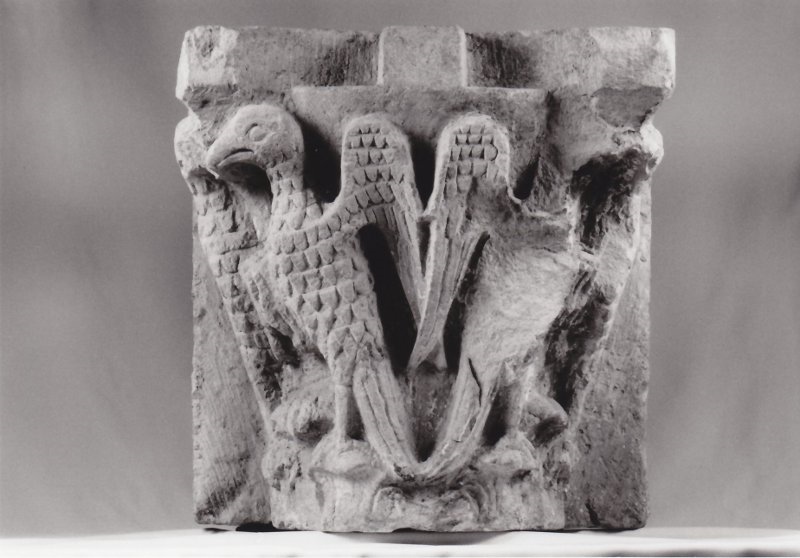
Chapiteau aux aigles
Description
Sur ce chapiteau de pilastre, quatre aigles s'affrontent deux à deux sous les angles de l'abaque, leurs grandes ailes à moité déployées, une patte relevée à hauteur du bréchet, l'autre posée sur un feuillage. Leur plumage se compose de motifs en forme d'écailles arrondies.Quelques longues plumes parallèles et traitées en aplat terminent les ailes et la queue. Le contour des yeux est incisé et le bec bien formé. A deux reprises on retrouve la représentation de ce rapace dans la sculpture conservée de Moutiers-saint-Jean : sur le chapiteau de l'offrande de Caïn et Abel et sur un chapiteau de pilastre où ils sont accouplés ; mais ils n'offrent guère d'aspects comparables aux oiseaux de ce chapiteau. Aussi, C. Sapin a-t-il proposé une datation "plus tardive par rapport aux ateliers connus de Moutiers-Saint-Jean" ; mais N. Stratford, en raison de ses dimensions, l'a associé aux six autres chapiteaux figurés provenant de la nef et de la croisée. En Bourgogne méridionale, quelques chapiteaux reproduisent ces oiseaux avec une patte repliée sous le poitrail mais au sein de compositions plus élaborées et d'une facture de plus grande qualité. La simplicité de la composition de Moutiers se retrouve sur un médaillon d'écoinçon datant du milieu du XIIe siècle, du cloître de Cardena en Castille et dont J.L. Senra a démontré l'influence clunisienne. (Frédérique Bouvard). (JANNET Monique et JOUBERT Fabienne (dir.), Sculpture médiévale en Bourgogne - Collection lapidaire du Musée archéologique de Dijon, EUD, 2000)
Subject depicted
représentation animalière (aigle, rapace)
About this work
The artwork titled "Chapiteau aux aigles" is preserved at musée archéologique. This piece is listed in the Joconde database of the Ministry of Culture, which catalogues the works held in French museums.
Technique and Materials
This work belongs to the field: archéologie, architecture, sculpture, médiéval. It was created using the following materials and techniques: calcaire (taillé). Its period of creation is identified as: 1ère moitié 12th Century.
The Conserving Museum
"Chapiteau aux aigles" is preserved at musée archéologique, an institution bearing the « Musée de France » label. This label ensures that the collections are managed rigorously in terms of conservation, inventory, and public accessibility.
Data sources
The information about this work comes from the Joconde database of the Ministry of Culture, published on data.culture.gouv.fr under the Open License v2.0 (Etalab).
About this artwork
Chapiteau aux aigles est une pièce de archéologie, architecture, sculpture, médiéval, au musée archéologique. calcaire (taillé). L'oeuvre présente les dimensions suivantes : Hauteur en cm 65 ; Largeur en cm 55 ; Profondeur en cm 64. Elle figure : représentation animalière (aigle, rapace). Cette pièce remonte à la 1ère moitié 12e siècle.
Creation context
Dans quel contexte a-t-il créé Chapiteau aux aigles ? La 1ère moitié 12e siècle constitue un moment de profonde effervescence créatrice, qui nourrit et stimule la démarche de l'artiste. Le musée archéologique, qui détient cette œuvre, permet au visiteur de comprendre les liens qui unissent la création artistique aux circonstances historiques de son émergence.
See also
Technique
Related pages
Frequently Asked Questions
Everything you need to know
The work « Chapiteau aux aigles » is held at musée archéologique, an institution labeled as a « Musée de France ». This label guarantees the quality of collection preservation and accessibility to the public.
This artwork is attributed to according to the Joconde database of the Ministry of Culture. Check the artist's profile on DellArte to discover their background, other works, and museums that house their creations.
Data comes from the Joconde database of the Ministry of Culture (data.culture.gouv.fr), distributed under Open License v2.0 (Etalab). The records are provided by the museums and validated by the French Museum Service.
The work is part of the collections of a « Musée de France »-labelled museum. Contact the hosting museum to verify if the work is currently on display or held in reserve. Opening hours and admission fees are available on the museum's official website.
Image usage rights depend on the work, the artist, and the museum. If the author died more than 70 years ago, the work is in the public domain in France. Text data (title, technique, dimensions) are under Open License and freely reusable.
The work's record contains information from the Joconde database: title, author, technique and materials used, dimensions, creation period, artistic domain, inventory number, hosting museum, and when available, a digital image.
Use the DellArte contact page to report errors. Since data comes from the Joconde database, major corrections (attribution, dating, technique) should be reported to the Ministry of Culture via data.culture.gouv.fr.
The Joconde database lists over 700,000 works. Use the search bar to find works by the same artist, technique, or period. Each museum entry provides access to its entire digitized collection.
The image resolution depends on the museum's digitization program. Some museums offer high-resolution images through their own digital platforms. The image displayed on DellArte comes from the Joconde database at its dissemination resolution.
Museum shops often sell reproductions of their main works (postcards, posters, art books). For public domain works, services like RMN-Grand Palais (photo.rmn.fr) offer professional photographic reproductions.