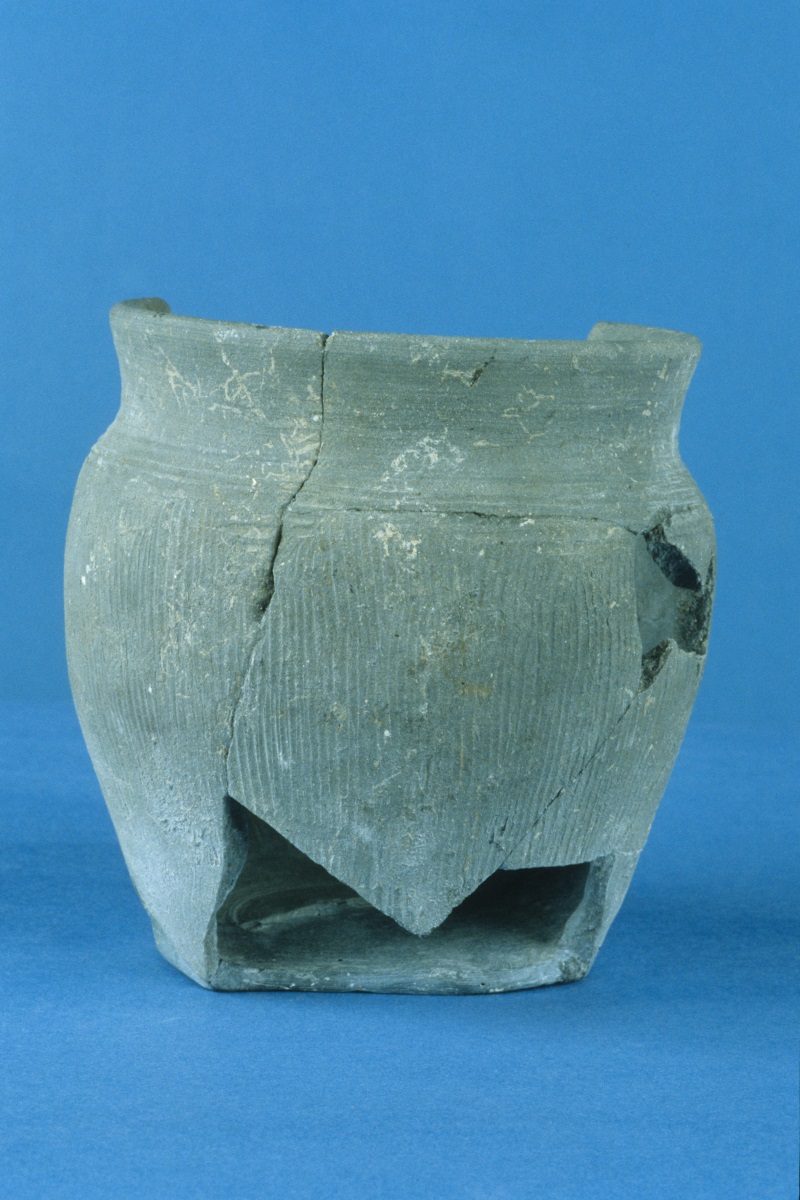
Céramique commune ; Céramique indigène
Description
Il s'agit d'une de ces urnes peignées de tradition indigène fabriquées à partir de la fin du Ier siècle avant J.-C. qui, selon M. Vidal, diffèrent des urnes peignées gauloises du IIe siècle avant J.-C. par un volume réduit, un col moins haut et un décor simplifié. L'abondance des exemplaires de ce genre dans plusieurs niveaux augustéens et tibériens rendant peu probable l'éventualité d'une présence anachronique dite résiduelle, il semble que la production de ce modèle d'urne se soit prolongée au moins jusqu'à la fin des années 30. La pâte grise comporte un abondant dégraissant assez grossier. La panse ovoïde a été peignée sans grand soin, plutôt suivant la verticale. La partie supérieure de l'épaule présente quelques rainures globalement horizontales au tracé irrégulier. Le col court se termine par un bord légèrement divergent à lèvre simple arrondie. Le fond est plat. Christophe Filhol, Archéologie toulousaine, 1995 ; Urne en céramique commune à pâte grise non tournée de tradition indigène comportant un décor peigné d'après J. Catalo (dir.), Hôtel d'Assézat/n°4 rue Clémence-Isaure Toulouse, DFS de sauvetage urgent, AFAN Grand Sud-Ouest, SRA Midi Pyrénées, 1995
About this work
The artwork titled "Céramique commune ; Céramique indigène" is preserved at musée Saint-Raymond. Referenced in the Joconde database, this work contributes to the national artistic heritage preserved in labeled museums.
Technique and Materials
This work belongs to the field: archéologie, céramique, romain. It was created using the following materials and techniques: terre cuite (cuisson en réduction, non tournée). Its period of creation is identified as: 2nd quarter 1st Century av JC.
The Conserving Museum
"Céramique commune ; Céramique indigène" is preserved at musée Saint-Raymond, an institution bearing the « Musée de France » label. This label ensures that the collections are managed rigorously in terms of conservation, inventory, and public accessibility.
Data sources
The information about this work comes from the Joconde database of the Ministry of Culture, published on data.culture.gouv.fr under the Open License v2.0 (Etalab).
About this artwork
Au musée Saint-Raymond, on trouve Céramique commune ; Céramique indigène. Elle est réalisée avec la technique suivante : terre cuite (cuisson en réduction, non tournée). La pièce a pour dimensions Hauteur en cm 12,4 ; Diamètre en cm 12,8 ; Diamètre lèvre en cm 11 ; Diamètre fond en cm 8,5. L'oeuvre date de la 2e quart 1er siècle av JC.
Creation context
achève Céramique commune ; Céramique indigène dans un climat artistique profondément marqué par la 2e quart 1er siècle av JC. Le musée Saint-Raymond, qui en conserve l'original, perpétue ainsi la mémoire d'un moment essentiel de l'histoire de l'art, où les créateurs ont su répondre aux défis de leur époque avec inventivité et audace.
See also
Related pages
Frequently Asked Questions
Everything you need to know
The work « Céramique commune ; Céramique indigène » is held at musée Saint-Raymond, an institution labeled as a « Musée de France ». This label guarantees the quality of collection preservation and accessibility to the public.
This artwork is attributed to according to the Joconde database of the Ministry of Culture. Check the artist's profile on DellArte to discover their background, other works, and museums that house their creations.
Data comes from the Joconde database of the Ministry of Culture (data.culture.gouv.fr), distributed under Open License v2.0 (Etalab). The records are provided by the museums and validated by the French Museum Service.
The work is part of the collections of a « Musée de France »-labelled museum. Contact the hosting museum to verify if the work is currently on display or held in reserve. Opening hours and admission fees are available on the museum's official website.
Image usage rights depend on the work, the artist, and the museum. If the author died more than 70 years ago, the work is in the public domain in France. Text data (title, technique, dimensions) are under Open License and freely reusable.
The work's record contains information from the Joconde database: title, author, technique and materials used, dimensions, creation period, artistic domain, inventory number, hosting museum, and when available, a digital image.
Use the DellArte contact page to report errors. Since data comes from the Joconde database, major corrections (attribution, dating, technique) should be reported to the Ministry of Culture via data.culture.gouv.fr.
The Joconde database lists over 700,000 works. Use the search bar to find works by the same artist, technique, or period. Each museum entry provides access to its entire digitized collection.
The image resolution depends on the museum's digitization program. Some museums offer high-resolution images through their own digital platforms. The image displayed on DellArte comes from the Joconde database at its dissemination resolution.
Museum shops often sell reproductions of their main works (postcards, posters, art books). For public domain works, services like RMN-Grand Palais (photo.rmn.fr) offer professional photographic reproductions.