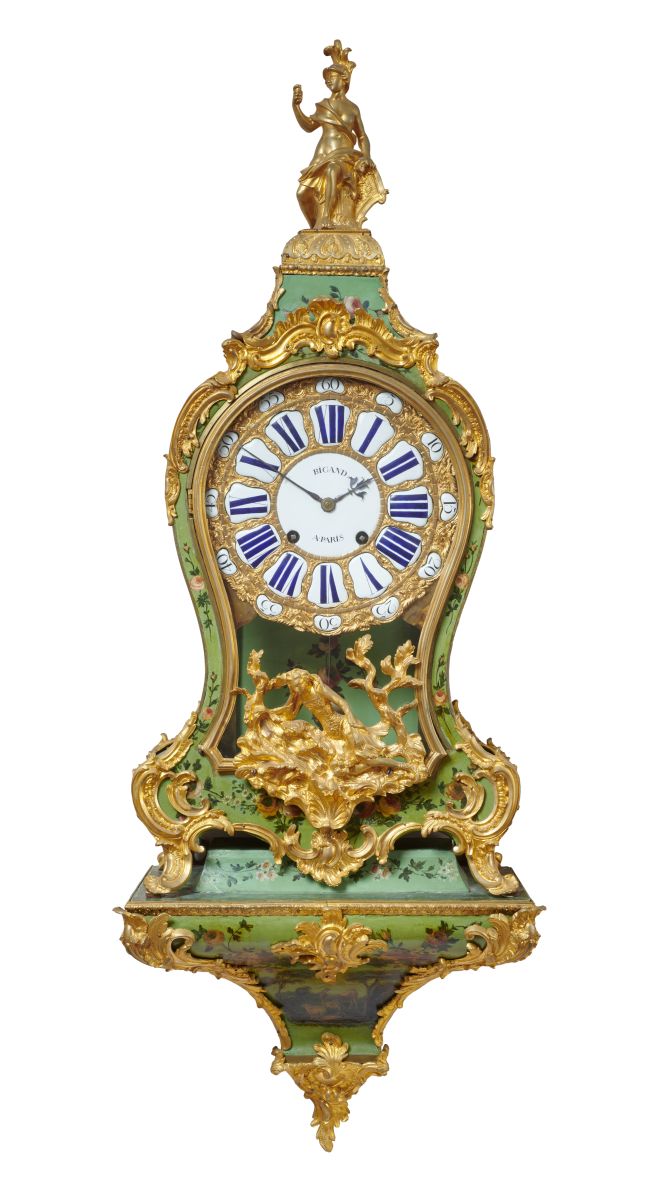
Cartel avec sa console
Description
Le cartel et sa console sont en vernis Martin à motif floral polychrome sur fond vert. Le vernis Martin est inventé par les frères Martin, à base de résine de copal. Cette technique est utilisée à partir de 1728, afin de concurrencer les laques de Chine et du Japon.#Le cartel est constitué d'une horloge sur pieds de forme violonée animée d'une riche ornementation en bronze ciselé et doré. Les bronzes présentent une Minerve au sommet, des feuillages d'acanthe ainsi que des agrafes à enroulement formant les pieds et le tablier. La façade s’ouvre par une porte ornée d'un bas-relief figurant une nymphe. Le cadran ciselé de fleurettes et rinceaux est orné de cartouches d'émail aux chiffres romains et arabes, et les aiguilles sont en acier ciselé. Le mouvement porte la signature gravée du maître horloger BIGAND A PARIS. L'ensemble repose sur une luxueuse console de forme évasée agrémenté de bronzes tels que des chutes feuillagées dans les angles et d'un culot pyramidal rocailleux.#Jean-Noël Bigand, reçu maitre le 27 février 1743, figure parmi les plus importants horlogers parisiens de la seconde moitié du XVIIIe siècle.
About this work
The artwork titled "Cartel avec sa console", attributed to Bigand Jean-Noël (17..-17..?), is preserved at musée Lambinet. This piece is listed in the Joconde database of the Ministry of Culture, which catalogues the works held in French museums.
Technique and Materials
This work belongs to the field: horlogerie, métrologie - instruments de mesure, arts décoratifs, orfèvrerie. It was created using the following materials and techniques: Bronze doré (vernis Martin). Its period of creation is identified as: 18th Century.
The Conserving Museum
musée Lambinet preserves this work in its collections. As a « Musée de France » labeled museum, the institution is committed to preserving and showcasing the pieces entrusted to it.
Data sources
The information about this work comes from the Joconde database of the Ministry of Culture, published on data.culture.gouv.fr under the Open License v2.0 (Etalab).
About this artwork
Cartel avec sa console est une oeuvre de Bigand Jean-Noël (17.-17.?), conservée au musée Lambinet. Le procédé technique employé est Bronze doré (vernis Martin). Elle mesure H. 96 cm, l. 43 cm, P. 21 cm#Cartel ; H. 39 cm, l. 47 cm, P. 25,3 cm#Console ; H. 129 cm, l. 47 cm, P. 25,3 cm#Mesure totale. La création de cette oeuvre remonte à la 18e siècle. Détail à relever : horloger.
Creation context
C'est durant la 18e siècle que Bigand Jean-Noël (17..-17..?) conçoit Cartel avec sa console, porté par un élan de renouvellement artistique qui traverse alors le monde de la création. Le musée Lambinet conserve aujourd'hui cette pièce née d'un moment historique singulier, où les conventions esthétiques sont remises en question et où de nouvelles voies s'ouvrent aux artistes les plus audacieux.
See also
Technique
Related pages
Frequently Asked Questions
Everything you need to know
The work « Cartel avec sa console » is held at musée Lambinet, an institution labeled as a « Musée de France ». This label guarantees the quality of collection preservation and accessibility to the public.
This artwork is attributed to Bigand Jean-Noël (17..-17..?) according to the Joconde database of the Ministry of Culture. Check the artist's profile on DellArte to discover their background, other works, and museums that house their creations.
Data comes from the Joconde database of the Ministry of Culture (data.culture.gouv.fr), distributed under Open License v2.0 (Etalab). The records are provided by the museums and validated by the French Museum Service.
The work is part of the collections of a « Musée de France »-labelled museum. Contact the hosting museum to verify if the work is currently on display or held in reserve. Opening hours and admission fees are available on the museum's official website.
Image usage rights depend on the work, the artist, and the museum. If the author died more than 70 years ago, the work is in the public domain in France. Text data (title, technique, dimensions) are under Open License and freely reusable.
The work's record contains information from the Joconde database: title, author, technique and materials used, dimensions, creation period, artistic domain, inventory number, hosting museum, and when available, a digital image.
Use the DellArte contact page to report errors. Since data comes from the Joconde database, major corrections (attribution, dating, technique) should be reported to the Ministry of Culture via data.culture.gouv.fr.
The Joconde database lists over 700,000 works. Use the search bar to find works by the same artist, technique, or period. Each museum entry provides access to its entire digitized collection.
The image resolution depends on the museum's digitization program. Some museums offer high-resolution images through their own digital platforms. The image displayed on DellArte comes from the Joconde database at its dissemination resolution.
Museum shops often sell reproductions of their main works (postcards, posters, art books). For public domain works, services like RMN-Grand Palais (photo.rmn.fr) offer professional photographic reproductions.