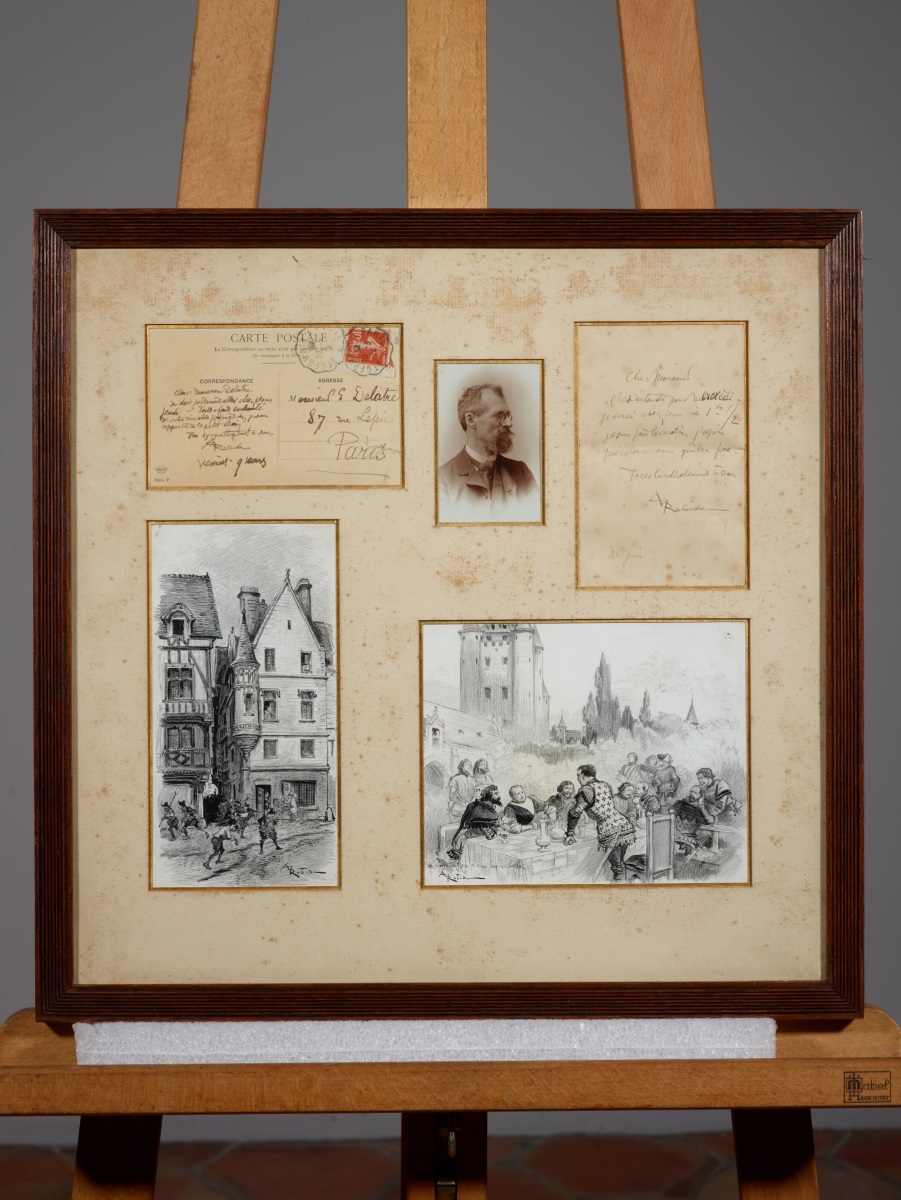
Cadre Albert Robida
Description
cadre contenant un portrait photographique, une carte postale, une lettre et deux gravures. ; Ce nouveau cadre monographique est l’un des plus complets du genre. Une photographie d’Albert Robida, placée en bonne place, s’accompagne d’une carte postale de l’artiste, datée du 9 mars 1914, dans laquelle Robida l’informe d’une venue au cours de laquelle il lui apportera un dessin. S’y ajoute une note du même à Delâtre au sujet d’une autre visite. Dans la partie basse du cadre, deux gravures signées par Albert Robida, dont l’une dédicacée à Eugène Delâtre, représentent des scènes d’imaginaire médiévale. Albert Robida (Compiègne, 1848-Neuilly-sur-Seine, 1926) était un peintre à la gouache, aquarelliste, graveur, lithographe, illustrateur, dessinateur et caricaturiste. Son style est souvent décrit comme la synthèse de multiples sources d’inspiration, combinées avec flexibilité et fantaisie, avec un goût de la narration qui ne cède en rien à l’exactitude historique. Les vues urbaines montmartroises d’Eugène Delâtre se rapprochent, par leur caractère pittoresque, de la démarche historiciste et romantique d’Albert Robida. Ces deux dessins que l’on nommera Combat dans une rue médiévale et Chevalier dans l’enclos du Temple, sont ainsi particulièrement représentatifs de la manière de Robida.
Subject depicted
mémoire,hommage,estampe,carte-postale,photographie,correspondance,artiste
About this work
The artwork titled "cadre Albert Robida", attributed to Imprimerie Eugène Delâtre, is preserved at musée d'art et d'histoire Paul Eluard. Referenced in the Joconde database, this work contributes to the national artistic heritage preserved in labeled museums.
Technique and Materials
This work belongs to the field: ethnologie, manuscrit, photographie, estampe. It was created using the following materials and techniques: papier, bois, encre, estampe, technique, tirage argentique. Its period of creation is identified as: 1ère moitié 20th Century.
The Conserving Museum
"cadre Albert Robida" is preserved at musée d'art et d'histoire Paul Eluard, an institution bearing the « Musée de France » label. This label ensures that the collections are managed rigorously in terms of conservation, inventory, and public accessibility.
Data sources
The information about this work comes from the Joconde database of the Ministry of Culture, published on data.gouv.fr under the Open License v2.0 (Etalab).
About this artwork
cadre Albert Robida est une pièce de ethnologie, manuscrit, photographie, estampe réalisée par Imprimerie Eugène Delâtre, au musée d'art et d'histoire Paul Eluard. La technique employée est : papier, bois, encre, estampe, technique, tirage argentique. Les dimensions de l'oeuvre sont : H. en cm 43,3 ; L. en cm 44,3. Sujet représenté : mémoire,hommage,estampe,carte-postale,photographie,correspondance,artiste. Sa période de création est la 1ère moitié 20e siècle.
Creation context
La création de cadre Albert Robida s'inscrit dans un moment charnière de la 1ère moitié 20e siècle. Imprimerie Eugène Delâtre y répond aux interrogations de son temps avec une acuité remarquable, produisant une œuvre dont le musée d'art et d'histoire Paul Eluard assure aujourd'hui la conservation et la diffusion auprès du public. Le contexte de création enrichit la compréhension de cette pièce majeure.
See also
Author
Related pages
Frequently Asked Questions
Everything you need to know
The work « cadre Albert Robida » is held at musée d'art et d'histoire Paul Eluard, an institution labeled as a « Musée de France ». This label guarantees the quality of collection preservation and accessibility to the public.
This artwork is attributed to Imprimerie Eugène Delâtre according to the Joconde database of the Ministry of Culture. Check the artist's profile on DellArte to discover their background, other works, and museums that house their creations.
Data comes from the Joconde database of the Ministry of Culture (data.gouv.fr), distributed under Open License v2.0 (Etalab). The records are provided by the museums and validated by the French Museum Service.
The work is part of the collections of a « Musée de France »-labelled museum. Contact the hosting museum to verify if the work is currently on display or held in reserve. Opening hours and admission fees are available on the museum's official website.
Image usage rights depend on the work, the artist, and the museum. If the author died more than 70 years ago, the work is in the public domain in France. Text data (title, technique, dimensions) are under Open License and freely reusable.
The work's record contains information from the Joconde database: title, author, technique and materials used, dimensions, creation period, artistic domain, inventory number, hosting museum, and when available, a digital image.
Use the DellArte contact page to report errors. Since data comes from the Joconde database, major corrections (attribution, dating, technique) should be reported to the Ministry of Culture via data.gouv.fr.
The Joconde database lists over 700,000 works. Use the search bar to find works by the same artist, technique, or period. Each museum entry provides access to its entire digitized collection.
The image resolution depends on the museum's digitization program. Some museums offer high-resolution images through their own digital platforms. The image displayed on DellArte comes from the Joconde database at its dissemination resolution.
Museum shops often sell reproductions of their main works (postcards, posters, art books). For public domain works, services like RMN-Grand Palais (photo.rmn.fr) offer professional photographic reproductions.