Bébé jumeau fillette
Description
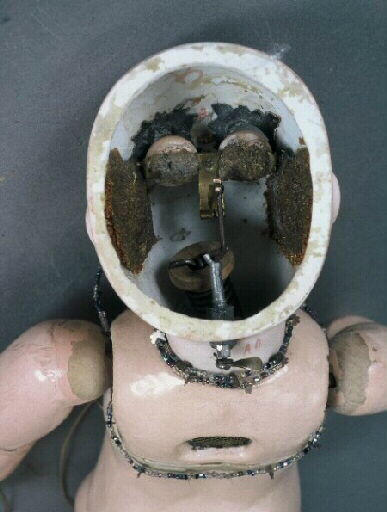
Corps de la poupée en composition (papier mâché) peinte, membres en bois. Une bande de cuir assure l'assemblage des deux parties du corps (il a été découpé pour introduire le mécanisme sonore). Mécanisme pour émettre un son : fil, verre. Tête de la poupée en biscuit de porcelaine moulé. Yeux en verre. Mélange de sciure de bois et de colle de peau fixant le système des yeux dormeurs dans la tête. Perruque de la poupée en cheveux cousus sur un tissu. L'ensemble est posé sur une calotte en liège et collé au pourtour du crâne avec de la colle de peau. Vêtements en coton, chaussures en cuir, collier en perles ; Poupée à articulations 'boule', corps en composition. Tête en biscuit. Yeux dormeurs bleus. Cils, sourcils, bouches peints. Perruque en mohair rapportée. Deux ficelles partent de la taille (côté gauche) qui permettent d'émettre un son lorsque l'on tire dessus. Une bande de cuir entoure le corps au niveau de la poitrine. Grille entre les omoplates. La poupée porte des chaussures noires, des chaussettes marron, un pantalon à coulisse, une chemise bordée de dentelle avec un ruban au cou, un collier de perle de rocaille, un bonnet
Subject depicted
figure (fillette)
About this work
The artwork titled "Bébé jumeau fillette", attributed to Société Jumeau et cie (fabricant), is preserved at musée des arts décoratifs. Referenced in the Joconde database, this work contributes to the national artistic heritage preserved in labeled museums.
Technique and Materials
This work belongs to the field: jeux - jouets. It was created using the following materials and techniques: papier mâché, bois, peau, moulage, peint, fil, verre, biscuit, moulage, verre, sciure, soufflé, collage, cheveu, liège, fibre végétale, collage, tissu, peau, coton, verre, maille, dentelle. Its period of creation is identified as: 4th quarter 19th Century.
The Conserving Museum
musée des arts décoratifs preserves this work in its collections. As a « Musée de France » labeled museum, the institution is committed to preserving and showcasing the pieces entrusted to it.
Data sources
The information about this work comes from the Joconde database of the Ministry of Culture, published on data.culture.gouv.fr under the Open License v2.0 (Etalab).
About this artwork
Le musée des arts décoratifs conserve Bébé jumeau fillette, oeuvre de Société Jumeau et cie (fabricant). Il s'agit d'une oeuvre en papier mâché, bois, peau, moulage, peint, fil, verre, biscuit, moulage, verre, sciure, soufflé, collage, cheveu, liège, fibre végétale, collage, tissu, peau, coton, verre, maille, dentelle. Ses dimensions sont H. en cm 49. Le sujet de cette oeuvre : figure (fillette). La création de cette oeuvre remonte à la 4e quart 19e siècle. Complément d'information : JUMEAU : Paris (75), 1842 ; Montreuil-sous-Bois (93), 1899 ; nationalité : Française.
Creation context
Société Jumeau et cie (fabricant) puise dans le dynamisme de la 4e quart 19e siècle l'inspiration qui donne naissance à Bébé jumeau fillette. Exposée au musée des arts décoratifs, cette œuvre constitue un témoignage précieux des courants esthétiques et des sensibilités qui caractérisent cette époque de mutation artistique.
See also
Domain
Related pages
Frequently Asked Questions
Everything you need to know
The work « Bébé jumeau fillette » is held at musée des arts décoratifs, an institution labeled as a « Musée de France ». This label guarantees the quality of collection preservation and accessibility to the public.
This artwork is attributed to Société Jumeau et cie (fabricant) according to the Joconde database of the Ministry of Culture. Check the artist's profile on DellArte to discover their background, other works, and museums that house their creations.
Data comes from the Joconde database of the Ministry of Culture (data.culture.gouv.fr), distributed under Open License v2.0 (Etalab). The records are provided by the museums and validated by the French Museum Service.
The work is part of the collections of a « Musée de France »-labelled museum. Contact the hosting museum to verify if the work is currently on display or held in reserve. Opening hours and admission fees are available on the museum's official website.
Image usage rights depend on the work, the artist, and the museum. If the author died more than 70 years ago, the work is in the public domain in France. Text data (title, technique, dimensions) are under Open License and freely reusable.
The work's record contains information from the Joconde database: title, author, technique and materials used, dimensions, creation period, artistic domain, inventory number, hosting museum, and when available, a digital image.
Use the DellArte contact page to report errors. Since data comes from the Joconde database, major corrections (attribution, dating, technique) should be reported to the Ministry of Culture via data.culture.gouv.fr.
The Joconde database lists over 700,000 works. Use the search bar to find works by the same artist, technique, or period. Each museum entry provides access to its entire digitized collection.
The image resolution depends on the museum's digitization program. Some museums offer high-resolution images through their own digital platforms. The image displayed on DellArte comes from the Joconde database at its dissemination resolution.
Museum shops often sell reproductions of their main works (postcards, posters, art books). For public domain works, services like RMN-Grand Palais (photo.rmn.fr) offer professional photographic reproductions.