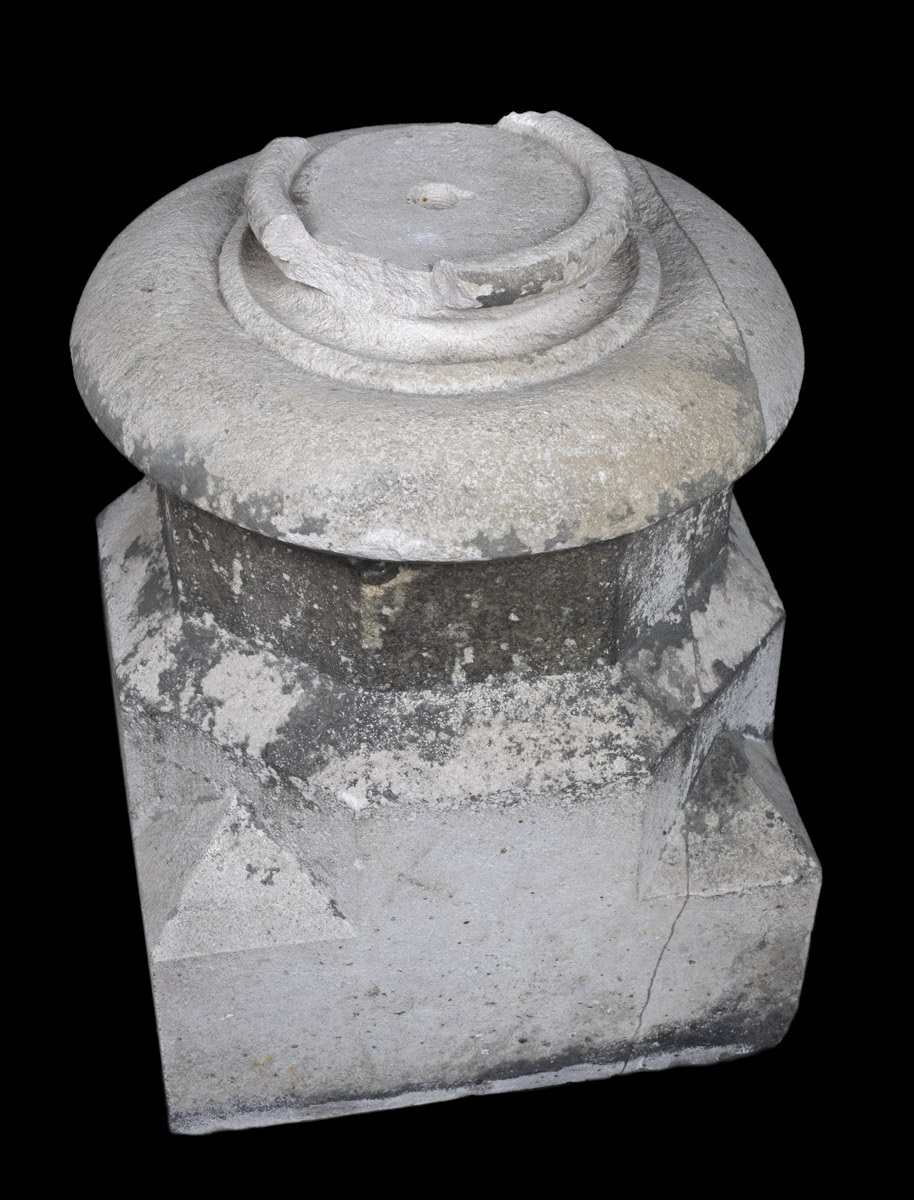
Base de bénitier
Description
Cette base et la cuve (inv. 997.0.108.2) formaient autrefois un bénitier placé dans un angle : la cuve, de plan octogonal, voit en effet son large rebord se prolonger en angle droit pour s'engager dans la paroi. Les cinq faces visibles sont creusées de trilobes, contrairement aux trois faces restantes, tournées vers le mur. La base moulurée de bénitier porte un socle octogonal adoptant par la suite un plan carré. L'examen des caractéristiques formelles autorise à dater le bénitier du XIIIe siècle. Deux bénitiers similaires apparaissent à Notre-Dame de Dijon, bien que non-engagés et certainement néo-gothiques ; rien n'indique cependant qu'ils ont été réalisés d'après un modèle se trouvant autrefois dans l'église. D'autre part, les mémoires de la CACO relatent la découverte en 1922 d'un bénitier formant une cuve de pierre octogonale et provenant de l'église Saint-Vivant de Vergy : bien que la description rappelle la cuve du musée, on ne mentionne toutefois aucun autre élément composant le bénitier, ni sa destination. (Didier Secula). (JANNET Monique et JOUBERT Fabienne (dir.), Sculpture médiévale en Bourgogne - Collection lapidaire du Musée archéologique de Dijon, EUD, 2000)
About this work
The artwork titled "Base de bénitier", attributed to anonyme, is preserved at musée archéologique. This piece is listed in the Joconde database of the Ministry of Culture, which catalogues the works held in French museums.
Technique and Materials
This work belongs to the field: archéologie, architecture, sculpture, médiéval. It was created using the following materials and techniques: calcaire (taillé). Its period of creation is identified as: 13th Century.
The Conserving Museum
"Base de bénitier" is preserved at musée archéologique, an institution bearing the « Musée de France » label. This label ensures that the collections are managed rigorously in terms of conservation, inventory, and public accessibility.
Data sources
The information about this work comes from the Joconde database of the Ministry of Culture, published on data.culture.gouv.fr under the Open License v2.0 (Etalab).
About this artwork
anonyme a réalisé Base de bénitier, actuellement au musée archéologique. Cette oeuvre est réalisée en calcaire (taillé). Elle mesure Hauteur en cm 40 ; Largeur en cm 29,5 ; Profondeur en cm 29,5. L'oeuvre appartient à la 13e siècle.
Creation context
C'est sous l'influence de la 13e siècle que anonyme donne vie à Base de bénitier. Aujourd'hui parmi les pièces les plus visitées du musée archéologique, cette œuvre rappelle un chapitre fondamental de l'histoire artistique, celui d'une époque où la création se réinvente en permanence.
See also
Technique
Author
Related pages
Frequently Asked Questions
Everything you need to know
The work « Base de bénitier » is held at musée archéologique, an institution labeled as a « Musée de France ». This label guarantees the quality of collection preservation and accessibility to the public.
This artwork is attributed to anonyme according to the Joconde database of the Ministry of Culture. Check the artist's profile on DellArte to discover their background, other works, and museums that house their creations.
Data comes from the Joconde database of the Ministry of Culture (data.culture.gouv.fr), distributed under Open License v2.0 (Etalab). The records are provided by the museums and validated by the French Museum Service.
The work is part of the collections of a « Musée de France »-labelled museum. Contact the hosting museum to verify if the work is currently on display or held in reserve. Opening hours and admission fees are available on the museum's official website.
Image usage rights depend on the work, the artist, and the museum. If the author died more than 70 years ago, the work is in the public domain in France. Text data (title, technique, dimensions) are under Open License and freely reusable.
The work's record contains information from the Joconde database: title, author, technique and materials used, dimensions, creation period, artistic domain, inventory number, hosting museum, and when available, a digital image.
Use the DellArte contact page to report errors. Since data comes from the Joconde database, major corrections (attribution, dating, technique) should be reported to the Ministry of Culture via data.culture.gouv.fr.
The Joconde database lists over 700,000 works. Use the search bar to find works by the same artist, technique, or period. Each museum entry provides access to its entire digitized collection.
The image resolution depends on the museum's digitization program. Some museums offer high-resolution images through their own digital platforms. The image displayed on DellArte comes from the Joconde database at its dissemination resolution.
Museum shops often sell reproductions of their main works (postcards, posters, art books). For public domain works, services like RMN-Grand Palais (photo.rmn.fr) offer professional photographic reproductions.