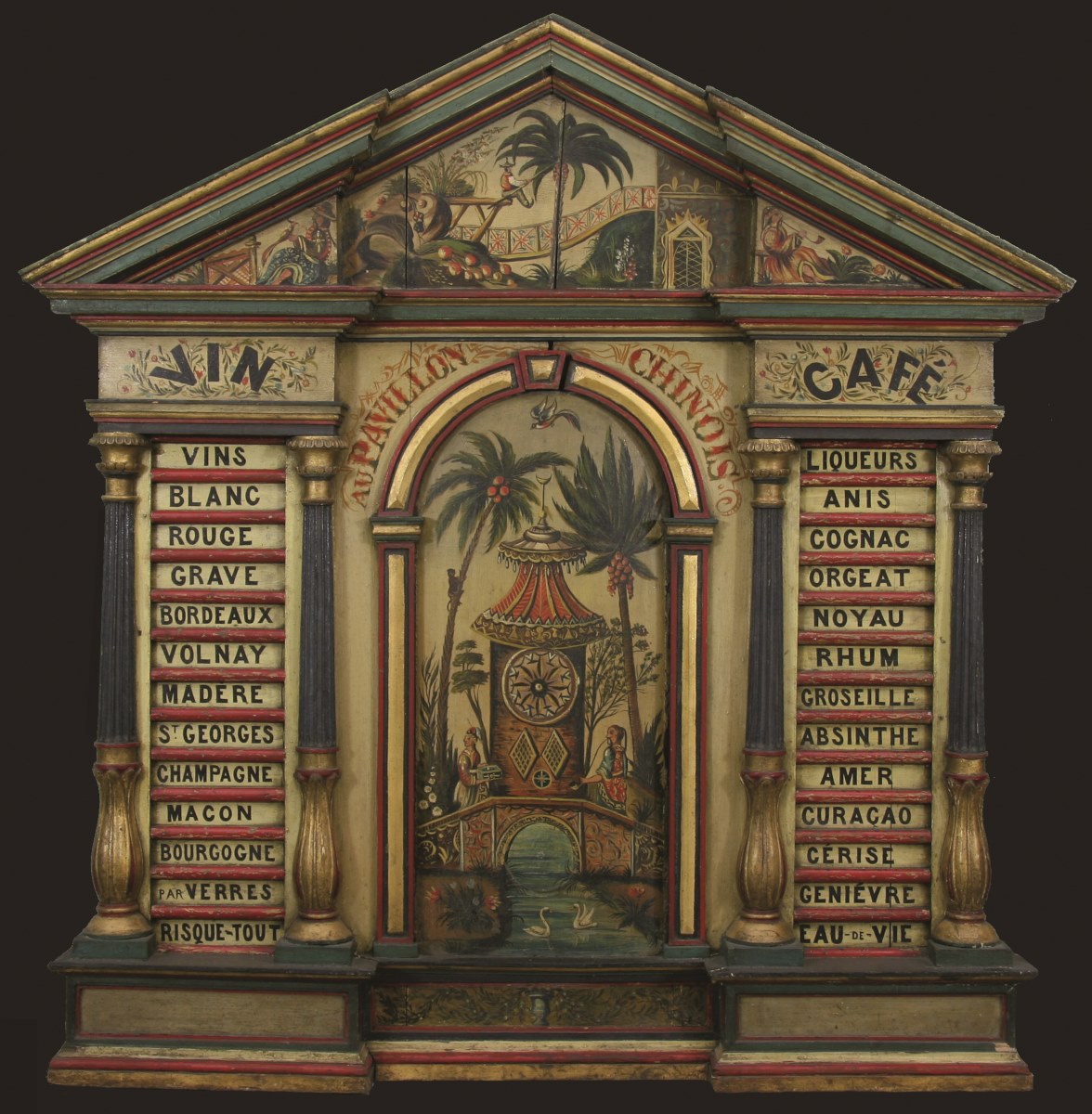
Au "Pavillon chinois". ; Tableau-enseigne de cabaret
Description
Panneau en bois sculpté polychrome au haut relief et placages. ; Enseigne reprenant l'élévation architecturale d'un portique avec fronton triangulaire soutenu de chaque côté par une double colonnade terminée par une corniche unique supportant l’imposant entablement. De chaque côté en avancée, les noms des différents produits étrangers, que l'on peut trouver dans cette boutique, sont mentionnés entre l'entrecolonnement latéral. Une distinction est faite entre les produits alcoolisés (à gauche sous l'appellation "vin") et les non-alcoolisés (sous l'appellation "café"). Le panneau central reprend le motif d'un paysage exotique "chinoiserie", très en vogue au XVIII siècle : deux cocotiers enserrent un kiosque dominant un pont et bestiaire du pays. Deux personnages "indigènes «se dirigent tous deux vers le pavillon chinois .Une scénette analogue dans le fronton, écho à la principale, reprend les codes usités à l'époque pour illustrer le caractère exotique du lieu (chinois: fumeur de longue pipe, cueilleur de fruits, travailleur actif, pont, luxuriance de la végétation) par le biais de ses boissons. Au-dessous un piédestal en forme de plinthe termine la composition d'ensemble. Utilisation d'un ancien panneau.
Subject depicted
cabaret,chinois,cygne#commerce#vin#activité financière#commerçant
About this work
The artwork titled "Au "Pavillon chinois". ; Tableau-enseigne de cabaret", attributed to Bury Armand (1823- ?), is preserved at musée de l'hospice Comtesse. This piece is listed in the Joconde database of the Ministry of Culture, which catalogues the works held in French museums.
Technique and Materials
This work belongs to the field: peinture, ethnologie. It was created using the following materials and techniques: (polychromie, placage, haut-relief), panneau de bois. Its period of creation is identified as: 2nd quarter 19th Century;3rd quarter 19th Century.
The Conserving Museum
"Au "Pavillon chinois". ; Tableau-enseigne de cabaret" is preserved at musée de l'hospice Comtesse, an institution bearing the « Musée de France » label. This label ensures that the collections are managed rigorously in terms of conservation, inventory, and public accessibility.
Data sources
The information about this work comes from the Joconde database of the Ministry of Culture, published on data.culture.gouv.fr under the Open License v2.0 (Etalab).
About this artwork
Au "Pavillon chinois". ; Tableau-enseigne de cabaret, oeuvre de peinture, ethnologie, est due à Bury Armand (1823- ?) et conservée au musée de l'hospice Comtesse. Il s'agit d'une oeuvre en (polychromie, placage, haut-relief), panneau de bois. Ses dimensions sont Hauteur en cm 109 ; Largeur en cm 105 ; Profondeur en cm 11,5. L'oeuvre dépeint : cabaret,chinois,cygne#commerce#vin#activité financière#commerçant. Sa période de création est la 2e quart 19e siècle;3e quart 19e siècle. Précisions sur cette oeuvre : BURY Armand dit Bury Père: Lille, 1823 ; ?, ? ; nationalité : Française.
Creation context
Bury Armand (1823- ?) achève Au "Pavillon chinois". ; Tableau-enseigne de cabaret dans un climat artistique profondément marqué par la 2e quart 19e siècle;3e quart 19e siècle. Le musée de l'hospice Comtesse, qui en conserve l'original, perpétue ainsi la mémoire d'un moment essentiel de l'histoire de l'art, où les créateurs ont su répondre aux défis de leur époque avec inventivité et audace.
See also
Domain
Related pages
Frequently Asked Questions
Everything you need to know
The work « Au "Pavillon chinois". ; Tableau-enseigne de cabaret » is held at musée de l'hospice Comtesse, an institution labeled as a « Musée de France ». This label guarantees the quality of collection preservation and accessibility to the public.
This artwork is attributed to Bury Armand (1823- ?) according to the Joconde database of the Ministry of Culture. Check the artist's profile on DellArte to discover their background, other works, and museums that house their creations.
Data comes from the Joconde database of the Ministry of Culture (data.culture.gouv.fr), distributed under Open License v2.0 (Etalab). The records are provided by the museums and validated by the French Museum Service.
The work is part of the collections of a « Musée de France »-labelled museum. Contact the hosting museum to verify if the work is currently on display or held in reserve. Opening hours and admission fees are available on the museum's official website.
Image usage rights depend on the work, the artist, and the museum. If the author died more than 70 years ago, the work is in the public domain in France. Text data (title, technique, dimensions) are under Open License and freely reusable.
The work's record contains information from the Joconde database: title, author, technique and materials used, dimensions, creation period, artistic domain, inventory number, hosting museum, and when available, a digital image.
Use the DellArte contact page to report errors. Since data comes from the Joconde database, major corrections (attribution, dating, technique) should be reported to the Ministry of Culture via data.culture.gouv.fr.
The Joconde database lists over 700,000 works. Use the search bar to find works by the same artist, technique, or period. Each museum entry provides access to its entire digitized collection.
The image resolution depends on the museum's digitization program. Some museums offer high-resolution images through their own digital platforms. The image displayed on DellArte comes from the Joconde database at its dissemination resolution.
Museum shops often sell reproductions of their main works (postcards, posters, art books). For public domain works, services like RMN-Grand Palais (photo.rmn.fr) offer professional photographic reproductions.