Untitled work
Description
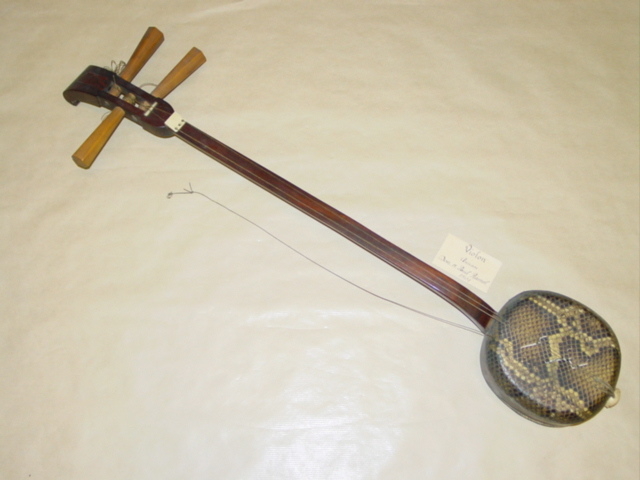
Instrument en bois sombre, sauf les trois clés en bois clair. Trois cordes dont une est cassée sont rattachées aux clés et à un bouton ovale en (os?ou ivoire?). La caisse de résonnance est faite d’un cercle en bois et de deux peaux tendues de python, les deux peaux sont déchirées. Atelier Batifort-Dumond 1989 Nîmes : De forme quasi circulaire, cet instrument diffère sensiblement des shamisen décrits habituellement. Les quatre côtés de la caisse sont légèrement convexes. Ils sont taillés dans un bois dur, rouge. La table d’harmonie et le fond sont en peau de serpent. Cette peau est collée sur le bord épais de la caisse. Au ras de cette peau une bande de cuivre est incrustée dans le bois. Un long manche de bois rouge traverse la caisse de part en part. A son sommet un chevillier creusé porte trois chevilles hexagonales. Il se termine par une sorte de spatule recourbée sur la face de laquelle et collé un idéogramme sur papier. Les trois cordes sont guidées par un sillet d’ivoire. Elles traversent un chevalet d’ivoire (ici placé trop haut, il devrait être sur la table), puis viennent s’attacher à l’autre extrémité du manche. Celui-ci, à cet endroit, est recouvert d’un capuchon d’ivoire percé pour permettre le passage des cordes.
About this work
The artwork titled "This artwork" is preserved at muséum d'histoire naturelle et de préhistoire. Referenced in the Joconde database, this work contributes to the national artistic heritage preserved in labeled museums.
Technique and Materials
This work belongs to the field: ethnologie, musique - chant - danse, Asie orientale. It was created using the following materials and techniques: peau de python, ivoire, bois, fibres végétales, cuir.
The Conserving Museum
"This artwork" is preserved at muséum d'histoire naturelle et de préhistoire, an institution bearing the « Musée de France » label. This label ensures that the collections are managed rigorously in terms of conservation, inventory, and public accessibility.
Data sources
The information about this work comes from the Joconde database of the Ministry of Culture, published on data.culture.gouv.fr under the Open License v2.0 (Etalab).
About this artwork
Cette oeuvre est réalisée en peau de python, ivoire, bois, fibres végétales, cuir. Dimensions de l'oeuvre : L. 81 cm ; l. 22 cm.
Creation context
La genèse de par est indissociable de l'atmosphère culturelle de la , moment de grands changements dans l'histoire de l'art. Conservée au muséum d'histoire naturelle et de préhistoire, cette œuvre renferme les échos d'un monde en pleine transformation, où les artistes cherchent de nouvelles manières de représenter la réalité.
See also
Related pages
Frequently Asked Questions
Everything you need to know
The work « Untitled work » is held at muséum d'histoire naturelle et de préhistoire, an institution labeled as a « Musée de France ». This label guarantees the quality of collection preservation and accessibility to the public.
This artwork is attributed to according to the Joconde database of the Ministry of Culture. Check the artist's profile on DellArte to discover their background, other works, and museums that house their creations.
Data comes from the Joconde database of the Ministry of Culture (data.culture.gouv.fr), distributed under Open License v2.0 (Etalab). The records are provided by the museums and validated by the French Museum Service.
The work is part of the collections of a « Musée de France »-labelled museum. Contact the hosting museum to verify if the work is currently on display or held in reserve. Opening hours and admission fees are available on the museum's official website.
Image usage rights depend on the work, the artist, and the museum. If the author died more than 70 years ago, the work is in the public domain in France. Text data (title, technique, dimensions) are under Open License and freely reusable.
The work's record contains information from the Joconde database: title, author, technique and materials used, dimensions, creation period, artistic domain, inventory number, hosting museum, and when available, a digital image.
Use the DellArte contact page to report errors. Since data comes from the Joconde database, major corrections (attribution, dating, technique) should be reported to the Ministry of Culture via data.culture.gouv.fr.
The Joconde database lists over 700,000 works. Use the search bar to find works by the same artist, technique, or period. Each museum entry provides access to its entire digitized collection.
The image resolution depends on the museum's digitization program. Some museums offer high-resolution images through their own digital platforms. The image displayed on DellArte comes from the Joconde database at its dissemination resolution.
Museum shops often sell reproductions of their main works (postcards, posters, art books). For public domain works, services like RMN-Grand Palais (photo.rmn.fr) offer professional photographic reproductions.