Untitled work
Description
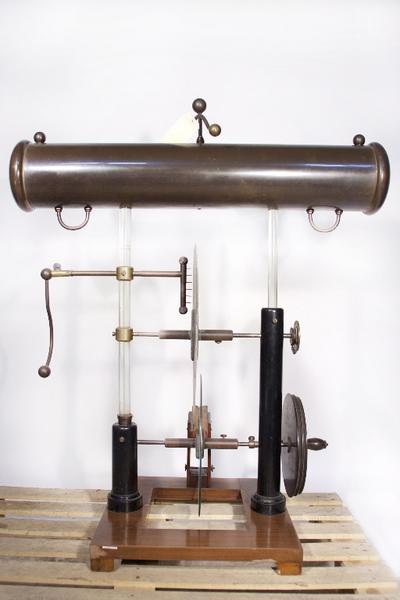
petits plateaux : verre ; axes verticaux : verre, ébonite ; grand plateau : ébonite ; socle : bois ; conducteur ; connectique ; axes horizontaux ; peignes ; tige : laiton ; coussins : cuir ; La machine de Carré, également appelée ' machine à influence ' ou roue de Carré, se compose de deux plateaux verticaux, l'un en verre et l'autre en ébonite, supportés par deux axes horizontaux en laiton. Ils sont situés à une faible distance l'un de l'autre et se recouvrent mutuellement sur trois quarts de leur rayon. Le disque inférieur est relié à une manivelle en bois, et passe entre deux coussins en cuir. Le disque supérieur possède un diamètre plus grand que le précédent. Il est actionné par un système de démultiplication d'une poulie fixée sur l'axe du plateau de verre, comportant la manivelle. Il est très proche d'un peigne en laiton qui aboutit à une tige articulée, formant un éclateur, elle-même située à une distance réglable d'un conducteur supérieur. Ce conducteur est un gros tube de laiton horizontal supporté par deux colonnes en verre avec un pied en ébonite. Il est complété dans sa partie inférieure par deux demi-anneaux, et dans sa partie supérieure par deux boules aux extrémités et par une tige centrale terminée par trois autres boules. L'ensemble repose sur un support en bois constituant le socle de la machine. La manivelle et la courroie permettent de faire tourner les deux plateaux en sens inverse, à des vitesses différentes. Le disque inférieur en verre tourne lentement et vient frotter sur deux coussins en cuir. Il se charge donc positivement et vient agir par induction sur le peigne à travers le plateau d'ébonite en rotation rapide. Les charges transportées vers le conducteur supérieur génèrent un courant. Cette machine est réputée pour être peu sensible à l'humidité et permet d'obtenir des courants continus allant jusqu'à 50 kiloélectronvolts.
About this work
The artwork titled "This artwork", attributed to CARRE Ferdinand (inventeur);GAIFFE A (fabricant), is preserved at musée des hospices civils de Lyon. Referenced in the Joconde database, this work contributes to the national artistic heritage preserved in labeled museums.
Technique and Materials
This work belongs to the field: sciences - techniques, hygiène - médecine - santé. It was created using the following materials and techniques: verre, ébonite, bois, laiton, cuir. Its period of creation is identified as: 3rd quarter 19th Century.
The Conserving Museum
"This artwork" is preserved at musée des hospices civils de Lyon, an institution bearing the « Musée de France » label. This label ensures that the collections are managed rigorously in terms of conservation, inventory, and public accessibility.
Data sources
The information about this work comes from the Joconde database of the Ministry of Culture, published on data.culture.gouv.fr under the Open License v2.0 (Etalab).
About this artwork
La réalisation fait appel à verre, ébonite, bois, laiton, cuir. Dimensions : L. 98 cm ; H. 116 cm ; l. 50 cm ; VOLUM. 0,5684. Elle est datée de la 3e quart 19e siècle. Informations complémentaires : CARRE : Moislains, 1824 ; Pommeuse, 1900.
Creation context
Comment le contexte de la 3e quart 19e siècle a-t-il influencé la création de ? CARRE Ferdinand (inventeur);GAIFFE A (fabricant) travaille à cette époque dans un climat de renouveau qui irrigue sa pratique et oriente ses choix formels. Le musée des hospices civils de Lyon offre au visiteur l'occasion de saisir cette dimension contextuelle essentielle à la compréhension de l'œuvre.
See also
Technique
Related pages
Frequently Asked Questions
Everything you need to know
The work « Untitled work » is held at musée des hospices civils de Lyon, an institution labeled as a « Musée de France ». This label guarantees the quality of collection preservation and accessibility to the public.
This artwork is attributed to CARRE Ferdinand (inventeur);GAIFFE A (fabricant) according to the Joconde database of the Ministry of Culture. Check the artist's profile on DellArte to discover their background, other works, and museums that house their creations.
Data comes from the Joconde database of the Ministry of Culture (data.culture.gouv.fr), distributed under Open License v2.0 (Etalab). The records are provided by the museums and validated by the French Museum Service.
The work is part of the collections of a « Musée de France »-labelled museum. Contact the hosting museum to verify if the work is currently on display or held in reserve. Opening hours and admission fees are available on the museum's official website.
Image usage rights depend on the work, the artist, and the museum. If the author died more than 70 years ago, the work is in the public domain in France. Text data (title, technique, dimensions) are under Open License and freely reusable.
The work's record contains information from the Joconde database: title, author, technique and materials used, dimensions, creation period, artistic domain, inventory number, hosting museum, and when available, a digital image.
Use the DellArte contact page to report errors. Since data comes from the Joconde database, major corrections (attribution, dating, technique) should be reported to the Ministry of Culture via data.culture.gouv.fr.
The Joconde database lists over 700,000 works. Use the search bar to find works by the same artist, technique, or period. Each museum entry provides access to its entire digitized collection.
The image resolution depends on the museum's digitization program. Some museums offer high-resolution images through their own digital platforms. The image displayed on DellArte comes from the Joconde database at its dissemination resolution.
Museum shops often sell reproductions of their main works (postcards, posters, art books). For public domain works, services like RMN-Grand Palais (photo.rmn.fr) offer professional photographic reproductions.