Untitled work
Description
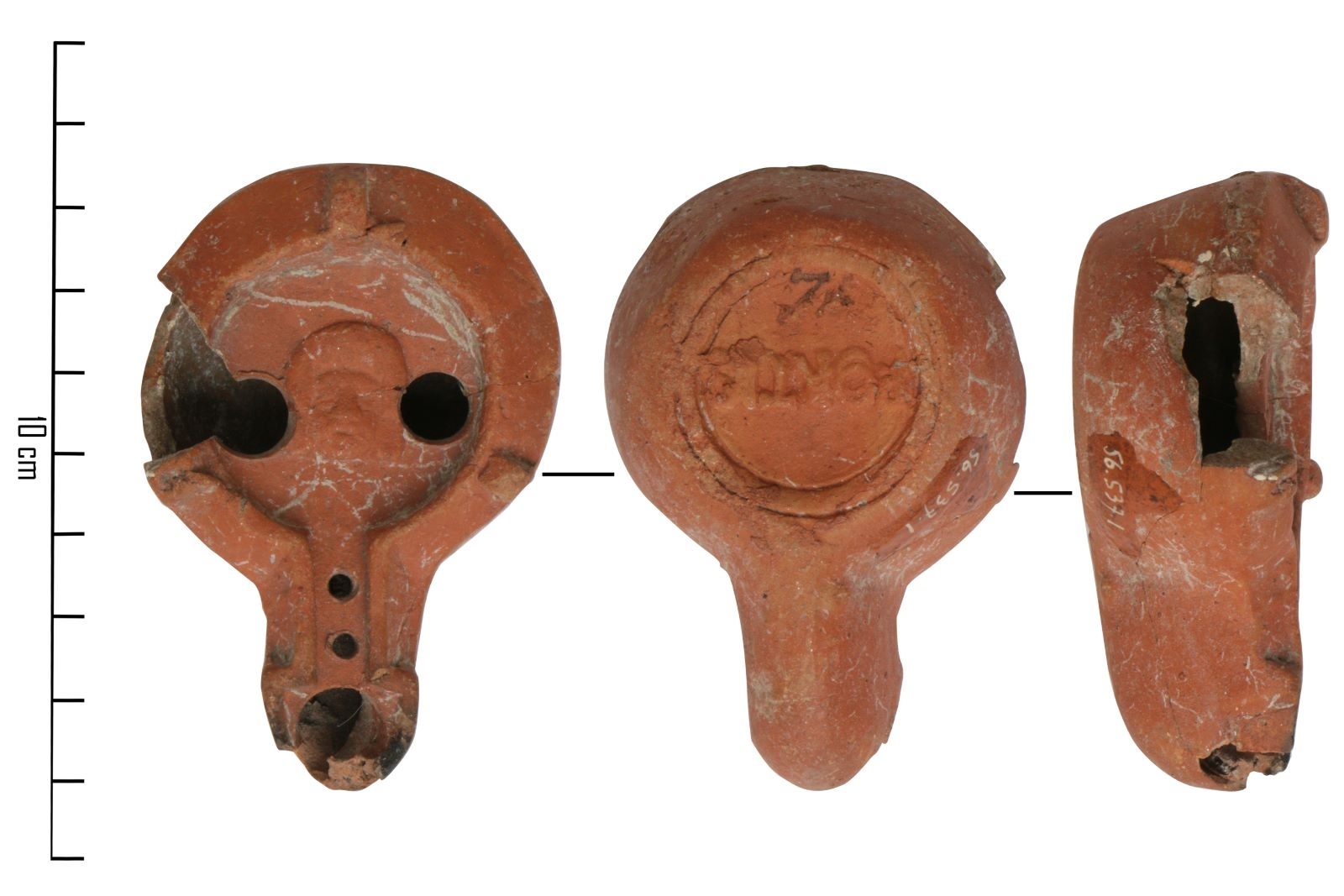
Loeschcke X a. Firmalampen moulée sans anse. Réservoir circulaire de profil tronconique. Bandeau penché vers l'extérieur portant trois tenons rectangulaires non percés, sur l'axe horizontal. Disque en cuvette bordée par un bourrelet. Bec long au méplat en forme de pelle et ouvert sur le disque. Base circulaire limitée par deux sillons portant la marque "FORTIS" en relief. Trous d'évent. Deux trous de remplissage de part et d'autre du décor. Bavures d'argile et bulles de surmoulage. Traces d'utilisation.
Subject depicted
masque
About this work
The artwork titled "This artwork", attributed to Fortis (potier), is preserved at musée Bargoin. Referenced in the Joconde database, this work contributes to the national artistic heritage preserved in labeled museums.
Technique and Materials
This work belongs to the field: archéologie, romain, vie domestique, croyances - coutumes, céramique. It was created using the following materials and techniques: terre cuite (moulé, engobe, cuisson). Its period of creation is identified as: 1er siècle;2nd Century.
The Conserving Museum
"This artwork" is preserved at musée Bargoin, an institution bearing the « Musée de France » label. This label ensures that the collections are managed rigorously in terms of conservation, inventory, and public accessibility.
Data sources
The information about this work comes from the Joconde database of the Ministry of Culture, published on data.culture.gouv.fr under the Open License v2.0 (Etalab).
About this artwork
La technique employée est : terre cuite (moulé, engobe, cuisson). L'oeuvre présente les dimensions suivantes : L. 7,4 cm ; H. 3 cm ; l. 5 cm ; Vol. 0,0001. Le sujet de cette oeuvre : masque. Cette réalisation date de la 1er siècle;2e siècle. Concernant cette pièce : L'atelier principal de ce potier était situé à Savignano. Fortis, qui constitue l'une des plus importantes firmes de lampes à canal, a connu une grande production en Vénétie. Ce nom de potier est très répandu en Gaule à partir de l'époque flavienne jusqu'à la fin du IIe s. apr. J.-C.(Lerat 1954, nos 144, 147, 157, 158 — Mouchot 1959, nos 1841 et 1852). Son activité s'échelonne de la deuxième moitié du Ier siècle ap. J.-C. à la fin du III siècle et même au-delà (Loeschcke 1919, p. 280-282).
Creation context
est le produit de la rencontre entre le talent de Fortis (potier) et les aspirations de la 1er siècle;2e siècle. Abritée au musée Bargoin, cette œuvre cristallise les questionnements artistiques propres à une époque qui voit naître de nouvelles formes d'expression et de nouveaux rapports à la création.
See also
Technique
Author
Related pages
Frequently Asked Questions
Everything you need to know
The work « Untitled work » is held at musée Bargoin, an institution labeled as a « Musée de France ». This label guarantees the quality of collection preservation and accessibility to the public.
This artwork is attributed to Fortis (potier) according to the Joconde database of the Ministry of Culture. Check the artist's profile on DellArte to discover their background, other works, and museums that house their creations.
Data comes from the Joconde database of the Ministry of Culture (data.culture.gouv.fr), distributed under Open License v2.0 (Etalab). The records are provided by the museums and validated by the French Museum Service.
The work is part of the collections of a « Musée de France »-labelled museum. Contact the hosting museum to verify if the work is currently on display or held in reserve. Opening hours and admission fees are available on the museum's official website.
Image usage rights depend on the work, the artist, and the museum. If the author died more than 70 years ago, the work is in the public domain in France. Text data (title, technique, dimensions) are under Open License and freely reusable.
The work's record contains information from the Joconde database: title, author, technique and materials used, dimensions, creation period, artistic domain, inventory number, hosting museum, and when available, a digital image.
Use the DellArte contact page to report errors. Since data comes from the Joconde database, major corrections (attribution, dating, technique) should be reported to the Ministry of Culture via data.culture.gouv.fr.
The Joconde database lists over 700,000 works. Use the search bar to find works by the same artist, technique, or period. Each museum entry provides access to its entire digitized collection.
The image resolution depends on the museum's digitization program. Some museums offer high-resolution images through their own digital platforms. The image displayed on DellArte comes from the Joconde database at its dissemination resolution.
Museum shops often sell reproductions of their main works (postcards, posters, art books). For public domain works, services like RMN-Grand Palais (photo.rmn.fr) offer professional photographic reproductions.