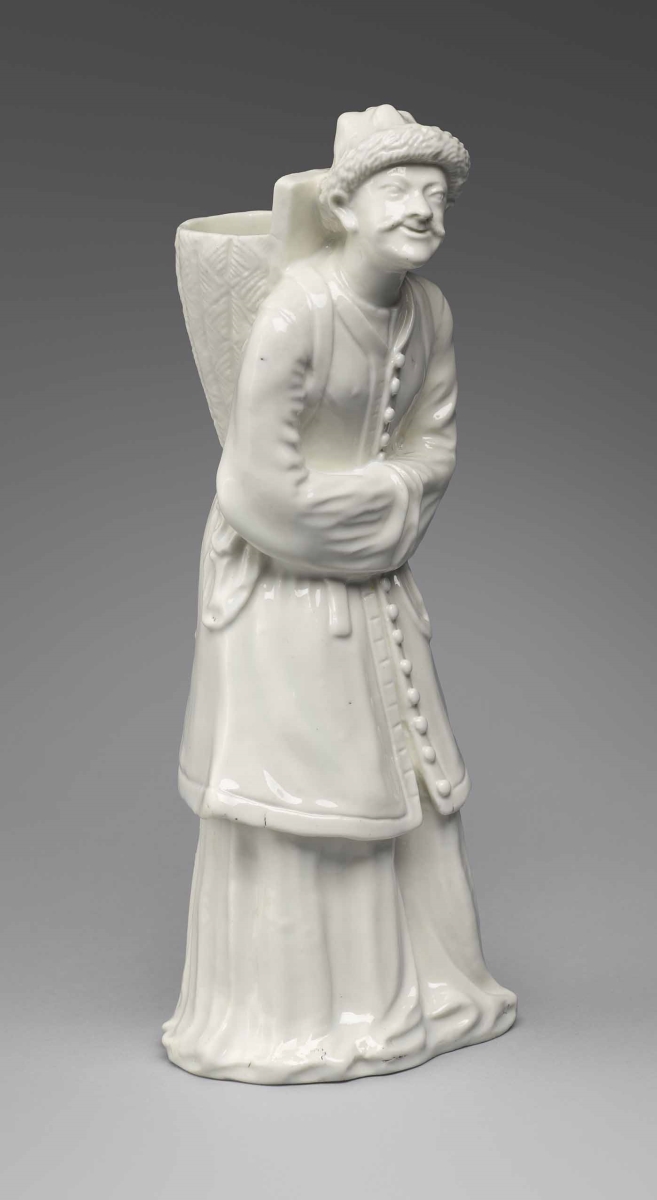
Untitled work
Description
Fait partie d'une paire avec la Hotteuse 2023-7-2-1. Vente Paris, Hôtel Drouot, Baron-Ribeyre, 28 mars 2023, lot 169 Les statuettes de hotteux et hotteuse appartiennent à la typologie restreinte de figures en ronde bosse produites par la manufacture de Chantilly. Ces objets à vocation décorative pouvaient être utilisés comme porte-fleurs ou porte-lumières, et étaient alors complétés par des montures de bronze doré, comme c’est le cas de la paire de hotteux et hotteuse conservée au Musée national de Céramique à Sèvres, inv. MNC 26359 1-2, acquis en 1991. Les figures de hotteux et hotteuses étaient produites par paire et pouvaient présenter un décor polychrome, cette typologie étant probablement inspirée d’une création du sculpteur Johann Joachim Kändler (1706 – 1775) pour Meissen . La production des figures de blancs de Chantilly dans les années 1740 – 1750 s’inspire des productions de la manufacture de Meissen, comme c’est le cas aussi pour d’autres manufactures françaises aux mêmes dates. Le Victoria & Albert Museum de Londres conserve par exemple une paire de hotteux et hotteuse polychrome et marquée au cor de chasse (C. 392 et 393). Les hotteux sont des marchands ambulants portant une hotte sur le dos. Ils font partie des fameux Cris de Paris, et sont représentés régulièrement dans l’iconographie depuis le XVIIe siècle. Ici, le hotteux adopte des caractéristiques orientales, contrairement à la hotteuse qui correspond à un type occidental. Il est possible que l’invention de ce pendant asiatique revienne à la manufacture de Chantilly afin d’ajouter une dimension pittoresque à la paire . Ce modèle de paire de hotteux et de hotteuse a été produit en plusieurs exemplaires par la manufacture.
About this work
The artwork titled "This artwork", attributed to Manufacture De Chantilly, is preserved at musée Condé. Referenced in the Joconde database, this work contributes to the national artistic heritage preserved in labeled museums.
Technique and Materials
This work belongs to the field: arts décoratifs, céramique. It was created using the following materials and techniques: porcelaine tendre (emaillé).
The Conserving Museum
"This artwork" is preserved at musée Condé, an institution bearing the « Musée de France » label. This label ensures that the collections are managed rigorously in terms of conservation, inventory, and public accessibility.
Data sources
The information about this work comes from the Joconde database of the Ministry of Culture, published on data.culture.gouv.fr under the Open License v2.0 (Etalab).
About this artwork
Cette oeuvre est réalisée en porcelaine tendre (emaillé). Ses dimensions sont Hauteur en cm 28.
Creation context
La genèse de par Manufacture De Chantilly est indissociable de l'atmosphère culturelle de la , moment de grands changements dans l'histoire de l'art. Conservée au musée Condé, cette œuvre renferme les échos d'un monde en pleine transformation, où les artistes cherchent de nouvelles manières de représenter la réalité.
See also
Technique
Domain
Author
Related pages
Frequently Asked Questions
Everything you need to know
The work « Untitled work » is held at musée Condé, an institution labeled as a « Musée de France ». This label guarantees the quality of collection preservation and accessibility to the public.
This artwork is attributed to Manufacture De Chantilly according to the Joconde database of the Ministry of Culture. Check the artist's profile on DellArte to discover their background, other works, and museums that house their creations.
Data comes from the Joconde database of the Ministry of Culture (data.culture.gouv.fr), distributed under Open License v2.0 (Etalab). The records are provided by the museums and validated by the French Museum Service.
The work is part of the collections of a « Musée de France »-labelled museum. Contact the hosting museum to verify if the work is currently on display or held in reserve. Opening hours and admission fees are available on the museum's official website.
Image usage rights depend on the work, the artist, and the museum. If the author died more than 70 years ago, the work is in the public domain in France. Text data (title, technique, dimensions) are under Open License and freely reusable.
The work's record contains information from the Joconde database: title, author, technique and materials used, dimensions, creation period, artistic domain, inventory number, hosting museum, and when available, a digital image.
Use the DellArte contact page to report errors. Since data comes from the Joconde database, major corrections (attribution, dating, technique) should be reported to the Ministry of Culture via data.culture.gouv.fr.
The Joconde database lists over 700,000 works. Use the search bar to find works by the same artist, technique, or period. Each museum entry provides access to its entire digitized collection.
The image resolution depends on the museum's digitization program. Some museums offer high-resolution images through their own digital platforms. The image displayed on DellArte comes from the Joconde database at its dissemination resolution.
Museum shops often sell reproductions of their main works (postcards, posters, art books). For public domain works, services like RMN-Grand Palais (photo.rmn.fr) offer professional photographic reproductions.