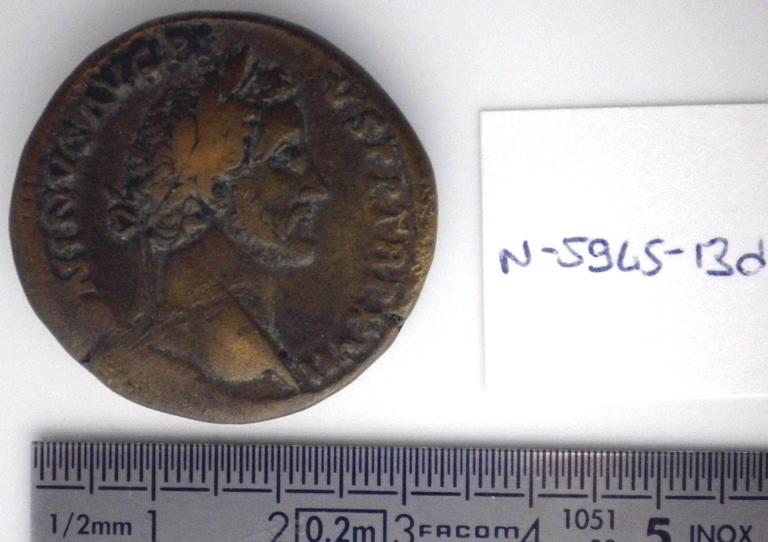
Untitled work
About this work
The artwork titled "This artwork", attributed to ANTONIN LE PIEUX (émetteur), is preserved at musée Dobrée. This piece is listed in the Joconde database of the Ministry of Culture, which catalogues the works held in French museums.
Technique and Materials
This work belongs to the field: numismatique, romain. It was created using the following materials and techniques: orichalque, frappé. Its period of creation is identified as: 3rd quarter 2nd Century.
The Conserving Museum
"This artwork" is preserved at musée Dobrée, an institution bearing the « Musée de France » label. This label ensures that the collections are managed rigorously in terms of conservation, inventory, and public accessibility.
Data sources
The information about this work comes from the Joconde database of the Ministry of Culture, published on data.culture.gouv.fr under the Open License v2.0 (Etalab).
About this artwork
Cette oeuvre est réalisée en orichalque, frappé. La pièce a pour dimensions Diamètre en cm 3.30 ; Poids en gr 26.80. Elle est datée de la 3e quart 2e siècle. Note sur cette oeuvre : ANTONIN LE PIEUX : Antonin le Pieux : nom latin : Titus Aurelius Fulvus Boionius Arrius Antoninus. Né le 19 Septembre 86 à Lanuvium, près de Rome. Il tire son surnom de ses contemporains qui voit en lui le modèle de vertu de ses ancêtres. Sa famille est originaire de Nîmes en Gaule Narbonnaise, appartenant à la bourgeoisie rurale, elle achète des terres en Italie pour pouvoir rentrer au sénat et s'enrichie. Empereur, Antonin n'oublie pas sa patrie d'origine, il fait reconstruire Narbonne détruite par un incendie et y favorise le réseau routier. Son ascension est très incertaine car peu de sources en font état. Questeur puis préteur, il est consul en 120. Il est l'un des quatre consulaires d'Italie puis occupe la charge de proconsul d'Asie de 133 à 136. Cette carrière discrète est à l'image de son règne serein. Il épouse entre 110 et 115 la nièce de la femme d'Hadrien qui l'adopte et fait de lui son successeur à la condition qu'il prenne sous sa protection le futur Marc-Aurèle. Il devient empereur le 10 Juillet 138 et ne quitte jamais l'Italie. Son règne maintien l'empire à son apogée et la paix. Il est marqué par le calme où rien ne bouge seul l'empire s'enrichit. Le culte chrétien profite de cette paix de l'empire pour faire une percée. Antonin meurt le 7 Mars 161.
Creation context
Quand ANTONIN LE PIEUX (émetteur) entreprend la réalisation de , la 3e quart 2e siècle bat son plein et redéfinit les codes de la création. Cette œuvre, aujourd'hui au musée Dobrée, porte la marque indélébile de son époque, témoignant des tensions créatrices et des aspirations qui animent alors les milieux artistiques.
See also
Technique
Domain
Author
Related pages
Frequently Asked Questions
Everything you need to know
The work « Untitled work » is held at musée Dobrée, an institution labeled as a « Musée de France ». This label guarantees the quality of collection preservation and accessibility to the public.
This artwork is attributed to ANTONIN LE PIEUX (émetteur) according to the Joconde database of the Ministry of Culture. Check the artist's profile on DellArte to discover their background, other works, and museums that house their creations.
Data comes from the Joconde database of the Ministry of Culture (data.culture.gouv.fr), distributed under Open License v2.0 (Etalab). The records are provided by the museums and validated by the French Museum Service.
The work is part of the collections of a « Musée de France »-labelled museum. Contact the hosting museum to verify if the work is currently on display or held in reserve. Opening hours and admission fees are available on the museum's official website.
Image usage rights depend on the work, the artist, and the museum. If the author died more than 70 years ago, the work is in the public domain in France. Text data (title, technique, dimensions) are under Open License and freely reusable.
The work's record contains information from the Joconde database: title, author, technique and materials used, dimensions, creation period, artistic domain, inventory number, hosting museum, and when available, a digital image.
Use the DellArte contact page to report errors. Since data comes from the Joconde database, major corrections (attribution, dating, technique) should be reported to the Ministry of Culture via data.culture.gouv.fr.
The Joconde database lists over 700,000 works. Use the search bar to find works by the same artist, technique, or period. Each museum entry provides access to its entire digitized collection.
The image resolution depends on the museum's digitization program. Some museums offer high-resolution images through their own digital platforms. The image displayed on DellArte comes from the Joconde database at its dissemination resolution.
Museum shops often sell reproductions of their main works (postcards, posters, art books). For public domain works, services like RMN-Grand Palais (photo.rmn.fr) offer professional photographic reproductions.