Untitled work
Description
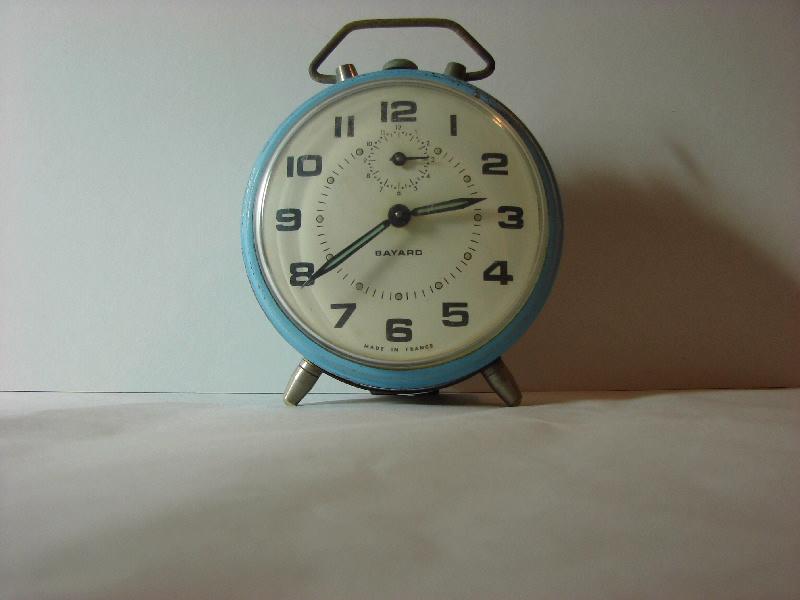
Il s'agit d'un réveil Bayard équipé du mouvement G 237 P. Le calibre G est un mouvement mécanique à sonnerie 30 heures. Le mouvement mécanique est logé dans un boîtier circulaire en tôle acier emboutie vernie de 10.3 cm de diamètre. Au sommet du réveil, se trouvent un bouton 'arrêt réveil' et une bélière nickelés. L'ensemble repose sur deux pieds coniques et une béquille nickelés. Le cadran en métal couleur blanc est bombé, composé de chiffres arabes noirs et possède deux aiguilles noires et fluorescentes en forme de lance. En dessous du chiffre '12', se situe un cadran de réveil gradué composé de chiffres arabes noirs avec son aiguille noire en forme de lance. A l'intérieur du cadran principal, une graduation indique les minutes. Les points des heures sont fluorescents. Le bas du cadran comporte l'inscription 'BAYARD'. La glace du cadran est en plastique bombé
About this work
The artwork titled "This artwork", attributed to BAYARD;REVEILS BAYARD (usine), is preserved at musée de l'Horlogerie. This piece is listed in the Joconde database of the Ministry of Culture, which catalogues the works held in French museums.
Technique and Materials
This work belongs to the field: horlogerie, métrologie - instruments de mesure. It was created using the following materials and techniques: tôle, acier, embouti, galvanoplastie, vernis, nickelé, matière plastique. Its period of creation is identified as: 3rd quarter 20th Century.
The Conserving Museum
musée de l'Horlogerie preserves this work in its collections. As a « Musée de France » labeled museum, the institution is committed to preserving and showcasing the pieces entrusted to it.
Data sources
The information about this work comes from the Joconde database of the Ministry of Culture, published on data.culture.gouv.fr under the Open License v2.0 (Etalab).
About this artwork
L'oeuvre a été exécutée en tôle, acier, embouti, galvanoplastie, vernis, nickelé, matière plastique. Mesures : Longueur en cm 10.3 ; Epaisseur en cm 5.2 ; Hauteur en cm 11.4 ; Diamètre en cm 10.3. Cette réalisation date de la 3e quart 20e siècle. Informations complémentaires : REVEILS BAYARD : La ' Société des Anciens Etablissements Duverdrey-Bloquel ' devient la Société Anonyme 'Réveils Bayard' le 14 décembre 1962. Elle perdure jusqu'en juin 1984. A partir de février 1907, DUVERDREY & BLOQUEL donnent l'appellation 'réveils Bayard', et cela bien avant que la marque 'Bayard' ne soit déposée en 1928. La S.A Jaeger devient en 1978 actionnaire majoritaire de la S.A 'Réveils Bayard'. En tant que filiale de la S.A Jaeger, la société 'Réveils Bayard' fait alors partie du groupe Matra-Horlogerie.
Creation context
La création de par BAYARD;REVEILS BAYARD (usine) s'inscrit dans le climat culturel et intellectuel de la 3e quart 20e siècle. Conservée au musée de l'Horlogerie, cette œuvre porte en elle les empreintes d'un moment charnière de l'histoire de l'art, où les artistes explorent de nouvelles formes d'expression et repoussent les limites de leur pratique.
See also
Frequently Asked Questions
Everything you need to know
The work « Untitled work » is held at musée de l'Horlogerie, an institution labeled as a « Musée de France ». This label guarantees the quality of collection preservation and accessibility to the public.
This artwork is attributed to BAYARD;REVEILS BAYARD (usine) according to the Joconde database of the Ministry of Culture. Check the artist's profile on DellArte to discover their background, other works, and museums that house their creations.
Data comes from the Joconde database of the Ministry of Culture (data.culture.gouv.fr), distributed under Open License v2.0 (Etalab). The records are provided by the museums and validated by the French Museum Service.
The work is part of the collections of a « Musée de France »-labelled museum. Contact the hosting museum to verify if the work is currently on display or held in reserve. Opening hours and admission fees are available on the museum's official website.
Image usage rights depend on the work, the artist, and the museum. If the author died more than 70 years ago, the work is in the public domain in France. Text data (title, technique, dimensions) are under Open License and freely reusable.
The work's record contains information from the Joconde database: title, author, technique and materials used, dimensions, creation period, artistic domain, inventory number, hosting museum, and when available, a digital image.
Use the DellArte contact page to report errors. Since data comes from the Joconde database, major corrections (attribution, dating, technique) should be reported to the Ministry of Culture via data.culture.gouv.fr.
The Joconde database lists over 700,000 works. Use the search bar to find works by the same artist, technique, or period. Each museum entry provides access to its entire digitized collection.
The image resolution depends on the museum's digitization program. Some museums offer high-resolution images through their own digital platforms. The image displayed on DellArte comes from the Joconde database at its dissemination resolution.
Museum shops often sell reproductions of their main works (postcards, posters, art books). For public domain works, services like RMN-Grand Palais (photo.rmn.fr) offer professional photographic reproductions.