Untitled work
Description
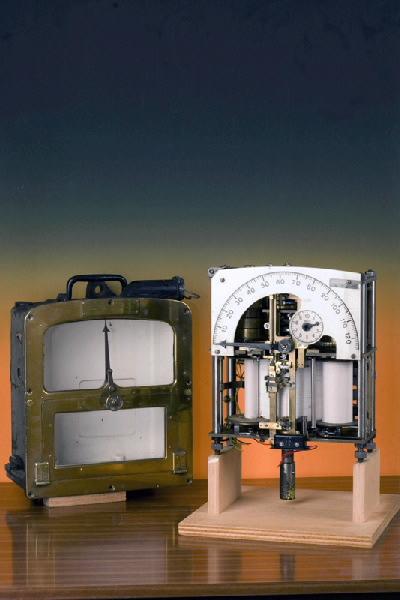
Mouvement ; Cadran ; Indicateur et enregistreur Flaman utilisée par la SNCF pour contrôler la vitesse, les horaires et temps d'arrêt d'un train (système de marquage sur une bande papier). Mécanique à porte échappement à ancre battant le 1/5e de seconde. Le mouvement est entraîné par deux barillets munis chacun de cinq ressorts. Le cadran est une demi-couronne en cuivre émaillé portant les nombre de 0 à 120. La boîte est en fonte et son cadran est en laiton poli avec une porte rabattante. Au sommet du boîtier, se trouve la plaque 'Ateliers Vaucanson'.
Subject depicted
représentation scientifique (transport, train)
About this work
The artwork titled "This artwork", attributed to VAUCANSON (ateliers), is preserved at musée de l'horlogerie. This piece is listed in the Joconde database of the Ministry of Culture, which catalogues the works held in French museums.
Technique and Materials
This work belongs to the field: horlogerie, métrologie - instruments de mesure. It was created using the following materials and techniques: laiton, fonte, papier, cuivre, émaillé. Its period of creation is identified as: 1ère moitié 20th Century.
The Conserving Museum
musée de l'horlogerie preserves this work in its collections. As a « Musée de France » labeled museum, the institution is committed to preserving and showcasing the pieces entrusted to it.
Data sources
The information about this work comes from the Joconde database of the Ministry of Culture, published on data.culture.gouv.fr under the Open License v2.0 (Etalab).
About this artwork
La réalisation fait appel à laiton, fonte, papier, cuivre, émaillé. Les dimensions de l'oeuvre sont : Longueur en cm 30 ; Epaisseur en cm 15 ; Hauteur en cm 36. Le motif représenté : représentation scientifique (transport, train). L'oeuvre date de la 1ère moitié 20e siècle. Précisions sur cette oeuvre : VAUCANSON (ateliers) : Février 1914 : Fondation de la société Vaucanson, du nom d'un grand inventeur d'automates mécaniques du XVIIIe siècle, elle prend la suite de la maison Lamazière et Bunzli à Blesdal (lieu dit de la commune de Saint-Aubin-le-Cauf) 1917 : Construction de nouveaux ateliers de 4800 m2au cour de la commune. Une cité ouvrière est construite le long de la rue qui borde l'usine. De 1918 à 1955 : Fabrication d'enregistreurs Flaman ou ' mouchards de locomotive ', ainsi que des machines à calculer, des pièces pour l'automobile et les appareils cinématographiques. 1955 : La société Ericsson acquiert une place majoritaire dans l'entreprise. L'usine est agrandie et modernisée pour se lancer dans la fabrication d'appareils et de centraux téléphoniques. 1963 : L'entreprise emploie 680 personnes et produit 500 000 postes téléphoniques par an. Plusieurs maisons ouvrières sont construites dans l'avenue face à l'usine pour les employés et les cadres de l'entreprise. Années 1970 : près de 1200 employés et plusieurs millions d'appareils fabriqués chaque année dans l'entreprise. Milieu des années 1980 : premières difficultés financières. Rachat de l'entreprise par Thomson puis Alcatel. 1992 : fermeture de l'entreprise. Les bâtiments sont repris par la société Sonas Automotive. En mai 2009 : Sonas Automotive ets rachetée par le groupe Halberg Février 2010 : le groupe ADESNA (Atelier de découpe et d'emboutissage de Saint-Nicolas d'Aliermont) rachète Sonas.
Creation context
La genèse de par VAUCANSON (ateliers) est indissociable de l'atmosphère culturelle de la 1ère moitié 20e siècle, moment de grands changements dans l'histoire de l'art. Conservée au musée de l'horlogerie, cette œuvre renferme les échos d'un monde en pleine transformation, où les artistes cherchent de nouvelles manières de représenter la réalité.
See also
Technique
Author
Related pages
Frequently Asked Questions
Everything you need to know
The work « Untitled work » is held at musée de l'horlogerie, an institution labeled as a « Musée de France ». This label guarantees the quality of collection preservation and accessibility to the public.
This artwork is attributed to VAUCANSON (ateliers) according to the Joconde database of the Ministry of Culture. Check the artist's profile on DellArte to discover their background, other works, and museums that house their creations.
Data comes from the Joconde database of the Ministry of Culture (data.culture.gouv.fr), distributed under Open License v2.0 (Etalab). The records are provided by the museums and validated by the French Museum Service.
The work is part of the collections of a « Musée de France »-labelled museum. Contact the hosting museum to verify if the work is currently on display or held in reserve. Opening hours and admission fees are available on the museum's official website.
Image usage rights depend on the work, the artist, and the museum. If the author died more than 70 years ago, the work is in the public domain in France. Text data (title, technique, dimensions) are under Open License and freely reusable.
The work's record contains information from the Joconde database: title, author, technique and materials used, dimensions, creation period, artistic domain, inventory number, hosting museum, and when available, a digital image.
Use the DellArte contact page to report errors. Since data comes from the Joconde database, major corrections (attribution, dating, technique) should be reported to the Ministry of Culture via data.culture.gouv.fr.
The Joconde database lists over 700,000 works. Use the search bar to find works by the same artist, technique, or period. Each museum entry provides access to its entire digitized collection.
The image resolution depends on the museum's digitization program. Some museums offer high-resolution images through their own digital platforms. The image displayed on DellArte comes from the Joconde database at its dissemination resolution.
Museum shops often sell reproductions of their main works (postcards, posters, art books). For public domain works, services like RMN-Grand Palais (photo.rmn.fr) offer professional photographic reproductions.