Untitled work
Description
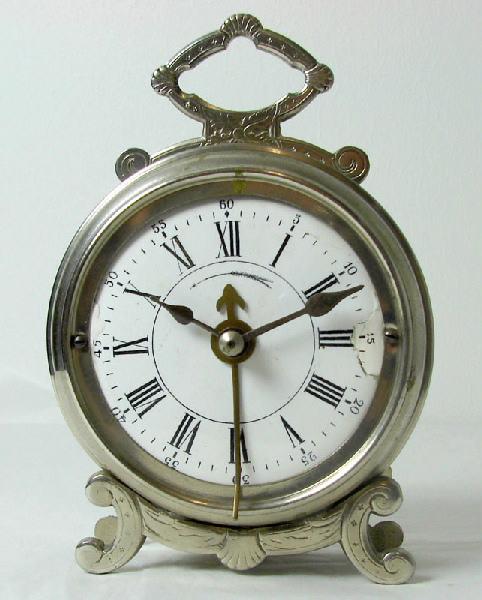
Il s'agit d'un réveil mécanique signé Albert Villon. Le mouvement est logé dans un boîtier en tôle emboutie nickelée, équipée d'une lunette de 10 cm de diamètre. Le réveil est surmonté d'une bélière moulée et décorée de feuilles ornementales. L'ensemble repose sur deux pieds moulés. Une coquille Saint-Jacques orne la partie inférieure du réveil. Le cadran émaillé blanc comporte des chiffres romains noirs et deux aiguilles laitonnées en forme de poire. En bordure, un second cadran indique les minutes en chiffres arabes noirs. Le réveil possède également une aiguille de réveil qui est cambrée à son extrémité pour régler le réveil. Cette même aiguille se prolonge de l'autre côté de l'axe de fixation et se termine par une pointe de flèche. A l'arrière du boîtier, figure une estampille représentant un petit lion passant avec les initiales d'Albert Villon 'A.V'
Subject depicted
ornementation (feuillage orn, coquille orn),représentation animalière (lion)
About this work
The artwork titled "This artwork", attributed to BAYARD;VILLON Albert;VILLON Albert (horloger);VILLON-DESSIAUX (manufacture);VILLON;DUVERDREY & BLOQUEL (manufacture), is preserved at musée de l'Horlogerie. Referenced in the Joconde database, this work contributes to the national artistic heritage preserved in labeled museums.
Technique and Materials
This work belongs to the field: métrologie - instruments de mesure, horlogerie. It was created using the following materials and techniques: tôle, émaillé, nickelé, cuivre, émaillé. Its period of creation is identified as: 2nd half 19th Century;1ère moitié 20th Century.
The Conserving Museum
"This artwork" is preserved at musée de l'Horlogerie, an institution bearing the « Musée de France » label. This label ensures that the collections are managed rigorously in terms of conservation, inventory, and public accessibility.
Data sources
The information about this work comes from the Joconde database of the Ministry of Culture, published on data.culture.gouv.fr under the Open License v2.0 (Etalab).
About this artwork
Le procédé technique employé est tôle, émaillé, nickelé, cuivre, émaillé. Mesures : Diamètre en cm 10. Sujet représenté : ornementation (feuillage orn, coquille orn),représentation animalière (lion). L'oeuvre appartient à la 2e moitié 19e siècle;1ère moitié 20e siècle. On sait de cette oeuvre que : VILLON : Envermeu, 17 octobre 1847 ; Thièdeville, 6 novembre 1926 ; nationalité : Française#VILLON : Envermeu, 17 octobre 1847 ; Thièdeville, 6 novembre 1926 ; nationalité : Française#VILLON, DUVERDREY & BLOQUEL : ?, 1896 ; ?, 1902.
Creation context
de BAYARD;VILLON Albert;VILLON Albert (horloger);VILLON-DESSIAUX (manufacture);VILLON;DUVERDREY & BLOQUEL (manufacture) voit le jour dans le contexte bouillonnant de la 2e moitié 19e siècle;1ère moitié 20e siècle, une époque de profondes transformations artistiques et culturelles. Aujourd'hui conservée au musée de l'Horlogerie, cette œuvre reflète les aspirations et les questionnements esthétiques de son temps. L'artiste puise dans l'effervescence créatrice de son époque les ressources nécessaires pour forger une œuvre qui dialogue avec les courants dominants tout en affirmant une voix personnelle.
Frequently Asked Questions
Everything you need to know
The work « Untitled work » is held at musée de l'Horlogerie, an institution labeled as a « Musée de France ». This label guarantees the quality of collection preservation and accessibility to the public.
This artwork is attributed to BAYARD;VILLON Albert;VILLON Albert (horloger);VILLON-DESSIAUX (manufacture);VILLON;DUVERDREY & BLOQUEL (manufacture) according to the Joconde database of the Ministry of Culture. Check the artist's profile on DellArte to discover their background, other works, and museums that house their creations.
Data comes from the Joconde database of the Ministry of Culture (data.culture.gouv.fr), distributed under Open License v2.0 (Etalab). The records are provided by the museums and validated by the French Museum Service.
The work is part of the collections of a « Musée de France »-labelled museum. Contact the hosting museum to verify if the work is currently on display or held in reserve. Opening hours and admission fees are available on the museum's official website.
Image usage rights depend on the work, the artist, and the museum. If the author died more than 70 years ago, the work is in the public domain in France. Text data (title, technique, dimensions) are under Open License and freely reusable.
The work's record contains information from the Joconde database: title, author, technique and materials used, dimensions, creation period, artistic domain, inventory number, hosting museum, and when available, a digital image.
Use the DellArte contact page to report errors. Since data comes from the Joconde database, major corrections (attribution, dating, technique) should be reported to the Ministry of Culture via data.culture.gouv.fr.
The Joconde database lists over 700,000 works. Use the search bar to find works by the same artist, technique, or period. Each museum entry provides access to its entire digitized collection.
The image resolution depends on the museum's digitization program. Some museums offer high-resolution images through their own digital platforms. The image displayed on DellArte comes from the Joconde database at its dissemination resolution.
Museum shops often sell reproductions of their main works (postcards, posters, art books). For public domain works, services like RMN-Grand Palais (photo.rmn.fr) offer professional photographic reproductions.