Untitled work
Description
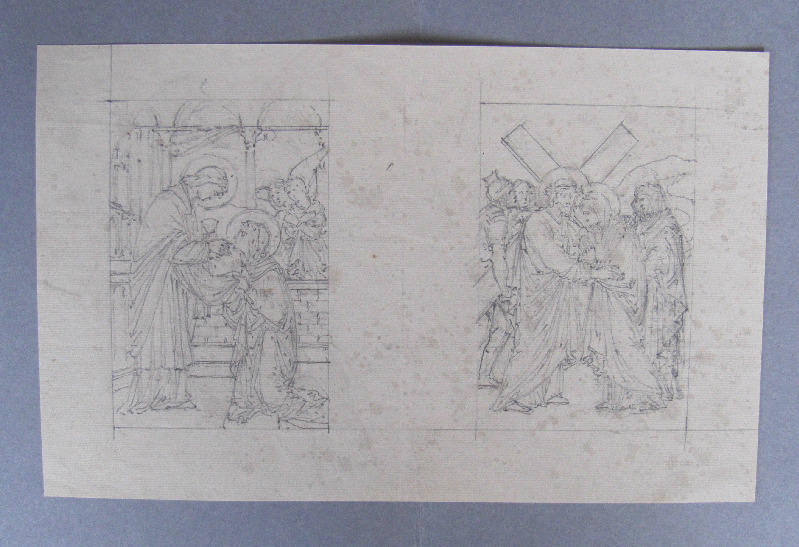
Étude au crayon sur papier ; Deux scènes sont dessinées au crayon. À gauche : la Communion de la Vierge, qu'observent deux anges. À droite : le Portement de croix. À l'arrière-plan, trois personnages sont représentés, dont un soldat romain qui soutient la croix du Christ. Au premier plan, Jésus, nimbé et portant la couronne d'épines, prend sa mère dans ses bras.
Subject depicted
scène biblique,Vierge Marie,Christ Jésus,soldat,Portement de Croix,communion de la Vierge
About this work
The artwork titled "This artwork", attributed to Atelier Boulanger, is preserved at musée des antiquités de la Seine-Maritime. This piece is listed in the Joconde database of the Ministry of Culture, which catalogues the works held in French museums.
Technique and Materials
This work belongs to the field: dessin, vitrail. It was created using the following materials and techniques: papier, dessin au crayon.
The Conserving Museum
"This artwork" is preserved at musée des antiquités de la Seine-Maritime, an institution bearing the « Musée de France » label. This label ensures that the collections are managed rigorously in terms of conservation, inventory, and public accessibility.
Data sources
The information about this work comes from the Joconde database of the Ministry of Culture, published on data.culture.gouv.fr under the Open License v2.0 (Etalab).
About this artwork
papier, dessin au crayon est le procédé utilisé pour cette oeuvre. Dimensions de l'oeuvre : Hauteur en cm 12.7 ; Largeur en cm 20.4. Le thème de l'oeuvre est : scène biblique,Vierge Marie,Christ Jésus,soldat,Portement de Croix,communion de la Vierge. On sait de cette oeuvre que : Atelier Boulanger : Pierre Jules Boulanger (1833-1911) Alfred Jules Boulanger (1858-1916) Marcel Pierre Jules Boulanger (1903-1989) Né à Rouen en 1833, Pierre Jules Boulanger est peintre- verrier à Paris au début des années 1860. De retour à Rouen, il prend, en, 1870, la succession de Théodore Bernard, et reste dans l'atelier du 24, rampe Saint-Hilaire jusqu'en 1882. Il s'installe ensuite 9, rue des Marronniers. Alfred Jules Boulanger est mentionné comme peintre- verrier sur l'acte de mariage de sa soeur en 1892, et sur les actes de naissance de ses neveux (1893 et 1897). Sur son acte de mariage, en 1925, Marcel Pierre Jules, fils d'Alfred Jules, est mentionné comme peintre-verrier. À la mort de Pierre Jules et Alfred Jules, l'atelier prend le nom de Veuve Boulanger (Suzanne Deschamps, femme d'Alfred Jules). Jusqu'en 1924, dans l'almanach de Rouen, la liste générale des habitants de Rouen mentionne "Boulanger (Veuve Jules), peintre-verrier, rue des Marronniers, 9", et la liste des industriels et commerçants de Rouen mentionne "Vitraux peints : Boulanger (J.), rue des Marronniers, 9", ainsi "Peintres-verriers : Boulanger (Ve), rue des Marronniers, 9" Dès 1925, le Bulletin religieux de l'Archidiocèse de Rouen publie cet avis : "À la suite de l'incendie de ses ateliers, M. J.-B. Devisme, peintre-verrier, informe sa clientèle qu'il continue provisoirement ses travaux dans les anciens ateliers de M. Boulanger, 9, rue des Marronniers, Rouen". L'atelier Boulanger a également restauré des vitraux du musée des Antiquités comme il est mentionné en 1883 à l'inventaire T.III p. 17 :"à Boulanger, à Rouen pour réparations aux vitraux __ 1000 fr".
Creation context
Atelier Boulanger achève dans un climat artistique profondément marqué par la . Le musée des antiquités de la Seine-Maritime, qui en conserve l'original, perpétue ainsi la mémoire d'un moment essentiel de l'histoire de l'art, où les créateurs ont su répondre aux défis de leur époque avec inventivité et audace.
See also
Technique
Domain
Author
Related pages
Frequently Asked Questions
Everything you need to know
The work « Untitled work » is held at musée des antiquités de la Seine-Maritime, an institution labeled as a « Musée de France ». This label guarantees the quality of collection preservation and accessibility to the public.
This artwork is attributed to Atelier Boulanger according to the Joconde database of the Ministry of Culture. Check the artist's profile on DellArte to discover their background, other works, and museums that house their creations.
Data comes from the Joconde database of the Ministry of Culture (data.culture.gouv.fr), distributed under Open License v2.0 (Etalab). The records are provided by the museums and validated by the French Museum Service.
The work is part of the collections of a « Musée de France »-labelled museum. Contact the hosting museum to verify if the work is currently on display or held in reserve. Opening hours and admission fees are available on the museum's official website.
Image usage rights depend on the work, the artist, and the museum. If the author died more than 70 years ago, the work is in the public domain in France. Text data (title, technique, dimensions) are under Open License and freely reusable.
The work's record contains information from the Joconde database: title, author, technique and materials used, dimensions, creation period, artistic domain, inventory number, hosting museum, and when available, a digital image.
Use the DellArte contact page to report errors. Since data comes from the Joconde database, major corrections (attribution, dating, technique) should be reported to the Ministry of Culture via data.culture.gouv.fr.
The Joconde database lists over 700,000 works. Use the search bar to find works by the same artist, technique, or period. Each museum entry provides access to its entire digitized collection.
The image resolution depends on the museum's digitization program. Some museums offer high-resolution images through their own digital platforms. The image displayed on DellArte comes from the Joconde database at its dissemination resolution.
Museum shops often sell reproductions of their main works (postcards, posters, art books). For public domain works, services like RMN-Grand Palais (photo.rmn.fr) offer professional photographic reproductions.