Untitled work
Description
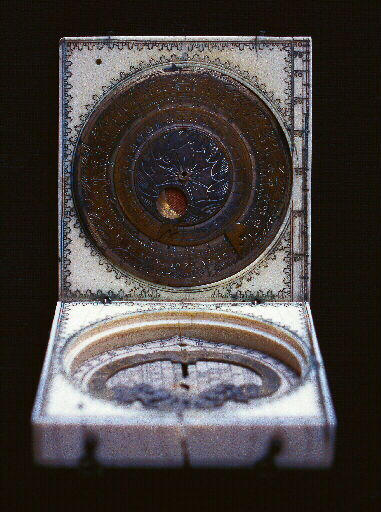
Ivoire taillé, gravé et teinté en noir. ; Disques lunaires et de calendrier perpétuel, et ellipse du cadran horaire analemmatique en laiton argenté et gravé. ; Aiguille en acier aimanté, verre et laiton, probablement plus tardive. ; Papier imprimé en noir ; Cadran de mer ou boussole monté en ivoire. Dessus fort simple (face Ia), centre uni, sans cadran polaire. Cercle divisé en deux fois douze (cadran équinoxial), agrémenté à l'entour et sur le bas de la boîte d'une fine gravure ornementale. Face Ib :Sous le couvercle, trois disques superposés du cadran lunisolaire : le plus grand avec les mois et les jours et une graduation 2 x 12 ; le deuxième gradué de 1 à 30 ; le troisième, présentant un trou rond indicant les phases de la Lune sur un tissu rouge, porte d'une rose des vents au milieu de nuages. Sur le côté, échelle gravée d'inclinaison du couvercle, graduée proportionnellement de 0° à 80°. Face IIa : L'évidement. L'ivoire en forme circulaire et les bords ornés comme dessus. Cadran elliptique ou cadran analemmatique gradué V-XII-VII, au fin décor gravé. Tableau de 20 villes de France avec leur latitude, les directions cardinales, et le cadran circulaire de boussole gradué en 4 x 90°. Dans les colonnes, on lit des indications abrégées telles que AR (Archevêché), EV (Evéché), UN (Université), POR (Ports), BAI, GEN, DE, GRE, SEN, MO. Ce tableau est un résumé de géographie. Dessous (face IIb) : Le cadran métallique argent contient au centre un carré divisé et rempli de chiffres, calendrier perpétuel. Puis dans les quatre vides que laisse autour, le cercle où sont les mois avec leurs divisions : 10, 20, 30 ou 10, 20, 31, on lit : Jacques Senécal, A Dieppe, fécit. Les faces internes sont décorées comme celles externes. Sous l'aiguille, un papier carré mentionne les villes : Aix... Dieppe, leur situation et diverses indications
Subject depicted
soleil,heure,mois,lune
Inscriptions
signature (français, latin),numéro
About this work
The artwork titled "This artwork", attributed to SENECAL Jacques (ivoirier), is preserved at Château-musée. This piece is listed in the Joconde database of the Ministry of Culture, which catalogues the works held in French museums.
Technique and Materials
This work belongs to the field: tabletterie, métrologie - instruments de mesure. It was created using the following materials and techniques: ivoire (gravé), laiton (argenté, gravé), acier, verre, papier (imprimé). Its period of creation is identified as: 17th Century.
The Conserving Museum
Château-musée preserves this work in its collections. As a « Musée de France » labeled museum, the institution is committed to preserving and showcasing the pieces entrusted to it.
Data sources
The information about this work comes from the Joconde database of the Ministry of Culture, published on data.gouv.fr under the Open License v2.0 (Etalab).
About this artwork
Elle est réalisée avec la technique suivante : ivoire (gravé), laiton (argenté, gravé), acier, verre, papier (imprimé). Cette pièce mesure L. mm 77 ; l. mm 70 ; Ep. mm 17. Elle figure : soleil,heure,mois,lune. La création de cette oeuvre remonte à la 17e siècle. Précisions sur cette oeuvre : SENECAL : ?, ?.
Creation context
Dans quel contexte SENECAL Jacques (ivoirier) a-t-il créé ? La 17e siècle constitue un moment de profonde effervescence créatrice, qui nourrit et stimule la démarche de l'artiste. Le Château-musée, qui détient cette œuvre, permet au visiteur de comprendre les liens qui unissent la création artistique aux circonstances historiques de son émergence.
See also
Frequently Asked Questions
Everything you need to know
The work « Untitled work » is held at Château-musée, an institution labeled as a « Musée de France ». This label guarantees the quality of collection preservation and accessibility to the public.
This artwork is attributed to SENECAL Jacques (ivoirier) according to the Joconde database of the Ministry of Culture. Check the artist's profile on DellArte to discover their background, other works, and museums that house their creations.
Data comes from the Joconde database of the Ministry of Culture (data.gouv.fr), distributed under Open License v2.0 (Etalab). The records are provided by the museums and validated by the French Museum Service.
The work is part of the collections of a « Musée de France »-labelled museum. Contact the hosting museum to verify if the work is currently on display or held in reserve. Opening hours and admission fees are available on the museum's official website.
Image usage rights depend on the work, the artist, and the museum. If the author died more than 70 years ago, the work is in the public domain in France. Text data (title, technique, dimensions) are under Open License and freely reusable.
The work's record contains information from the Joconde database: title, author, technique and materials used, dimensions, creation period, artistic domain, inventory number, hosting museum, and when available, a digital image.
Use the DellArte contact page to report errors. Since data comes from the Joconde database, major corrections (attribution, dating, technique) should be reported to the Ministry of Culture via data.gouv.fr.
The Joconde database lists over 700,000 works. Use the search bar to find works by the same artist, technique, or period. Each museum entry provides access to its entire digitized collection.
The image resolution depends on the museum's digitization program. Some museums offer high-resolution images through their own digital platforms. The image displayed on DellArte comes from the Joconde database at its dissemination resolution.
Museum shops often sell reproductions of their main works (postcards, posters, art books). For public domain works, services like RMN-Grand Palais (photo.rmn.fr) offer professional photographic reproductions.