Untitled work
Description
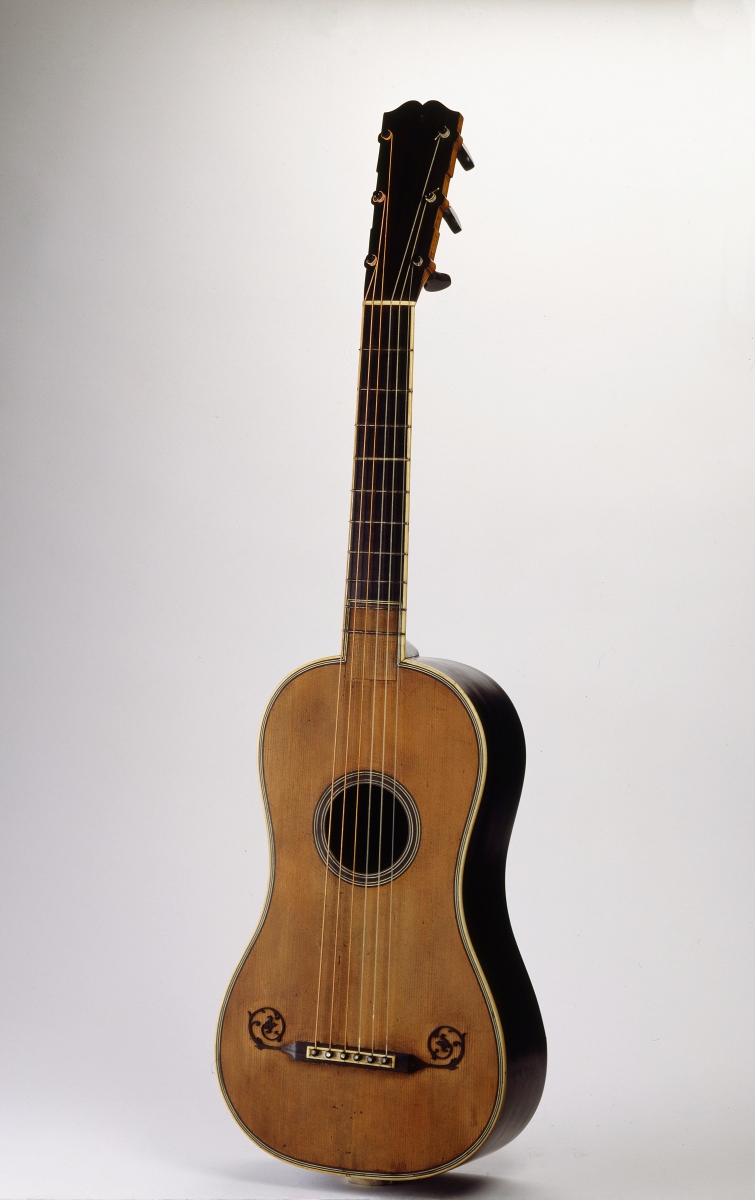
Instrument en sapin plaqué d'acajou, d'ébène, filets d'ivoire et incrustations de maillechort. ; Guitare à 6 cordes simples. Couronne d'éclisse en ébène. Fond en sapin plaqué d'acajou. Dos de manche et talon plaqués d'ébène ainsi que le cheviller sur ses deux faces. Le cheviller est assemblé au manche par une enture en pointe. Les 6 chevilles sont en ébène. Table en bois résineux (sapin ou épicéa) dont le bord est à plusieurs brins d'ébène et d'ivoire avec une certaine épaisseur en ivoire qui se poursuit sur les bords du manche. Bord de rose décoré d'ébène avec filet d'ivoire. Chevalet en ébène avec renfort d'ivoire percé de 6 boutons d'attache. Fleurons aux extrémités. Touche en ébène, dans le plan de la table, cependant sensiblement bombée. 10 barrettes de maillechort incrustées. Cette jolie guitare appartient, de par sa forme et certaines caractéristiques, au XVIIIe siècle. Elle a pu être montée à l'origine de 5 rangs doublés, soit 10 cordes : ainsi le cheviller, de par sa taille, pourrait facilement porter 10 chevilles. Le chevalet comporte encore les fleurons décoratifs qui disparurent des guitares après la Révolution. On peut supposer que l'instrument a été entièrement remanié au XIXe siècle, ce dont on peut voir une trace sur la table au niveau de la naissance de la touche. [notice de Joël DUGOT]
About this work
The artwork titled "This artwork", attributed to Aldric Jean François (1765-1843), is preserved at musée de l'hospice Comtesse. This piece is listed in the Joconde database of the Ministry of Culture, which catalogues the works held in French museums.
Technique and Materials
This work belongs to the field: musique - chant - danse, lutherie. It was created using the following materials and techniques: ebène, acajou, sapin, bois résineux, ivoire (facture instrumentale). Its period of creation is identified as: 4th quarter 18th Century.
The Conserving Museum
"This artwork" is preserved at musée de l'hospice Comtesse, an institution bearing the « Musée de France » label. This label ensures that the collections are managed rigorously in terms of conservation, inventory, and public accessibility.
Data sources
The information about this work comes from the Joconde database of the Ministry of Culture, published on data.culture.gouv.fr under the Open License v2.0 (Etalab).
About this artwork
Cette pièce est en ebène, acajou, sapin, bois résineux, ivoire (facture instrumentale). Ses dimensions sont Longueur en cm 92,8 ; Largeur de corps en cm 27 / 18 /21,4 ; Hauteur du talon en cm 9,2 /10,4 ; Longueur vibrante en cm 63,8. Cette réalisation date de la 4e quart 18e siècle. Note sur cette oeuvre : ALDRIC Jean-François : Mirecourt, 1765, avril 28 ; ?, après 1840.
Creation context
Quand Aldric Jean François (1765-1843) entreprend la réalisation de , la 4e quart 18e siècle bat son plein et redéfinit les codes de la création. Cette œuvre, aujourd'hui au musée de l'hospice Comtesse, porte la marque indélébile de son époque, témoignant des tensions créatrices et des aspirations qui animent alors les milieux artistiques.
See also
Frequently Asked Questions
Everything you need to know
The work « Untitled work » is held at musée de l'hospice Comtesse, an institution labeled as a « Musée de France ». This label guarantees the quality of collection preservation and accessibility to the public.
This artwork is attributed to Aldric Jean François (1765-1843) according to the Joconde database of the Ministry of Culture. Check the artist's profile on DellArte to discover their background, other works, and museums that house their creations.
Data comes from the Joconde database of the Ministry of Culture (data.culture.gouv.fr), distributed under Open License v2.0 (Etalab). The records are provided by the museums and validated by the French Museum Service.
The work is part of the collections of a « Musée de France »-labelled museum. Contact the hosting museum to verify if the work is currently on display or held in reserve. Opening hours and admission fees are available on the museum's official website.
Image usage rights depend on the work, the artist, and the museum. If the author died more than 70 years ago, the work is in the public domain in France. Text data (title, technique, dimensions) are under Open License and freely reusable.
The work's record contains information from the Joconde database: title, author, technique and materials used, dimensions, creation period, artistic domain, inventory number, hosting museum, and when available, a digital image.
Use the DellArte contact page to report errors. Since data comes from the Joconde database, major corrections (attribution, dating, technique) should be reported to the Ministry of Culture via data.culture.gouv.fr.
The Joconde database lists over 700,000 works. Use the search bar to find works by the same artist, technique, or period. Each museum entry provides access to its entire digitized collection.
The image resolution depends on the museum's digitization program. Some museums offer high-resolution images through their own digital platforms. The image displayed on DellArte comes from the Joconde database at its dissemination resolution.
Museum shops often sell reproductions of their main works (postcards, posters, art books). For public domain works, services like RMN-Grand Palais (photo.rmn.fr) offer professional photographic reproductions.