Untitled work
Description
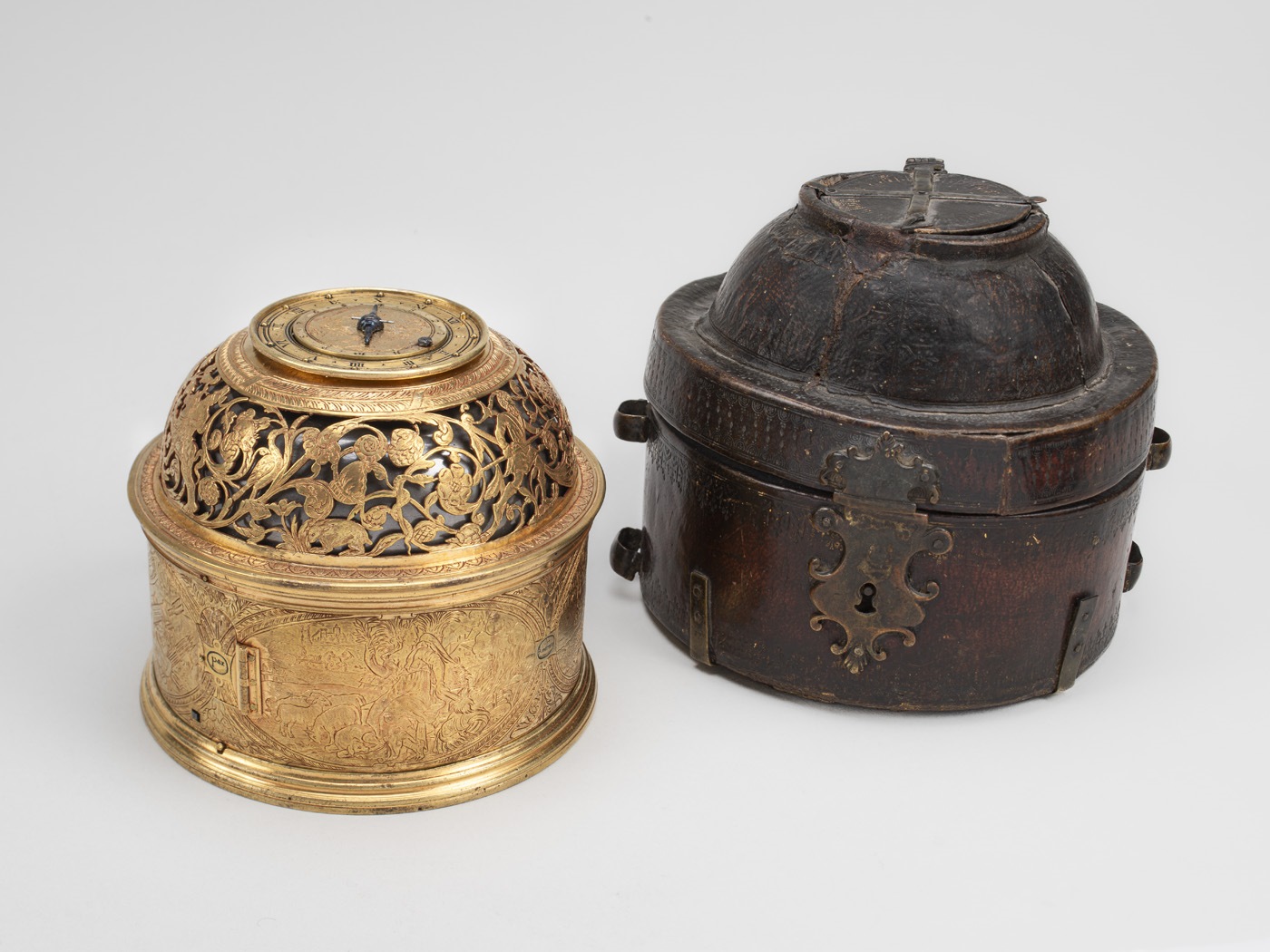
Boîte de l'horloge en cuivre repercé, gravé et doré, avec cadran horizontal au sommet du dôme. Elle est accompagnée de son étui de transport en cuir. Le fond amovible de la boîte, avec les trois trous de remontage, est gravé d'une guirlande de feuillages, fruits et fleurs. Le corps cylindrique de la boîte est gravé de quatre scènes d'après des estampes d'Etienne Delaune : la Guerre, la Paix, l'Abondance, la Famine, chacune portant à sa gauche sa légende latine : Bellum, Pax, Abondantia, Invidiu. Deux volets sont situés en regard de chacune des deux fusées. Dôme repercé et gravé, évoquant la chasse au sanglier et au lièvre dans une frondaison luxuriante de rinceaux, d'oiseaux et de fleurs. Les éléments de ce décor (cavalier, homme à la pique, sanglier, lièvre, oiseaux) sont copiés sur des gravures de Virgile Solis illustrant ces thèmes. Au sommet, le cercle des heures est muni de picots servant de repères habituels. Au centre, le cadran du réveil est gravé d'un paysage. Le mouvement comporte une sonnerie des heures et réveille-matin. Sous la platine inférieure se trouve la signature gravée : Simon Gribelin Blois. La coq à décor de fraisier est chevillé. Le ressort d'emboîtage d'une grande élégance et ses deux verrous d'acier bleui, assortis à l'encliquetage de l'armage initial, sont exécutés en feuilles d'acanthe. L'armage initial est un dispositif d'encliquetage qui permet au ressort moteur de travailler dans la zone la plus homogène de son élasticité, en le tendant légèrement avant remontage. Cette oeuvre est accompagnée de son étui d'origine en maroquin frappé et doré. Une double ouverture permet de recevoir l'horloge et au sommet d'observer le cadran. Quatre coulisses fixées à la gainerie servaient au passage d'une cordelière de transport. Une serrure à clef en garantissait la sécurité. Simon Gribelin, établi à Blois dès 1588, était horloger du roi. Il mourut après 1633. Ce maître protestant eut trois fils : Abraham, Jacob et Isaac, respectivement horloger du roi, graveur et peintre en émail, de haute notoriété à Blois, ville de la cour. (Michel Hayard)
Subject depicted
figure,allégorie,guerre,paix (la),abondance,disette # cavalier,chasseur,sanglier,lièvre,oiseau,rinceau
About this work
The artwork titled "This artwork", attributed to Gribelin Simon (actif 1593-après 1625) (horloger);Delaune Étienne (1518?-1583) (d'après);Solis Virgil (1514-1562) (d'après), is preserved at musée Paul Dupuy. This piece is listed in the Joconde database of the Ministry of Culture, which catalogues the works held in French museums.
Technique and Materials
This work belongs to the field: horlogerie, métrologie - instruments de mesure, arts décoratifs. It was created using the following materials and techniques: cuivre, repercé, gravé, doré, maroquin, frappé. Its period of creation is identified as: 1st quarter 17th Century.
The Conserving Museum
"This artwork" is preserved at musée Paul Dupuy, an institution bearing the « Musée de France » label. This label ensures that the collections are managed rigorously in terms of conservation, inventory, and public accessibility.
Data sources
The information about this work comes from the Joconde database of the Ministry of Culture, published on data.culture.gouv.fr under the Open License v2.0 (Etalab).
About this artwork
La technique employée est : cuivre, repercé, gravé, doré, maroquin, frappé. Mesures : Diamètre en cm 11,4 ; Hauteur en cm 9,5. Sujet représenté : figure,allégorie,guerre,paix (la),abondance,disette # cavalier,chasseur,sanglier,lièvre,oiseau,rinceau. Sa période de création est la 1er quart 17e siècle. Précisions sur cette oeuvre : Simon Gribelin est établi à Blois dès 1593. Il mourut postérieurement à 1625#Delaune Etienne : ?, 1518 ; ?, 1583 ; nationalité : Française#Solis Virgile : Nuremberg, 1514 ; Nuremberg, 1562 ; nationalité : Allemande.
Creation context
Gribelin Simon (actif 1593-après 1625) (horloger);Delaune Étienne (1518?-1583) (d'après);Solis Virgil (1514-1562) (d'après) conçoit dans un environnement artistique façonné par la 1er quart 17e siècle. Cette pièce, conservée au musée Paul Dupuy, porte l'empreinte des débats esthétiques et des innovations techniques qui animent alors la scène culturelle. Comprendre ce contexte permet d'apprécier pleinement la portée de l'œuvre.
See also
Author
Related pages
Frequently Asked Questions
Everything you need to know
The work « Untitled work » is held at musée Paul Dupuy, an institution labeled as a « Musée de France ». This label guarantees the quality of collection preservation and accessibility to the public.
This artwork is attributed to Gribelin Simon (actif 1593-après 1625) (horloger);Delaune Étienne (1518?-1583) (d'après);Solis Virgil (1514-1562) (d'après) according to the Joconde database of the Ministry of Culture. Check the artist's profile on DellArte to discover their background, other works, and museums that house their creations.
Data comes from the Joconde database of the Ministry of Culture (data.culture.gouv.fr), distributed under Open License v2.0 (Etalab). The records are provided by the museums and validated by the French Museum Service.
The work is part of the collections of a « Musée de France »-labelled museum. Contact the hosting museum to verify if the work is currently on display or held in reserve. Opening hours and admission fees are available on the museum's official website.
Image usage rights depend on the work, the artist, and the museum. If the author died more than 70 years ago, the work is in the public domain in France. Text data (title, technique, dimensions) are under Open License and freely reusable.
The work's record contains information from the Joconde database: title, author, technique and materials used, dimensions, creation period, artistic domain, inventory number, hosting museum, and when available, a digital image.
Use the DellArte contact page to report errors. Since data comes from the Joconde database, major corrections (attribution, dating, technique) should be reported to the Ministry of Culture via data.culture.gouv.fr.
The Joconde database lists over 700,000 works. Use the search bar to find works by the same artist, technique, or period. Each museum entry provides access to its entire digitized collection.
The image resolution depends on the museum's digitization program. Some museums offer high-resolution images through their own digital platforms. The image displayed on DellArte comes from the Joconde database at its dissemination resolution.
Museum shops often sell reproductions of their main works (postcards, posters, art books). For public domain works, services like RMN-Grand Palais (photo.rmn.fr) offer professional photographic reproductions.