Untitled work
Description
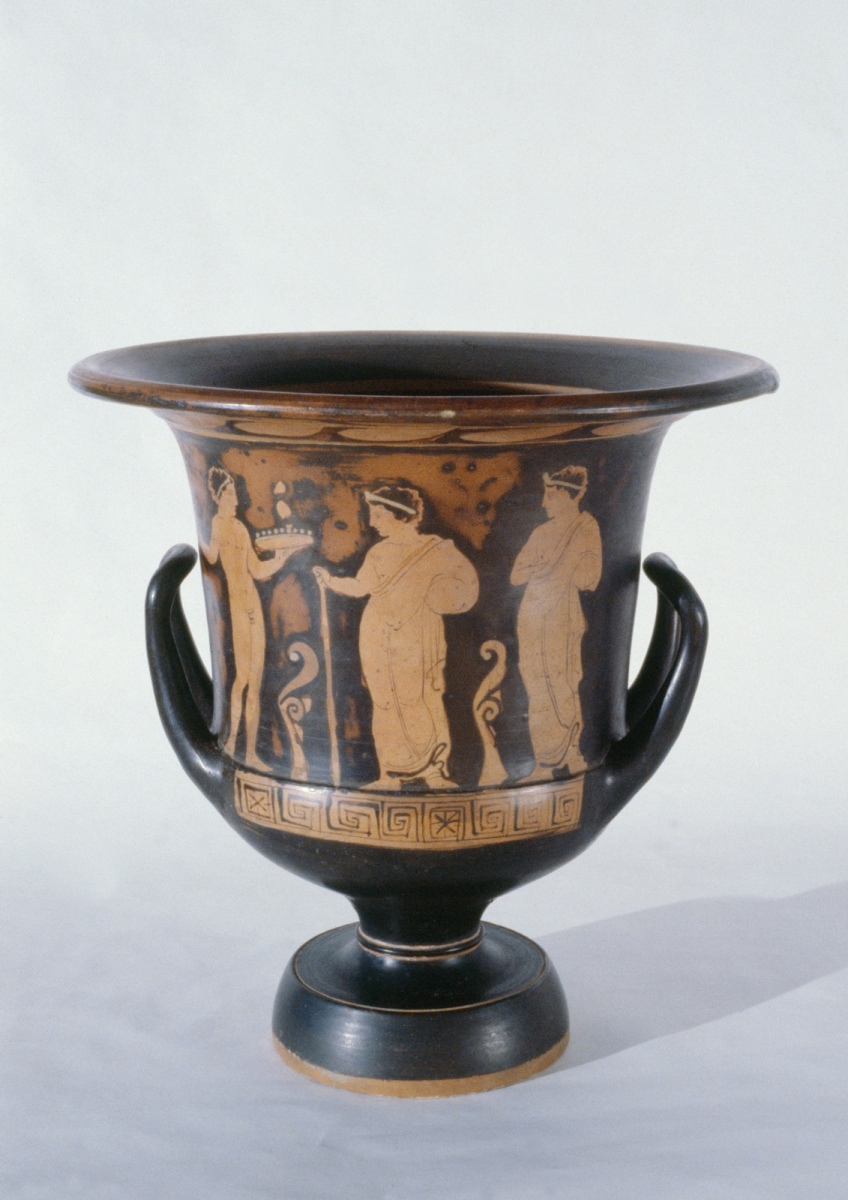
Sous la lèvre, guirlande de feuilles de laurier vers la gauche ; sous la scène, frise de méandres, interrompue par trois croisillons en sautoir inscrits dans un carré, soulignée par une rangée d’oves sur la face A. Sur la panse : Face A : Trois personnages : au centre, Dionysos assis tenant un canthare et s’appuyant sur un narthex ; devant lui, une ménade debout tenant un tambourin et un thyrse ; derrière lui, un satyre debout levant une torche. Dans le champ, un motif de couronne pointée et deux rinceaux végétaux stylisés, avec volutes et feuilles. Face B : Trois jeunes hommes, dont deux vêtus d’un himation, regardant le troisième, nu, tenant un plat garni d’oeufs de la main gauche et un strigile de la main droite. Mathieu Scapin ; Cratère en calice portant un décor figuré sur chaque face. Sous la lèvre du calice, un décor de rameaux de laurier. Sous la scène figurée de la face A, se trouve une rangée d’oves soulignant des motifs géométriques tandis que sur la face B, seul les motifs géométriques sont présents. La scène figurée de la face A présente, au centre, Dionysos assis tenant un canthare (vase à boire du vin) s'appuyant sur une branche de narthex (férule). Devant lui, une ménade debout tenant un tambourin et un thyrse (bâton surmonté d'une pomme de pin). Derrière lui, un satyre debout levant une torche. Sur la face B, trois jeunes hommes, dont deux vêtus d'un himation (manteau de laine) regardant le troisième, nu, tenant un plat. Le cratère est un vase utilisé dans le cadre du banquet pour mélanger le vin à de l'eau et des épices. Anaell Viollat, 2016, d'après la notice d’Hélène Guiraud extraite du catalogue « L'art grec au musée Saint-Raymond », 1993.
Subject depicted
(Dionysos, Ménade, canthare, thyrse, laurier, satyre, tambourin)
About this work
The artwork titled "This artwork", attributed to GROUPE DU BUCRANE (attribué à), is preserved at musée Saint-Raymond. This piece is listed in the Joconde database of the Ministry of Culture, which catalogues the works held in French museums.
Technique and Materials
This work belongs to the field: archéologie, céramique, grec. It was created using the following materials and techniques: terre cuite (figures rouges, vernis noir, rehauts blancs, rehauts noirs), terre cuite, vernis noir, rehaut blanc, rehaut noir. Its period of creation is identified as: 2nd quarter 4th Century av JC.
The Conserving Museum
"This artwork" is preserved at musée Saint-Raymond, an institution bearing the « Musée de France » label. This label ensures that the collections are managed rigorously in terms of conservation, inventory, and public accessibility.
Data sources
The information about this work comes from the Joconde database of the Ministry of Culture, published on data.culture.gouv.fr under the Open License v2.0 (Etalab).
About this artwork
Le procédé technique employé est terre cuite (figures rouges, vernis noir, rehauts blancs, rehauts noirs), terre cuite, vernis noir, rehaut blanc, rehaut noir. Dimensions de l'oeuvre : Hauteur en cm 39,5 ; Diamètre en cm 23,8 ; Diamètre pied en cm 17,1 ; Diamètre lèvre en cm 37,9. Sujet représenté : (Dionysos, Ménade, canthare, thyrse, laurier, satyre, tambourin). Elle a été créée durant la 2e quart 4e siècle av JC.
Creation context
La création de par GROUPE DU BUCRANE (attribué à) s'inscrit dans le climat culturel et intellectuel de la 2e quart 4e siècle av JC. Conservée au musée Saint-Raymond, cette œuvre porte en elle les empreintes d'un moment charnière de l'histoire de l'art, où les artistes explorent de nouvelles formes d'expression et repoussent les limites de leur pratique.
Frequently Asked Questions
Everything you need to know
The work « Untitled work » is held at musée Saint-Raymond, an institution labeled as a « Musée de France ». This label guarantees the quality of collection preservation and accessibility to the public.
This artwork is attributed to GROUPE DU BUCRANE (attribué à) according to the Joconde database of the Ministry of Culture. Check the artist's profile on DellArte to discover their background, other works, and museums that house their creations.
Data comes from the Joconde database of the Ministry of Culture (data.culture.gouv.fr), distributed under Open License v2.0 (Etalab). The records are provided by the museums and validated by the French Museum Service.
The work is part of the collections of a « Musée de France »-labelled museum. Contact the hosting museum to verify if the work is currently on display or held in reserve. Opening hours and admission fees are available on the museum's official website.
Image usage rights depend on the work, the artist, and the museum. If the author died more than 70 years ago, the work is in the public domain in France. Text data (title, technique, dimensions) are under Open License and freely reusable.
The work's record contains information from the Joconde database: title, author, technique and materials used, dimensions, creation period, artistic domain, inventory number, hosting museum, and when available, a digital image.
Use the DellArte contact page to report errors. Since data comes from the Joconde database, major corrections (attribution, dating, technique) should be reported to the Ministry of Culture via data.culture.gouv.fr.
The Joconde database lists over 700,000 works. Use the search bar to find works by the same artist, technique, or period. Each museum entry provides access to its entire digitized collection.
The image resolution depends on the museum's digitization program. Some museums offer high-resolution images through their own digital platforms. The image displayed on DellArte comes from the Joconde database at its dissemination resolution.
Museum shops often sell reproductions of their main works (postcards, posters, art books). For public domain works, services like RMN-Grand Palais (photo.rmn.fr) offer professional photographic reproductions.