Untitled work
Description
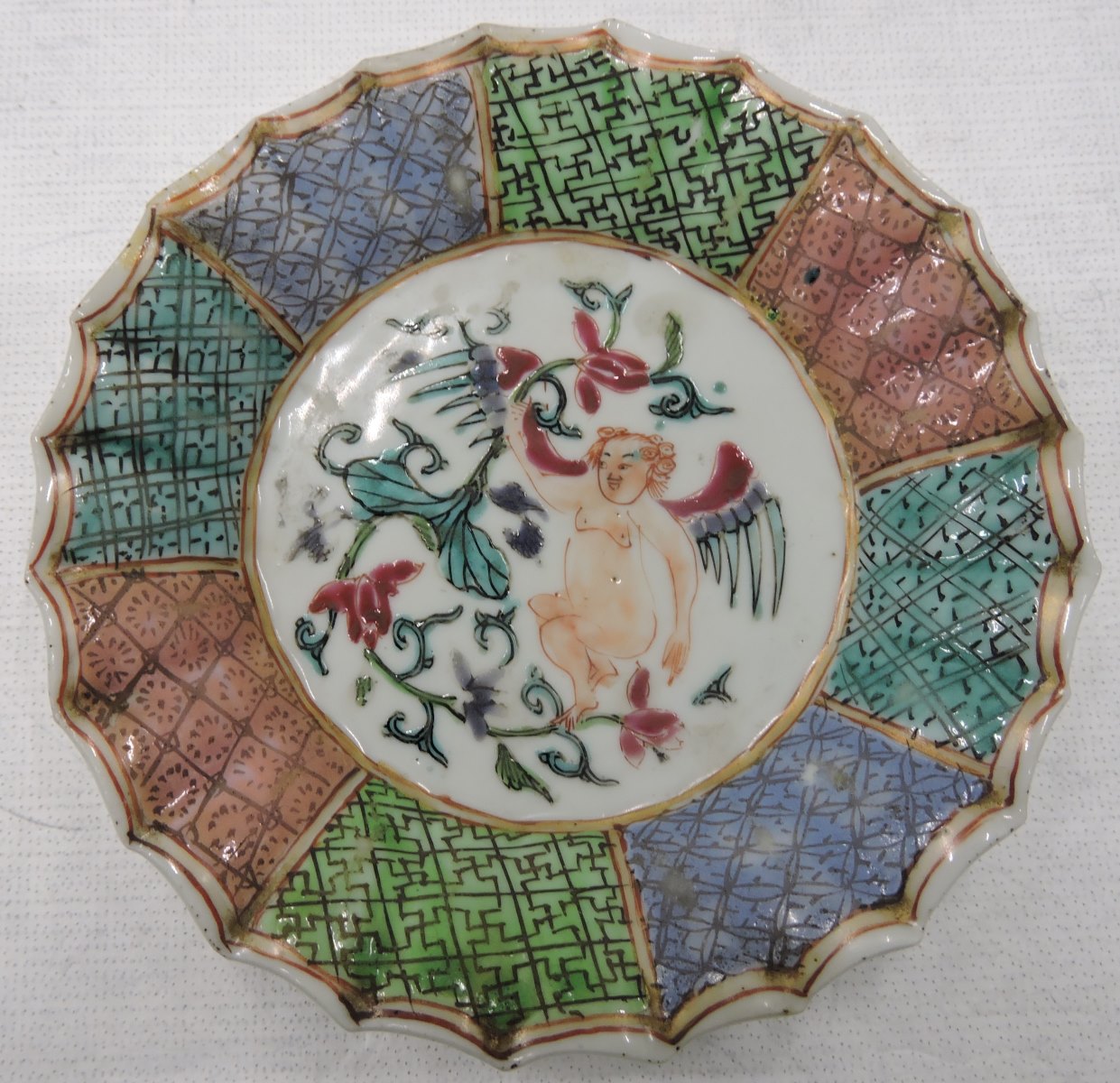
Porcelaine moulée et émaux semi-opaques dits de famille rose sur couverte transparente ; Cette assiette moulée à la lèvre festonnée propose une adaptation chinoise truculente d’une iconographie religieuse occidentale, à savoir celle des chérubins. Les premières gravures européennes vulgarisées en Chine furent les illustrations de l’Evangile publié par le père Nadal, chez Plantin, à Anvers vers la fin du XVIe siècle et sont diffusées par les Jésuites. Les céramistes chinois ont puisé de nombreux thèmes de décor dans la culture visuelle chrétienne, comme les gravures de Marc Antonio Raimondi d’après Raphaël. Sur cette soucoupe qui devait faire partie d’un service à thé ou à café, un chérubin nu notablement roux tient des rinceaux de lotus, symbole du bouddhisme, sur fond blanc laissé en réserve. La bordure très ornée présente des motifs géométriques de fleurettes, de losanges ou de svastikas entrelacées sur fond coloré qui sont tout à fait typiques de la céramique d’exportation du règne de Yongzheng. De même, la transparence des émaux permet de dater la soucoupe de cette période. Plus tard, lors du règne de Qianlong, les chérubins et autres angelots sont représentés avec moins de naïveté, parfois en grisaille pour imiter le style pictural européen.
About this work
The artwork titled "This artwork", attributed to anonyme, is preserved at musée des beaux-arts. Referenced in the Joconde database, this work contributes to the national artistic heritage preserved in labeled museums.
Technique and Materials
This work belongs to the field: céramique, Asie orientale. It was created using the following materials and techniques: porcelaine. Its period of creation is identified as: 18th Century.
The Conserving Museum
"This artwork" is preserved at musée des beaux-arts, an institution bearing the « Musée de France » label. This label ensures that the collections are managed rigorously in terms of conservation, inventory, and public accessibility.
Data sources
The information about this work comes from the Joconde database of the Ministry of Culture, published on data.culture.gouv.fr under the Open License v2.0 (Etalab).
About this artwork
La technique employée est : porcelaine. Ses dimensions sont Diamètre de la soucoupe en cm 10,5 ; Hauteur en cm 2. L'oeuvre date de la 18e siècle.
Creation context
Le moment historique de la 18e siècle éclaire la démarche de anonyme lorsqu'il crée . Cette réalisation, préservée au musée des beaux-arts, contient les résonances d'un milieu artistique en pleine mutation, où tradition et modernité s'entrechoquent pour produire des œuvres d'une grande originalité.
See also
Technique
Domain
Author
Related pages
Frequently Asked Questions
Everything you need to know
The work « Untitled work » is held at musée des beaux-arts, an institution labeled as a « Musée de France ». This label guarantees the quality of collection preservation and accessibility to the public.
This artwork is attributed to anonyme according to the Joconde database of the Ministry of Culture. Check the artist's profile on DellArte to discover their background, other works, and museums that house their creations.
Data comes from the Joconde database of the Ministry of Culture (data.culture.gouv.fr), distributed under Open License v2.0 (Etalab). The records are provided by the museums and validated by the French Museum Service.
The work is part of the collections of a « Musée de France »-labelled museum. Contact the hosting museum to verify if the work is currently on display or held in reserve. Opening hours and admission fees are available on the museum's official website.
Image usage rights depend on the work, the artist, and the museum. If the author died more than 70 years ago, the work is in the public domain in France. Text data (title, technique, dimensions) are under Open License and freely reusable.
The work's record contains information from the Joconde database: title, author, technique and materials used, dimensions, creation period, artistic domain, inventory number, hosting museum, and when available, a digital image.
Use the DellArte contact page to report errors. Since data comes from the Joconde database, major corrections (attribution, dating, technique) should be reported to the Ministry of Culture via data.culture.gouv.fr.
The Joconde database lists over 700,000 works. Use the search bar to find works by the same artist, technique, or period. Each museum entry provides access to its entire digitized collection.
The image resolution depends on the museum's digitization program. Some museums offer high-resolution images through their own digital platforms. The image displayed on DellArte comes from the Joconde database at its dissemination resolution.
Museum shops often sell reproductions of their main works (postcards, posters, art books). For public domain works, services like RMN-Grand Palais (photo.rmn.fr) offer professional photographic reproductions.